
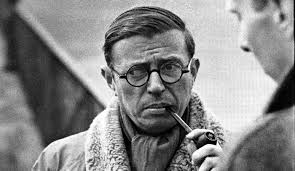
Part IV: Existence Precedes Essence
In the first three posts, I attempted to define existentialism through the idea of individual choice, but definitions are next to impossible when referencing anything to do with existentialism. The idea of individual choice, however, is featured prominently and pushes existentialism into another idea much more complex than any before it; it is the idea of existence preceding essence. F.W.J. Schelling was credited with being the very first to use the phrase in a speech he delivered in 1841. Soren Kierkegaard, who was in attendance of Schelling’s speech, has used this idea in some of his works, but it was Jean-Paul Sartre who formulated the idea and expanded on it. The phrase is featured prominently in a lecture of his entitled, “Existentialism is a Humanism,” which was given in 1945. The phrase is foundational to many philosophers and foundational to much of their work, especially Martin Heidegger and his metaphysics featured in his masterpiece, “Being and Time.”
This phrase, in my opinion, captures the spirit of existentialism better than all others. Its basis flows out of a defiance to the dominant idea of the time, that our essence was more fundamental than our existence. The existential inverted phrase promotes the opposite; it presents the idea that essence, something thought to be distinctly human, is not given, as has been thought, but, instead, it is developed, which is radically different than any thinking before it. Existentialism believes that we first exist (existence) and then create and develop our own essence through our existence, i.e., our choices and our actions. Sartre believed that existence preceded essence and saw it as defining and determining our thinking. This next part is quite brilliant, in my opinion.
Sartre, instead of arguing about the true nature of man, turned the argument on its head by insisting that there is no such thing as human nature … only human condition. Sartre posited that we live as “self-conscious first-person perspectives” imagining and reimagining who we are as we live. What he was saying was that being conscious of our own existence is ultimately what it means to be human. That is our condition, which implies that our nature is neither good nor bad but a condition that is creating and developing our own essence. For Sartre, there is no pre-ordained sinful nature; each person comes into existence and then through decisions and actions creates their own unique essence.
This issue of human nature, a philosophical battle ground for many years, was seemingly answered with this one phrase; according to Sartre, there is no predefined subject, no fixed identity and no pre-ordained path or objective, at least that was his assertion. There is only existence and all things come after it, which leaves everything in our hands as human beings. Sartre writes, “Man, first of all exists, encounters himself, surges up in the world—and defines himself afterwards.” While Sartre believed this, he also acknowledged that we face, as human beings, a number of constraints in our lives. He believed human beings had appetites and desires for power and fame, which deals directly with the nature of man whether he acknowledges it or not. He did acknowledge that pre-existing identities and meanings will be “thrust” upon us, but our role is to define ourselves and not allow them to define us.
As I have referenced, existentialism establishes as one of its fundamental truths—if one can even use the word “truth” in reference to anything existential—that human beings are not born with a pre-defined purpose but instead forge their own path through their own human existence. I must ask this question; is that not a predefined purpose? The idea or phrase attempts to push aside any thoughts of an involved or interested deity in favor of individual human agency, which suggests that individuals are not born with or given an essence but develop it through their individual existence, which fits nicely with an evolutionary mindset. Most existentialists believe this mindset produces personal freedom and personal responsibility while acknowledging that situations and circumstances do fall outside of our control at times. We can acknowledge that existentialism produces a kind of freedom, but I am not sure we find the responsibility Sartre thought would follow. If we are now living in an existential world, what do we see? Do we see personal responsibility? Do we even see personal freedom? What exactly do we see before us because it is a manifestation of existentialism, but that is a post for another day. This post is already too long so I will take that line of thinking up next time. Until then, please remember, thinking matters!
Discover more from Bridge Roe: Where Thinking Matters
Subscribe to get the latest posts sent to your email.
 Bridge Roe: Where Thinking Matters