Bridge Roe, the phrase, comes from two words that mean a lot to me. Both of these words come from my past. They are reminders of a childhood filled with optimism, potential and memories … lots of memories. They are reminders that we are shaped by our choices, our past, our present and our future. We can choose to be optimistic, to see the glass as half full and to fondly remember our past.
I believe in a lot of things here at Bridge Roe. I believe in God, people, hard work, truth, integrity, honor, synergy, service, difference … and you. Yes, I believe in you, even if you disagree with me. Why? Well, it begins with a deeply-held belief that I learned through difference. I do not want you to be like me … you can’t be like me because you are you and I am me. I want you to be the best “you” you can be and I believe that the only way that can happen is through interaction with others who are different. I mean, we can’t all be the same, can we?
You have probably come to the conclusion by now that difference is an important word to me, and you would be right. Difference is all around us. There are no two snowflakes that are alike. Trees are different; flowers are different. I see difference as beautiful and yet, most of us are afraid of it. Don’t be! Embrace difference because it is both beautiful and powerful. When you take a belief that you have and engage that belief with its opposite, if you are sincerely seeking truth through a process that will either confirm your idea as true or teach you something new. This is the power of difference and why we all need to understand it and embrace it. Here at Bridge Roe you will encounter difference in all its beauty, its power and its truth.
“Embrace difference because it is both beautiful and powerful.”
We live in strange times; do we not? When it comes to culture, it is hard to define things with the same old terms. They hardly seem to fit anymore. Left and right, in many instances, are the same, which leaves us with a dilemma as far as right and wrong? It is no longer terms like party or ideology that define things for us. It seems cloudy or hazy; maybe, it was this way all along and I am just now catching up. Over the last few weeks, I read two stories that seem to make my point.
First, there is the suspension by the WNBA of the Seattle Storm co-owner Celeste Keaton for verbally confronting two teenage fans supporting Indiana Fever guard Sophie Cunningham’s stance on transgender athletes. I saw this headline and my first thought was that I was missing something. Surely a success woman, a co-owner of a WNBA franchise, would not have the time nor the interest for such nonsense, but I was wrong. Apparently, she did indeed harass two 16 year old female fans, even swearing at them at one point. There was even testimony that she tried to trip one of them, laughing afterwards at them.
The second story involved Dr. Anthony Fauci. His diary was released to the pubic a few weeks ago, exposing his arrogance and pride, which should surprise no one. This week he was hauled before Congress to answer questions regarding his decisions involving the Covid pandemic. It seemed like a waste of time and money to me, which was confirmed as the good doctor, as predicted, invoked the Fifth Amendment over 100 times. He has the right to invoke the Fifth, but it seemed mildly out of touch, especially for his vocation and his role as the chief doctor in all the land.
If I was given one question to ask, it would involve the Hippocratic oath that he took when he became a physician. That oath today has a number of variations, but all of those are captured in another work by Hippocrates called Of the Epidemics, in which he stated that doctors must have two goals: to help and to do no harm. Those goals sum up the oath all physicians take, and the reason they take that oath is because they posses enormous power. They have the knowledge to heal but they also have the knowledge to harm.
I am not a physician, but it still seems pretty clear to me that Dr. Fauci, as a physician, was given great latitude and power in navigating Covid. He was trusted to tell the truth and to make decisions for the good of all, and yet, there is evidence that his decisions were motivated in other ways. From my perspective, the number one issue for me was his potential violation of the do no harm clause of his oath as a physician. To be fair, he was not the only one complicit, but he was the highest ranking physician and considered the top medical mind of the time, which seems to have been lost in the midst of him invoking the Fifth over 100 times.
Both of these stories highlight this clash of cultures: the old and the new. We have a mature successful owner acting like an insecure middle school girl, and then we have renowned trusted physician who is supposed to the best and brightest of us, acting like one of the worst of us. This is more than left or right and liberal and conservative. There are no longer labels that apply neatly to these situations. These are no ideological issues. They are broader and deeper, extending into areas that just a few years ago had no lines of division.
These two instances suggest labels more in line with misanthropic and philanthropic. One loves humanity and all that comes with humanity; the other hates it and seeks to destroy it to recreate it as something else. A successful mature female owner berating two teenage girls for their support of one of their favorite players is misanthropic. It extends beyond an opposing party or ideology into areas of hate against who we are as human beings. The two girls were not promoting anything vile or harmful; they were supporting Miss Cunningham’s stance, which is a common position many take respectfully.
Hating another adult or an institution for supporting a position opposite of yours is one thing; hating two sixteen year old girls for supporting that same position is quite another. It borders on abuse as it was directed at those who, for all intents and purposes, are still considered children. Miss Keaton has yet to realize that the hatred she directed at two 16 year girls is not hatred against a stance but against who we are as human beings. It is bullying children into believing an idea through intimidation and not allowing that idea to compete in the arena of ideas.
And then there is Dr. Fauci who became enamored with his fame and fortune. Can any of us really admit we would not at least be tempted to do the same given the same circumstances? The issue with this man centered one thing, power. He was given great power with no accountability. There is an old adage that goes something like this: absolute power corrupts absolutely. I think there is no greater example of this than Dr. Anthony Fauci. He was given great power to make decisions for the good of us all, and now there appears to be other factors that went into those decisions. This can’t be ignored. It must be investigated to ensure we learn from it and not repeat it.
If you are still operating by the old labels, they are no longer relevant. You only need to read these two stories to understand this. Story one should open your eyes to the volatility of the misanthropic. It is no longer about parties, policies and ideologies. We have moved well beyond those, which makes everyone vulnerable. The misanthropic have no vision, no real ideology and no moral compass; they only have hate, and when you finally say no to them they will hate you too.
Story two should remind you what unchecked power can do, even to a respected doctor who took an oath to help and never harm. His story reminds us that even our best and brightest have hearts that are deceptive and weak; even those educated in the best schools whose primary calling is to care for others can get swept up in the self–centered clutches of power and money. What is now relevant is how we—the hard working every day citizens that made this country—are now expendable.
It is no longer about us. It is about them, and when I say them, I am referring to the politician, the professional athlete, the recording artist and the entertainer; all of the people on which we spend our hard-earned money. They are rich and power because of us, but many of us have forgotten that. Very few of them have contributed to this country. They have only taken from it, and as they take, they now berate us and tell us how inferior we are. Yet, many of us continue to spend our money on them. We had better wake up before we lose everything. They want us divided. They want us infighting. Why? Divided we fall … to them.
As ordinary citizens of this country, we need to start looking at each other, not as enemies but as allies. We are not left or right, Republican or Democrat, or conservative or liberal. We are left and right, Republican and Democrat and conservative and liberal because no one has it all right. We need each other! How do we take away the government’s power over us? We unite. How do we do that? Stop watching the news; you only see what they want you to see. Stop trusting what you hear and look it up and confirm it. We must be for each other and not for an ideology or a party. If we don’t, this country which has given each of us so much, will disappear, and when it does, you will want it back but it will be too late.
Soccer was the only sport I did not play as a kid. My children played it, forcing me to learn about it, and I became a fan. When it comes to the World Cup, I have always been a fan, but for reasons that extend beyond the sport. I enjoy the game, but I enjoy the community that comes with the game more. I love the watch parties, the national pride, and the sportsmanship. This year the World Cup has come to North America and with it millions of fans. They came expecting a dirty crime-ridden country with mean selfish people, but instead, they found a country and a people they did not expect. The media and many of our politicians tend to present our country, and all of us as mean, selfish people. Why do you think that is? I will let you speculate on that one. Many entertainers and a smattering of professional athletes have presented our country in negative ways, and yet with a clear conscience, all of them continuing to collect their millions of dollars from those of us in this country. Hmmm?
We live in a democratic republic rooted in free speech and individual rights, and everyone has the freedom to express their own opinion, but everyone also has the freedom to disagree with those opinions expressed. We criticize our leaders because we should, but we should do it in the right way, and we should do it when they deserve it, and not just when they do not align with our views. Here is the thing about criticism … it is constructive when you are criticizing policies and procedures that affect many who are different from you in unfair ways. When your criticism flows out of your privileged preference or your ideological desire, and benefits only you and those like you, well, then, can it be considered criticism at all. Many express their opinions without even thinking about them. For example, many entertainers openly embrace socialism, which is akin to a butcher embracing veganism.
You are wondering, what this has to do with the World Cup? I have friends who live in Boston, which the Tartan Army (Scottish fans) has invaded, and they tell me that these Scotts are the nicest, friendliest people they have ever met. They are marked by a love for their country, a love for a good time, and a love for one more thing … America. What do they love about our country? Well, it starts with the people, moves to endless beverage refills (I guess that is not offered elsewhere in the world), ranch dressing (many are bringing large quantities of the stuff home with them) and ends with the immense beauty found inside our borders. Have you ever heard anything like this from any of our politicians or our media? All you hear from them is how awful our country is and how selfish and hateful we are, but the millions of people who have invaded our country ( a record 3.6 M) for the World Cup have another story to tell … the one they are experiencing, and they are telling it. They think you are amazing people! They think your country is an amazing place, and they are right!
What can we learn about our country from this World Cup? First, if you were unsure, it has now been confirmed by millions of people from other countries. We have a great country. It is not a perfect country, but no country is. Second, we are a friendly and loving people despite what the politicians and media say about us. My friends in Boston, who are typical Yankees, have been blown away by the Scotts. They have told me that if you meet a Scott, you are their friend and part of their clan. They love to celebrate, but they do not do it by burning cars or destroying property. As a matter of record, they do the opposite. Third, we are, for the most part, one of the safest countries in the world. Most of the people who have been visiting our country have been blown away by how safe our country is. You can walk the streets at night and do it safely. Fourth, there is an abundance of provisions. There are grocery stores, restaurants, drug stores, coffee shops and bar and grilles seemingly on every block. You can get a burger and fries at midnight if you so desire. This is not the case in most of the world. Finally, the opportunities for entertainment are beyond belief. This is an immense privilege we have as Americans. We have professional sports, college sports, movie theaters, water parks, amusement parks, concerts, golf courses, and of course, we have Buc-ee’s. Apparently, there is nothing like Buc-ee’s anywhere else in the world.
There is nothing like this country, but if we are not careful, we are going to kill the golden goose. Here are a few questions I have. Do those for higher taxes, think they can spend your money better than you can? Do those for socialism think they can run your life better than you can? Do those who want bigger government, want a smaller you? What is so great about government? We need to realize that a government is composed of people like you and me who are given power. If we do not provide checks and balances to those with power, then those with power will use the power given to them against the very ones who gave it to them in the first place. Once one becomes a politician, he or she does not become more intelligent, wiser, or kinder; they do, however, become more powerful.
A politician, whether left or right, is never the answer to your problems; you are your own answer, and those you elect are supposed to use government to put you in a better position to care for yourself and your family. Government was never meant to solve all your problems; it was meant to provide you with the means to solve your own problems. Here are some suggestive actions we can take. First, stop listening to politicians and to the media as if they are telling the truth; they do not tell the truth. The media stopped caring about truth a long time ago. Second, stop being lazy, and do you own homework on issues; stop letting others do your thinking for you. Third, challenge the false narratives by asking questions. Embrace the goodness of this country, but not in unrealistic ways. Here is your first assignment. In our past, when we were at our worst, who were the leaders at that time? Whose policies were governing us at that time? You might be surprised by what you find. There will always be issues, but together we can solve them. Divided we cannot.
How are we to respond to someone pushing these false narratives? One of the best responses I have found is this question: How do you know that you are right? Pretenders will back pedal and stumble all over themselves because they don’t have an answer. Most of the time, they are just repeating the hate they have heard from those who think like they do. Those who have integrity and who are really seeking the truth will think about the question and try to answer it. They may not have the right answer or the one you want to hear, but they will have a reason for what they believe. You should respect that response, even if you disagree with it. I have learned more from those with which I disagree than from those with which I agree.
I will leave you with this. After World War I, my grandfather, born and raised in Italy, was sent to America to find work because there was none in Italy. He came alone at 17 years old and lived and worked in this country, until his death in his late 90s. He did not take any short cuts, worked hard, was honorable and trustworthy, and this country rewarded him with a wonderful life. He became a citizen and was proud to be an American. Because he worked hard, he was always wary of those who wanted something for nothing … who wanted to take a short cut … who were lazy and constantly complaining and criticizing others. My grandfather’s answer to every problem was to work harder. He retired three times. He worked in a mill, retired, and then went to work again as a security guard. He retired from that and then worked again in a butcher shop until he retired for good in his 80s. When my grandmother died, my grandfather moved in with my parents. That did not slow him down. He continued to walk three miles a day. He continued to mow our lawn, work his garden, and dig up any tree root he found impeding his lawn mowing, and he did this well into his 90s. Hard work is not always the answer, but it usually leads to the answer.
I am a huge World Cup fan, and my reasons extend way beyond the game of soccer! I hope yours do as well.
The Disappearance of Deference: The Importance of Virtue
If you tackled that last post … thank you so much. The writing of that post was a bit cathartic for me, but it did bring me finally to the topic of virtue, which will close this series on deference. Virtue, according to Aristotle, is the disposition to choose the mean relative to oneself in accord with the right principle for the situation. Let me explain what Aristotle means by his idea of the mean. The mean is the middle or the moderate, and it is where I believe truth lives. Polar extremes are where we love to reside because they are quick, clear, and precise. They, however, are not home to truth. The mean emphasizes moderation which is how we are to live. For example, too much water in a short period of time can kill you; too little water over a longer period can kill you. The right amount of water throughout your life will keep you healthy. You will find that this axiom works in most of life. This mean or middle should be the position of a virtuous person. It should be the position of a wise person. We should understand that polarized positions rarely produce wise decisions, but this seems to be one of those lessons we never learn. I think it has something to do with our nature.
Virtue, according to Aristotle, is a hexis, a state, a stable disposition, or habit of right actions at right times in right ways according to the right principles. It is doing the right thing for the situation or the moment at the expense of self. Here is the complicated part; these right actions that we choose, to be virtuous, they must also be our own choices. They cannot always be choices that come at the expense of ourselves. Aristotle’s point is that we, as people, will struggle to constantly make choices at our own expense; as a matter of human nature, we will not be able to make such choices consistently. However, if we are virtuous people in pursuit of virtue, the virtuous choices that we make will also be our personal choices because of the virtue that is part of who we are. This is why I think Aristotle found virtue so valuable. These right choices that we make are chosen because they embody a mean between desire and reason, which would make the choice, even if chosen for selfish purposes, virtuous, due to our pursuit of virtue. Again, a choice would only be virtuous if the person making the choice was pursuing virtue. We are not just virtuous; it is not a class we take or a characteristic we choose to have. Virtue is a daily pursuit that will come at the expense of self, but that daily pursuit will make us into someone who can and will choose virtue consistently.
In a virtuous person, reason will be moral and govern desire, which was necessary to live a good life. Aristotle believed that a virtuous action involved the right balance of reason and desire. It was the coming together of the two, and their proper balance that was important, but it required a daily consistent intentional pursuit of virtue. Why was the pursuit important? If we do not pursue virtue, then we will pursue ourselves in some way. As I have referenced earlier, the wider the gap between reason and desire the more selfish and malicious we are, which will strengthen our addiction to ourselves, and that will be who we pursue. The gap is the key. This is why I believe Aristotle advocated a practical form of reasoning.
The standard for a courageous act was not a general understanding of the act itself, those involved in the act, or even one’s feelings and perceptions of the act or the situation, but, instead, it was a personal standard based upon a principle rooted in the willingness to act against one’s better judgement for the good of others. This act often came at the expense of self, which would become a more difficult decision each time unless one was in daily pursuit of virtue. This was and is why virtue is important, but it is not a stagnate thought or an essential characteristic. It is a fluid and active posture, a mindset and a morality that must be pursued each day.
We will not live this way if we are selfish, or if we are ruled only by desire. We will only live this way if we are virtuous, which is having the right balance of reason and desire. Our virtuous actions will be those needed for the time and the situation only if we have developed a habit of pursuing virtue daily. We will make the right choice if we have the right balance of reason and desire which will manifest as practical thinking rooted in virtue, which will produce the right action. How do we end up making more virtuous decisions than not? Well, we must possess a belief that an action for the good of others is ultimately also an action for the good of ourselves, and that is a thought only found in virtuous people. Deference for others is one indication of the presence of virtue.
What do we see today in culture? Do we see deference for others, especially those who are different than we are? Do we see deference in our leaders, in our celebrities or professional athletes? What about truth and honesty in our leadership? What about our news media or our colleges and schools? We should not be surprised at any of what we see for one reason … virtue. Where is the next generation being taught virtue? Where are they being asked to be virtuous? Today, virtue is hardly referenced anymore. It is seen as weakness. We live in a pragmatic secular world that has lulled us to sleep with the many choices we think we have, but the harsh reality is that each choice that we make for convenience or for self is actually a choice that takes us farther away from virtue.
Has deference left us for good? I am not sure, but I do know that the gap between reason and desire is growing, making us more selfish, more egocentric, and much more needy. If the gap continues to widen, then we can expect more of the same. Right is wrong; everyone is a victim, and no one takes responsibility for anything anymore. There will no longer any shame, and if we are no longer ashamed of anything, then there will be little difference between right and wrong. It is also an indication that reason is dying, and desire is replacing it. If we reason by desire alone, then we are back to power, and we know, all too well, that those with the most power decide our morality and our truth. If that is where we are, then the battles will be fierce because everything is on the line. What will reduce these battles? It depends on when we wake up to the importance of each other. Could it be that deference becomes important to us again? Maybe, but it will not start without a spark and that spark starts with you and me. To change the world, we must begin with ourselves, and maybe a good starting point is with deference for others.
Thanks for suffering through this series with me. I hope you could tell from my posts, that I learned much from this series. I am so thankful you weathered the storm with me. Thank you for your perseverance of my writing and my thinking. Blessings to all of you! Until next time …
Part IV: The Disappearance of Deference: Dissolving Morality
Full disclosure: this one is a bit long, but the subject matter demanded the length. My apologies.
When it comes to morality, Aristotle believed that moral principles were ingrained into one’s character by past actions “done in right ways and with right attitudes.” These past actions would come from community from those older and wiser. All of this could only take place in communities of differences where morality was much more than a list of wrongs and rights. This was, as Aristotle asserted, ingraining moral principles into one’s character through repeated physical actions done in community with others who would either confirm or correct. It was the action that revealed the morality. Aristotle believed that communal interaction with those older and wiser was how we would recognize the right application for the situation, which, for him, was a form of morality, but none of it mattered without the action. We are born into and live within communities for a reason; we are raised in families with parents; we are taught in schools by teachers and eventually we work and submit to others in vocation, and all of it develops in us a moral sense. The process of maturity, including the development of morality and the ability to reason, involves communities of difference and our interaction with them.
It is important to note the role that action plays in cognitive recognition and moral development. I see this as evidence in support of the importance of communities of difference, which supports Aristotle’s assertion of the relationship between reason and desire, but it would render Kant’s views of reason as merely practical null and void. There is ample evidence to support Aristotle’s notion that a gap exists between reason and desire. This gap between reason and desire has an important distinction; a smaller gap, the more likely we are to think in moral and practical ways, and the more inclined we are to have deference. This smaller gap would also indicate that reason was impacting desire, which is moral in context. A wider gap, the less likely we are to think in practical or moral ways and to have deference, but the issue does not stop there. A wider gap also indicates that we are more likely to reach a point of malicious intent when it comes to morality, due, in part, to reason and desire operating autonomously with little to no impact on each other.
As sensual people, desire will trump reason if they act independent of each other. In this situation, it will be our desire that pushes us to the point of narcissism and even madness when it comes to morality. Every decision, including moral ones, will be rooted in self, which turns our selfish desires into our own morality. In this moral state, there is no greater good, no concern for others, no empathy and certainly no deference. Our morality and our desire become one. We become hostile to anyone who does not share our ideology, our thoughts or reason as we do, which pushes us to seek community with only those who are like us. We join homogenous groupings that we think share our ideas and beliefs, which seems to confirm our rightness and everyone else’s wrongness, but the opposite is true. These groupings become our morality and determine our thoughts, ideas, and values. In these groups, we think one dimensionally, do little to no thinking on our own and repeat the groups as our own. We do not think in a dialectic way, and our morality becomes narrow and skewed.
In this moral state, decisions are not based on a greater good or on a concern for others; instead, decisions, policies and even laws are based only on the morality of the group and their explicit ideology or worldview, manifesting through our own perception. It is our perception that becomes our truth, and all thoughts, ideas and decisions are based upon it, which are not original but merely an extension of our grouping. In this moral state, we feel safe and right because we are surrounded by those who share our morality, and our perceptions are always true and right as long as they are rooted in the morality of the grouping. The concept of a greater good dissolves along with empathy for others and all that is left is power. At this point, Aristotle would see this situation as a complete moral failure due to it being based on desire alone. He would see it as a failure to think practically and reason rightly because every situation would be perceived according to one’s own internalized values and for one’s own personal gain, which would come at the expense of all others and any kind of general good. There would also be a personal cost. In this situation, there is no growth or maturity; there is no development. There is only sameness, bitterness, and cynicism.
Sadly, I see this situation playing out before us today. In this moral state, internalized personal values become one’s morality and the main means of reason which form their own reality. In one sense, it is a shared reality with those in the grouping, but in another sense, it is a lonely and isolated place where one feels trapped; to think different thoughts is to commit treason to the grouping. This is devastating because the grouping has become family. It is welcoming and accepting, but only of those who align with its morality and ideology. This causes a loss of a proper perspective on the world and gives way to an isolated and egocentric approach to life. In such a moral state, one’s perceptions are flawed as they become skewed and narrowed, leaving only room for the grouping’s own ideology and morality. Perception instead of reason merges with desire evolving into something masquerading as morality used in moral ways.
Perception, for Aristotle, was a psychophysical state, which lead him to this idea of akrasia (Please return to my first post for a reminder of what this is.) which revealed the importance of physical action to morality. When a thought moves us to action, we believe and value that thought to the point that we act on it, which is the physical part of morality. Aristotle thought an individual’s actions were not solely defined by their circumstances, thoughts, or ideas but they also included the actions produced by these thoughts and ideas. These physical actions were powerful and moral. For Aristotle, this narrow egocentric view of the world would be unlikely and unable to produce any moral action on behalf of others; it would only be able to produce action for the benefit of self. We are an egocentric people, and our morality is an ongoing fight between the desire to be selfish and the conviction to be selfless, which Aristotle recognized as the battle between reason and desire.
Aristotle thought that this polarized immoral state was the result of desire dominating reason. For him, it was a lack of character development, which was needed to withstand the temptation of self, that allowed this immoral state to thrive. As people, we will always battle the temptation to be selfish, but it is a battle meant to be fought in community with others who are different and not in isolation on our own. In isolation, especially morally, there will be no means to fight this temptation and to develop the character required to withstand it. It is the relationship between the circumstance of the immediate situation and the circumstance of the particular or the “perfect form” that are the battle lines in the fight to develop the character needed to ward of those temptations. He considered these communities of difference as the proper environment needed to win these battles.
Aristotle referenced that the battle between reason and desire was difficult because all states of practical thought converge at the same point, which obscured the differences between those who speak of judgment, understanding, practical wisdom and reason with those who possess judgment, understanding, practical wisdom and reason. When we only speak of these issues and no longer act on them, we will never possess them, and they will never become ours to use. These situations indicate that reason and desire are operating independently from one another, and discernment, which is a product of a right relationship between reason and desire and is morally necessary for practical thinking and deference, is no longer being produced, leaving us in an ongoing moral dilemma.
The answer to this moral dilemma is phronesis, which is roughly translated as practical wisdom, prudence, and sound judgment; it could also be considered deference. For Aristotle, it was this phronesis that acted as intellectual virtue, allowing individuals to make right choices in difficult situations for the greater good, but it was produced only in communities of difference, which is where we learn about virtue. It is virtue that is necessary for phronesis (or deference). Phronesis cannot exist without virtue, and virtue needs phronesis to be developed. For Aristotle, phronesis was the “eye of the soul” and enabled a person, who was virtuous—this virtue came from those past actions done in right ways with right attitudes in community—to do what should be done in a situation, and, if necessary, do it at the expense of person’s selfish desires. It was phronesis that pushed akrasia to the side and replaced it, but again, this could only be developed in communities of difference.
This phronesis was not about following a set of rigid rules or an explicit ideology; instead, it was more akin to respecting and allowing reason and desire to work as perception and experience, and together, they would serve as the means to finding the “golden mean,” which, for Aristotle, was the appropriate middle or moderate response. Where have all the moderate responses gone? This golden mean does not come from within us, but instead, it comes from outside of us, from others, from community, and from our own internalizing of our interactions with differences. Phronesis, in a virtuous person, gives that person the ability to recognize the right action for the situation in much the same way a coach would coach players. It would be akin to a coach using knowledge, experience, and sense to determine how to prepare players in practice to perform well in a game. This would come from your own knowledge and your own experience developed by someone who mentored you. It would also come from your own sense for the game, which would be based upon how you internalized your past knowledge and experience with your current situation.
Aristotle compared this phronesis to prudence, which is also analogous to deference. While deference is not practical thinking per say, it does begin in the same right position … an openness to the right action for the situation at the expense of self, which would make its nature moral. Aristotle suggested that when we act morally, we act with courage. Courage is an action made that is right even if it come as the expense of our own desire. He stated that to act this way would require our perception of the action to function as an instantiation, which is a form of courageous behavior (the perfect “form”). In a way, he was saying that acting in moral ways is acting in courageous ways because it is acting for good at the expense of self. It is how reason and desire come together to make a good decision. Sometimes that decision will also be our desire, but many times it will not.
Aristotle saw practical thinking as a kind of moral temperament, in part, due to the need practical thinking has for selfless action of the individual. This selfless action, according to Aristotle, was a learned action in community and could not be produced in moral isolation by desire alone; it required reason and virtue. Kant suggested it was a priori while Aristotle a posteriori, in part due to the need for virtue. Aristotle believed that passions (desire) alone, which isa priori, could not respond in right ways because of their sensual, self-centered, and innate nature. They are rooted in who we are as people, in our daily desires. However, he also believed that virtue could only be acquired through a process of intentional conditioning through training in communities in possession of virtue, and yes, you guessed it, these communities would need to be communities of difference.
This opens another line of thinking altogether regarding virtue. I will tackle that subject next time. Until then …
In my last post, I submitted a thesis regarding who we have become as human beings. We are egocentric; we live in communities of sameness and deference is slipping away from who we are. Has reason also changed? To find that answer we need to go back to Aristotle and start with his thoughts on reason.
Aristotle claimed that abstract forms of reasoning—and most reasoning begins in abstract form—are impossible without imagery; imagery used in reasoning tends to be concrete and come from community. Aristotle suggested that this “imagery” presented a “particular” that the thinker used as an example to measure a thought; he called this imagery a universal (a standard) used to adjust and correct one’s thoughts. One way to think about these particulars or universals would be as if they are akin to Plato’s perfect “forms.” The particular or the form was thought to be the center of cognition, especially when we think about moral ideas. It was a baseline of sorts on which to measure our initial thoughts and perceptions, but, according to Aristotle, these standards do not come from within us; instead, they come from outside of us, from community and the morality and differences found there. It is community that is part of the development of practical thinking and of reason, and, for me, deference is the gate that allows for that development.
But if all ideas are a priori, as many assert today, then reason would also be a priori, which makes little sense if we consider Aristotle’s ideas on reason as accurate. If reason is a priori, it would mean that these particulars, or forms, would no longer function as universal standards because we would no longer interact with community in the ways of the past, which would reduce their impact on us. Our interactions would be primarily with communities of sameness, which would no longer provide moral baselines. Instead, we would seek these communities for confirmation and encouragement, especially if the only communities we engage are those who share our same ideology. In such situations, we would no longer reason; instead, our thinking would be an extension of our own ideology and come in isolated chunks or pieces extending from our own thoughts and in support of our own thoughts. We would not rationalize or even contemplate; we would simply act or not. Everything would be personal to us because every thought would place us at the center. Every thought counter to ours would be perceived as hostile and threating because, in essence, they would be.
Change, correction and accountability would be our enemy, which means we would keep repeating the same mistakes and never grow or mature. There would be no such thing as a general good because we would have no concern or need for such a good; our only concern would be for our own good. Every thought and action would extend out from us and be rooted in who we are. We would be offended more than encouraged; everything would be personal, and gossip and rumor would serve as a means of confirmation and promotion of our own ideas and thoughts. Thinking this way would not produce any kind of truth or morality, but instead, produce irrationality, dysfunction, and chaos, leaving those who think this way always seeking power and offended if they do not find it. The idea of good would be mangled and reduced to plays of power; the ideas extending from these people would only have two purposes: accumulate power or reluctantly submit to those who have power. There would be no need for respect, deference, truth, or morality. There would be no learning and certainly no reasoning. There would only be divisions, insults, lies and everyone would be watching out only for themselves. Excellence would evaporate and any idea of morality would be considered weakness because every situation would be a play for power, which would be selfish and pragmatic, with morality considered a weakness. Any moral decision for sake of others would be crushed and used for the sake of self.
With abstract thought, even in this situation, we would still first seek clarification and understanding about an idea before we moved it to action, which is still a form of learning and reasoning, but if we no longer interact or embrace any kind of difference, then, there would be no way for that difference to impact us. Our actions would be reduced to reactions in ways that either benefited us or submitted to the most powerful good at our own expense. Our actions would be reduced to only reactions, which would be purely pragmatic and practical. Any new situation would force either our reaction, which would be based upon an old situation, a power play, if we had power, or our submission to the most powerful idea, but there would be no practical thinking or reasoning as those elements necessary for both would no longer be part of who we are. In each new situation, our own personal good would be the goal. We would no care for others, the greater good or doing what is right.
The absence of practical thinking, according to Aristotle, is ultimately a failure to be moral when we should be moral, which is what separates human beings from all other beings. It would also be a failure to reason properly. Reasoning, practical thinking … both, for Aristotle, were moral in nature. Our tendency, according to Aristotle, is to be too easily swayed to be general in moral situations for selfish purposes, which is what is produced when we live in a world void of deference. Is this not what we see playing out before us in culture? In such a moral state, we would make the choice that is beneficial to us, regardless of its application or situation to others or the greater good. Deference, respect, and concern for others would be gone. The only issue that would matter to us would be our own well-being and this would come at the expense of the greater good and of others.
The even more disturbing part is that the morally right decision would mean very little to us. We would see it as weak and lacking excellence; we would even present it as a poor decision when it was merely a decision against us. Our response would either be to submit to the decision or invoke our own power to sway the decision toward us. I would question whether we, in this moral state, would even recognize how morally upside-down or selfish our decision was, in part, due to who we had become as a human being. Would the general good be general or even considered good anymore? I am not sure. Would there be a right way to do things, or would that merely be a distant memory?
Do you recognize any of this? It is the path that we are on. Politicians, entertainers, athletes … all with power and all looking out only for themselves at the expense of everyone else while lecturing the rest of us on what we should be doing. If truth is relative and merely a means to a personal end, then there is no moral basis on which to lecture anyone anymore. There is no good and evil. There is only self. What would be the first sign that our culture is on this wrong path? In my opinion, it would be the disappearance of deference.
This concludes this section, but there is another one the way. Until then …
As I begin this section, it is important that we not leave this idea of akrasia behind. Aristotle saw akrasia as a failure (actually, a state of failure) to accept the circumstances associated with the context of an individual action, which, in certain situations could be considered delusional. This akrasia was powerful and could and would become presuppositional, due to its nature, if employed consistently. According to Aristotle, the state of failure found in akrasia is produced by the strained relationship between thought and perception. When one’s perception reaches the point of reality and impacts thoughts and actions, it’s nature will become presuppositional for the individual. It will become their reality and impact who they are and how they live.
The Thomas Theorem applies here, which states, “if men define situations as real, they are real in their consequences.” This theory refers to the point when an individual’s subjective perception of a situation trumps the objective facts of the situation and shapes and impacts behavior, affecting the resulting actions of the individual’s behavior. The application of the Thomas Theorem indicates the presence of the following assumed truths as lived out by the individual:
It is assumed that human behavior is guided only by one’s own perception and interpretation and not impacted by objective truth.
It is assumed that it is the individual who defines what is taking place, even when involving others, by way of their own perceptions and interpretations which are the basis for one’s subsequent actions.
It is assumed that even if one’s actions are based upon one’s own false perceptions, there are real world consequences to these actions due to the person acting on them amid others.
There is a point where delusion begins, and the Thomas Theorem presents the elements needed for that point. I believe the ability to accept the actual consequences of a situation over one’s perceptions of that situation is reality, but it is a reality that does not necessarily emanate from within us even if the impact is predominately on us. Reality is, in most cases, based upon our thoughts aligning with most others in the situation. The deeper we retreat into ourselves the more the potential for our delusion to become our reality, which is what I see in our world today through our use of phones, social media, and technology.
This Thomas Theorem presents one scenario on how impactful diverse versions of truth can be on us, especially when our own beliefs and subsequent actions are responses to those versions of truth. There are many terms for these situations: one of the most common would be referenced as self-fulfilling prophecies. How are we to respond to this existential threat to who we are as people. In the past, we have not had to respond as we have lived and socialized inside, what I call, communities of difference. These tended to keep our delusional tendencies in check, as we all have them, but those communities are diminishing in number. Instead, what is growing in number and in impact are communities of sameness, which promote one predominant ideology as true and right over all others. It is these communities that clamor for power; the more powerful they become, the more they will impact the moral structure of who we are as human beings.
In the past, we co-existed amid our differences, in part, due to the mutual respect of our differences which were developed in these communities of difference. To be clear, there were problems in these communities as well, but from my perspective, there were also readily available solutions too. This is why I believe the absence of deference is important. To solve anything involves change, whether that change is an original thought or a perception, it will require both difference and conviction. Both of those come from a community of difference and not from an individual in moral isolation. Living inside one’s own isolated morality tends to produce a person who is suspicious of difference, void of respect and in possession of little consideration for others; all of these just happen to be the moral foundation of deference.
The problem we face today is that morality is presented as reason and as a priori, which would make it pragmatic and situational. In this situation, there would be no alternate consideration for one simple reason: there would be no source for it. This would be, in part, due to the isolation of the individual from difference. If every person lives inside their own homogenous morality, there can be no deference because deference depends on difference and the respect of that difference. An absence of deference would be due, in part, to a community where akrasia and its state of failure and the assumed truths of the Thomas Theorem existed as norms, which would make reason circular and morality pragmatic and situational. To reason away from an original thought at the expense of self would require an alternate thought that was embraced as valid, reasonable, and equal. The geneses of that alternate thought would have to come from a source external to who we are in our isolated moral situation; it would have to come from a community where difference was allowed to exist. Without difference and deference to that difference, would we even consider anything external to own thoughts? I think we know the answer.
This alternate thought to our original one would have to be respected and perceived as valid and equal. We would have to live with it and see it each day in action in community. The only way our minds would be changed would be if we were convinced that our original thought was wrong. That conviction, in my opinion, would begin, in part, with deference, which would be an openness to change. The change itself would come from the community and the different moralities found there. To be clear, a community used to be a heterogenous collective of which an individual was a member of difference. Not too long ago, communities were everyone shared the same ideology and morality were not referenced as a community or even in a positive light. There are many forms of community. Community could be one’s family, school, friend group, church, workplace, or neighborhood, but these communities of difference are dying due to the consolidation of communities into one morally homogenous community group with one moral ideology. Many of these communities have a home that is often online, making it much easier to expand but also much easier to educate the community in the isolated morality.
Considering all this, what does reason look like today? That is the next question I will tackle in my next post. Until then …
I think we can agree that we are a divided people. It may be one of the last issues on which we agree, but that does not make it any less true. As divided people, we tend to view those who hold different values and beliefs as the enemy; we offer them no respect, no friendship, and certainly no deference, which prompts my question: Is deference gone for good? Does its absence divide us or are we divided because of its absence? I should probably offer my understanding since the term is one that can now mean many things.
Deference, for me, is a posture of respect for others and their judgements or opinions, especially those with whom we differ. It is a humility of self and a courteous regard for others. Deference extends beyond a concern for a person; it is also a concern for that person’s reputation and character. It is careful consideration of one’s own thoughts and opinions to avoid gossip, slander, and false accusations. I also see it as embracing difference in such a way as to respect it in both people and ideas. Today, difference divides, which may explain why deference is disappearing. This situation is unhealthy because we have now been given the means to isolate ourselves into our own homogenous groups of sameness. Now, we not only avoid difference—we attack it. I recently read an article on Aristotle’s views on reason that presented an interesting perspective on all this. This series of posts will explore this line of thinking.
The author began the article with a statement … that Aristotle’s Nicomachean Ethics was generally about practical thinking. While I hold a slightly different view, this idea of practical thinking does speak to my concerns regarding deference. The author suggested that practical thinking, according to Aristotle, was something that “we, as human beings, use to impact others by way of our reason.” It was this statement that garnered my attention because it was a statement rife with implications regarding reason. If Aristotle was right, and I believe that he was, then he has something to say regarding both reason and deference. Let’s begin with Aristotle’s semantics associated with practical thinking. He thought that any kind of thinking that required the “conceptualization of one of more actions” was considered practical thinking due, in part, to the movement of a thought to a physical action. This, for him, was the natural progression of practical thinking, which makes a cleaner distinction between it and cognition.
According to the author, to understand Aristotle’s views on practical thinking, it is best to begin with the term, “akrasia,” which, for him, was acting against one’s better judgment. Aristotle saw akrasia as “lacking self-mastery; it is often translated as “weakness of will” or “incontinence,” which is an action against one’s better judgment or in accord with one’s own desires at the expense of a right decision, which tends to represent the general good. Could we also say, in a secondary sense, that akrasia is a lack of deference as well? Maybe. According to Aristotle, the failure to act against one’s better judgment for the sake of good was a conflict between reason and desire and a lack of self-control. It is the action that is key. Aristotle saw thinking that produced a physical act as the manifestation of thoughts to actions governed by beliefs and values, making practical thinking moral in nature. It was one’s beliefs and values that often determined when a thought became an action. To act for the good of others or for the general good at the expense of self was, for Aristotle, an element of practical thinking, and, for me, foundational to deference, because the implication is that both practical thinking and deference are moral in some way. However, there are those who would say that the same could be said of evil acts. They, too, are thoughts manifesting as acts, but their moral make up is, instead, immoral in nature. The point being that practical thinking is practical when its thoughts manifest as actions, but it is the nature of those actions that determine its moral makeup, which is where I see it impacting deference.
I see deference disappearing from our culture and there are many reasons why. After reading this article, I have become convinced that the loss of practical thinking that is moral in nature could be one of those reasons. I believe one major contributor to this loss is technology and its many forms. It now provides the means to promote self while also attacking difference, which is not deference, but it is practical thinking. I believe Aristotle would agree that technology does contribute to this idea of akrasia. Today, most accusations are based upon one’s own perceptions and feelings. While I acknowledge that perceptions and feelings matter more today than they did yesterday, they are still personal and limited, especially when applied beyond oneself and in communal ways. In the past, it would be at great personal risk to apply one’s personal insecurities broadly, and yet today, those expressions seem to be more the norm. Modrak, the author, referenced that a consistent failure to act according to one’s better judgment or for the general good would seem irrational and maybe even criminal. These acts, regardless of their composite, are still moral in nature even if their foundation is more immoral than moral. Too many of us determine truth according to our own perceptions and feelings with no concern for others or their perceptions and feelings. We often act on these thoughts, and it is this action that makes our thinking practical, but action alone does not determine good or bad in regard to the morality of our actions.
Determining morality today has less to do with right and wrong and more to do with personal perceptions and feelings. When we use our own perceptions and feelings to determine moral goodness, we are using them as presuppositions—those beliefs that are foundational and guide all our other beliefs—but they remain personal preferences in support only of ourselves. This is problematic. In most cases, they are in direct contrast to our better judgment and to the general good because they are rooted in who we are. The idea that practical thinking is merely the conceptualization of a thought into an action is skewed, and only partially the issue. This, too, is due, in part, to technology. When we use a preference as a presupposition, which we do in social media, when it is actually a preference, we will eventually perceive our preferences as presuppositional thoughts and ideas due to our constant use of them in presuppositional ways. Yet, their sole purpose will still be self-proliferation, which, is, at best, a lack of deference and, at worst, a form of madness.
Let me stop here and explain why I made this logical leap. Acting against one’s better judgement for good is considered moral, but acting for self against what is good used to be considered immoral or amoral, but today, those distinctions have become cloudy. If practical thinking rooted in an individual’s selfish preference now functions as a presupposition, it would be thinking akin to asserting one’s selfish desires as one’s moral foundation, with those selfish desires governing all other beliefs. In the past, we saw selfish actions as evil. It was the villain who was the one who wanted to take over the city for personal gain, but it was the hero who saved the day. Why? Well, it was the hero who acted for the greater good on behalf of the general population at great personal expense. Today, perceptions of actions like these are no longer cut and dry. There is no longer consensus as to their nature.
According to our nature, our personal perceptions and feelings, as good as they may be, are self-centered and meant to be vetted in community to determine their communal validity before they ever manifest as practical thinking. However, with the onset of technology, more and more perceptions and feelings are finding their way online into like-minded platforms and in like-minded communities. They are no longer vetted in communities by difference, but instead, they are confirmed in online communities of like-minded perceptions and feelings. The dialectic process (thesis – antithesis – synthesis) has all but disappeared in culture, and it is quickly disappearing in academia as well. The vetting process, used in the past to confirm the true from the false, has been replaced with homogenous confirmation celebrations that promote a group’s specific thoughts and ideas as true and right because, in such groups, they are. This is from where the divide comes. Both sides celebrating their thoughts and ideas as true and right.
I see deference, common sense, empathy, and the like developed and refined, in the past, by way of community. Community was necessary because, as social beings, we are meant to live in community with other human beings who will almost certainly be different. We will respect some, dislike others, and befriend others, but we will socialize with everyone and learn and develop inside these percolators of differences found in communities. It is statistically impossible for all our thoughts to be right and true all the time. However, today, we have become isolated, but the isolation I reference is not just a physical one. It has extended into a moral and psychological one, manifesting in forms of moral absolutism or cognitive bias. Living in such moral isolation is living inside one’s own moral rightness in a community of others who share our moral rightness. It is a moral isolation that is reinforced daily through a homogenous community. In this community, individual goals of self-preservation and self-proliferation and those preferences are shared and masquerade as morality.
In any situation of conflict, the morality of the community will be right because its communal moral focus will always be itself, which makes every decision rooted in the protection and promotion of self. Morality, in this sense, is a priori, innate, and always emanating from within. Living in such a state is living in a created moral reality that is circular, producing more and more of its own morality, which is a vortex of sorts that pulls its members deeper into itself. This is the nature of a cult, but on a more macro-level. It is a belief system in alignment with Kant’s view of morality. That it was rooted in purely rational thought but separate from sensory experience. This view, as we will come to understand, contradicts Aristotle’s views on practical thinking and my views on deference.
This is the context for our next discussion which will focus on the differences between thoughts and perceptions and reason and desire and their relationship with practical thinking and deference. Until then …
My earliest memories invovle a radio, my father and the Boston Red Sox. My father and I used to listen to Red Sox games in our yard as we sat around an open fire at night. I fell in love with baseball, and I think it was those nights around the fire listening to the radio that sparked that love. I am older now, and I am sure that I have changed, but neither age or change are the reasons I no longer love baseball or any professional sport, for that matter. I still watch the occasional MLB game or NHL game, but the NFL and the NBA … I just can’t do it. Well, the more truthful answer is … I will not do it.
The professional game is bad no matter the league. Most fundamentals are gone and have been replaced with speed and athleticism, which are impressive, but with the absence of fundamentals and consistent play, they are not nearly as impressive as they could be. There is a loyalty, but it is not to the game or the fan. It is to self. Everyone is worried about themselves at the expense of the game. Now, the college game is going the way of the professional game. Money is everything. There are no rules and NIL is rampant, even extending down into the high school ranks.
Granted, something had to change. I understand that. Coaches and colleges were making massive amounts of money at the expense of the players so I have no issue with the players making some money, but the amount of money they are making is crazy. And the fact that there is little to no oversight, is just crazy. Why does it matter? It matters because the game is being destroyed, ripped apart at its roots. There are many issues: load management, the transfer portal, NIL, corporate sponsorships, and more … all destroying the golden goose one feather at a time. Some pundits are already discussing their concerns about the state of the game, but it is too late for me. The game is unwatchable, and when it becomes unwatchable for the many, then, professional sports will crumble.
And then there is the giant elephant that no one wants to address: the gambling which is all over professional and college sports. With the amount of money on the table, does anyone really believe that these sports are still pure? It is becoming harder and harder to believe in the integrity of the professional game. There is so much money at play and so much inconsistent play that it is hard not to believe that some sort of fix is taking place. People bet on everything. They bet on made baskets, turnovers, point spread, rushing yards, tackles, strikeouts, foul balls, goals, saves … you name it and people are betting on it. How can a game stay pure in this state. It can’t.
I have moved on from professional sports. I don’t watch any of them, and I am quickly arriving at a similar place with college sports. It is sad. I used to love watching professional sports with my father. It was always my respite, and it was always the common ground we shared. After a day working hard, I could come home and forget about life for a while, but no more. Professional sports is now political, agenda driven and culturally-sensitive. I did not watch professional sports for any of these things. I watched because I wanted to forget about these things. I wanted to watch athletes play a sport I love at a high level. I wanted to watch teams take pride in playing hard for the fans that support them. All of these things are gone, and now, I am too.
How are we to live? It is a simple question that few wrestle with these days, and yet, in years past, many of the brightest minds could not seem to get past it. Have we evolved past this issue? I think each of us care deeply about how we live, but our concern for others, well, that seems to have waned these days. If only life were that simple. If our only concern was our life, that would be so much easier. The harsh reality is that our life is interconnected with other lives in a variety of ways. We are in families; we live in neighborhoods. We work with others; we socialize and worship with others. We are connected whether we like it or not, and yet, many of us live as if we are not, even when that connection is an important part of who we are.
If our only concern was ourselves, would it matter how we live? I am not sure it would. What would we be saying about our perceptions, assumptions and judgements? We would be asserting that they are always correct, because, in essence, they are, if our world is only about us. So many in our world live this way today, and yet depend on many others for their world. We see this attitude on the news, in government, in professional sports, in Hollywood and even, sadly in some churches. Addiction to self is a scary thing that can overtake all of us if we are not careful, but one of the remedies is to look at what you have and ask, why do I have it? News professionals depend on those who watch them. Government officials depend on those who elect them, and the pattern continues for professional athletes, actors and musicians. Be wary of thinking you are the center of your universe because eventually you will realize, either by self reflection or harsh reality, that you are not.
A concern for how we are to live is more complicated you than might think. It is actually a concern for others, a desire to live a proper life, an intent to be honorable, truthful … you get the idea. We live in strange times. Everything we do these days seems to push us deeper into our own little world. We seek to live in our own private Wonderland, and today, we can through technology. Everything can be about us because an egocentric world is acceptable and even promoted. Not only are you living for yourself, but you are being given the means to do it more and more. You can spend hours online … by yourself. You can communicate with the world … without leaving your home. You can even work from your home. These trends push us away from others and deeper into an addiction to ourselves, which is our own private Wonderland. Let me ask a question: do you wake up each morning, slide to the edge of your bed, and before your feet hit the ground, ask your self how you should live today in consideration of others?
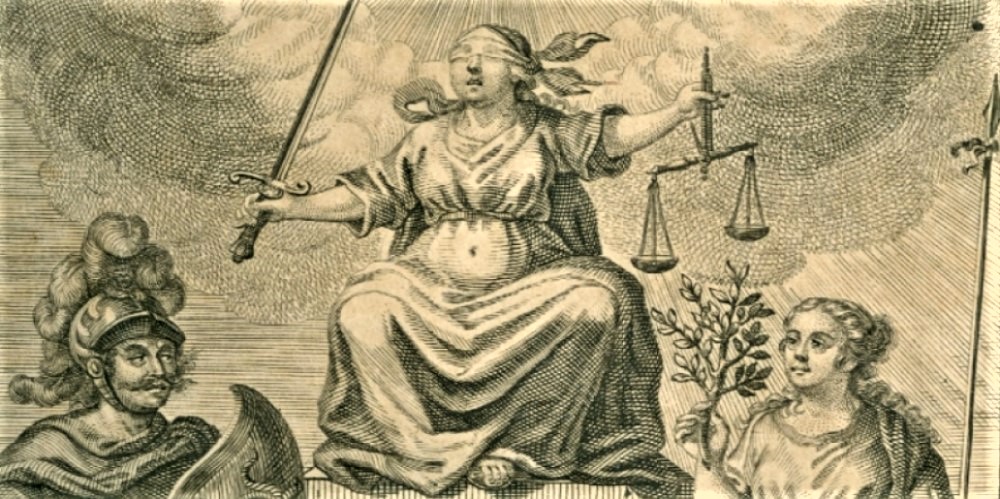
Many wrestled with this question in the past for good reason. The picture above is from a book by Hugo Grotius entitled, “On the Law of War and Peace.” In his book, he argued that international law should be based on natural law, which is derived from human reason. One of the assumed truths of natural law is the belief that moral principals and rights are inherent in human nature. These rights are believed to be revealed through human reason. You can probably guess the assumption natural law makes about the nature of man. Those who ascribe to natural law also embrace the “overlap thesis” which asserts that law and morality are intwined (they “overlap” each other) and indwell in us, and it is this indwelling that moves individuals to inherent acts of goodness. This “overlap thesis” has been a huge part of educational theory and therefore, it has become part of the fabric of life in the West. We depend on our reason for everything. We rarely do research, study the facts or take our time before making decisions these day, and it is because of the overlap thesis that we do this. We live as if we are morality and that our logic and reason are without flaws, and we can do that because we live in Wonderland where we are morality. We can only live this reality if life is about us. If we are concerned about others and seeking to live a life of honor and integrity, well, Wonderland becomes a nightmare.
When considering how we should live, there is an important question we must ask. What is the difference between good and evil? In our current discussion, this question seems to be fairly important, especially in regard to how we are to live. Are they relative? Is living for self with no concern for others an inherent act for good or for evil? If we live in our corner of the world and do not infringe on others, are we being evil or good? Depends on what you are doing, right? Can we say we are living for good when we our only concern is for ourselves? If we isolate and self protect, are those considered acts for good, even if to do both means infringing on someone else? These are all hard questions, and every one of them depends on what you consider to be good. If goodness is defined by you then the world is your oyster and there is little that would be defined as evil, but if you are a citizen and in community with others, then living your life just got more complicated because you must consider their views as much as your own. If you do that, then you are no longer in Wonderland.
Today, everyone is quick to judge others with little concern for others or even worse, little concern on whether their judgements are true. We tend to make everything personal and when we live in isolation (When I say isolation I mean either living by yourself or living in a small community where everyone holds the same absolute beliefs.), everything becomes personal, and the idea of truth becomes hard to find. What if we are wrong? What if our perception is false or there is another explanation? Can we know the intent of the heart or the motivation behind one’s actions? We cannot and yet we live as if we have that power because we are increasingly living lives that are isolated and self-centered. I don’t see a lot of self reflection, humility or accountability taking place in the world. Even when caught in a lie or in a wrong accusation, most will offer no admission of guilt, no apology and no path towards restoration. We need to only look at our own politicians for countless examples of this. For me, the issue comes back to truth. Do we care about what is true and right anymore or do we care only about ourselves?
Truth, commonly defined, is conformity to fact or reality, but what if we are our own reality? The more isolated we become, the more truth becomes relative. How can we determine what is true and right without community? I don’t think we can and in our current state, I don’t think we can expect to move closer to truth, especially when we live in Wonderland. Everywhere we look community is breaking down, which, in turn, breaks down life the way it is meant to be lived. It is community that holds us accountable and teaches us right from wrong. It is the older who teach the younger about truth through experience in community, which brings us back to the question, how are we to live?
I close with this. Dark and light are not opposites. Dark is the absence of light. I think good and evil are the same. Evil is the absence of good, but what if we are the good? Can there be evil in Wonderland? I don’t think there can, which is our problem. Today, most believe man is inherently good and evil is an after thought, but a look at culture will immediately question that thinking. Can we find truth by ourselves? Can our actions always be good if we are the judge and jury? Speaking only for myself, an emphatic no! However, I think the question, “how am I to live” is a good place to start. If you are asking yourself that question, then, I think you are stepping on the right path. If you are not, then maybe you should get off your current path. Living in Wonderland is a great thing until you become tired of yourself, and we all eventually grow weary of even ourselves. We were created to be in community! Blessings!
What is Artificial Intelligence (AI)? According to NASA, AI “refers to computer systems that can perform complex tasks normally done by human-reason, decision making, creating, etc.” NASA states that there is “no single, simple definition” regarding AI and that is because it is changing and growing constantly.
As I speak with people on the topic, I tend to receive two responses: one of fear and one of reckless abandonment. There are those who are extremely concerned about AI and what it will do to us as human beings. Then, there are those who can’t wait to open Pandora’s Box and see all the wonderful benefits waiting to be used.
In the little research I have done about AI, I have discovered that, in general, there are three fundamental components of all AI Systems. There is Data, which is how a system learns and makes decisions. Without large quantities of data, there are no decisions. There are Algorithms. These are sets of rules systems use to process these large quantities of data. Then, there is Computing Power. AI systems need computing resources to process these large quantities of data through their complex algorithms. As you can imagine, there are needs for large quantities of power to run these AI systems.
As far as the history of AI, the groundwork for the idea began in the early 1900s, but the largest advances are recent. Alan Turing began exploring artificial networks in the 1950s; he published a paper entitled, Computer Machinery and Intelligence, in which he proposed a test of machine intelligence. He called this test the Imitation Game, which eventually became the Turing Test. This was a watershed moment as AL technology began to develop rapidly after this point.
Computer development began with increasing processing speeds in the 70s and 80s, producing faster, cheaper more accessible computers. During this time, the very first AI language was created, but computers were still too weak to demonstrate any kind of intelligence. The 80s were a time of growth and of increased interest in AI, and this was due, in part, to breakthroughs in research, which increased funding opportunities. The 90s produced the first functioning AI systems: the first AI to defeat a world champion chess player, AI robots, AI self-cleaning vacuums, and AI speech recognition software. In the late 1990s and 2000s, there were significant advances in AI. Automation and machine learning were used to solve problems in academia as well as in the real world, which brings us today.
There are AI systems all around us and their use continues to increase daily. Ai is used in law, medicine, education, engineering, science and more. There are enormous benefits to its use. It can solve problems and diagnosis diseases, but like anything else, with the benefits come the detriments. There are detriments, even though I have spoken to several who see none. I have my own concerns, but for today I will just address one: entropy.
AI systems are created with entropy in mind, but it is the entropy found in thermodynamics. The second law of thermodynamics states that the entropy of an isolated system can only increase or remain constant; it never decreases. As great as AI is, it is still a created system, and it still must deal with entropy. I tend to look at entropy and its relationship with AI from the perspective of physics, which indicates that the tendency of systems is to move towards a greater state of disorder and randomness and not away from it. If I am right to look at entropy’s relationship with AI this way, what does it say about AI’s future? Is it endless? Is it immune from entropy?
As AI becomes more a part of its own data, and by data, I mean that content which it creates that is added to the data to which it has access, what will happen to its state of entropy? Will it decrease or increase? I believe it will most certainly increase. I do see, in the distant future, an ancestral relationship with its data when its data base moves past a 50% bifurcation point. What I mean by this is that at some point in the future I see AI creating so much data that become part of the data base ( the internet) that it begins to use its own created data to make decisions. Will this matter?
I do think this will matter. What will it do to its ability to think and reason? Here is a harder question, will it be too late? What I mean by that question is will it be too late for us at this future date due to our conditioning and dependence on AI systems? If, at a future date, this ancestral state of entropy is reached and it results in AI systems suddenly providing some false information or some untrue truth, will we be able to recognize this information as false or will we be too far gone? There are hard questions not being discussed regarding AI that need to be discussed. Will we take the time to discuss them or are we too in a hurry to usher in AI as the solution to all our problems. When that day comes, AI will be the least of our worries. Until next time …
We have examined deconstructivism, but there is one question that remains: how are we to respond to it? I would suggest that any response begins by, first, coming to an understanding of instability as it is defined by deconstructivism. There are questions that come with any speculation of instability as an organic state of language. What if its organic state was, instead, something else? What if instability was merely the tension of determination? Derrida provided some support for this type thinking when he referred to the openness of instability as “aporia,” describing it as a puzzle or quandary (Jackson & Massei, 2012). What if “aporia” was that which was imposed over meaning by deconstructivism? Nothing is for certain and should not be thought of in those terms.
Let’s begin this post, instead, with some hard truth; instability is a part of life, but it is a part of life we fight against. No one wants to be unstable, even when it comes to language. We seek clarity not confusion, especially in our communication. What do we do with confusion? We look for ways to clarify it and eliminate it, and yet deconstructivism seems, to me, to seek to keep it. I see it seeking to be the means of clarity. Do I dare go further? I think it goes beyond clarity and seeks to be “the” means of meaning. What other purpose would it have for keeping instability alive, especially in language? Let’s back up a bit and look at what instability does, if left on its own. Simply, it destroys stability. As we have studied deconstructivism, we have referenced its interaction with norms. Instability undermines stability, especially when it comes to stable norms. Derrida advocated that an important part of the process of deconstructivism was to keep asking questions, which is a theoretical device used to keep meaning and language from falling into a sameness, which is never seen as a critical tool of analysis or as positive. Sameness is never welcomed in critical analysis and always viewed with suspicion and as bias.
Derrida saw both language and thought as living in what he called binary opposition, which he suggested was a confirmation of the instability of language. He saw language relying on opposing concepts like good/evil, true/false and happy/sad to sustain itself. He did not see these as part of the natural state of language but as constructions imposed on meaning and language by human beings. What is language if not a tool of communication for human beings? I do not see language as entity unto itself; I see it strictly as a tool used by human beings to communicate. In my reading of Derrida, I did not get the sense that he saw language in the same light as I see it. He saw these binary oppositions as existing within a dangerous possibility: that one term would be given the privileged status over the other term, thus affecting the natural state and balance of language. He claimed that this privileged status (one term over the other) prevented meaning from “disseminating out beyond its initial intended meaning” in multiple directions, which assumes language is not a tool but an entity unto itself. One question I have regarding binary oppositions is this one: do they not define each other? Is not dark the absence of light? Is not false the answer that is not the right answer? What is the alternative if these binary oppositions are removed? I don’t see them as constructions of human beings but instead, as observations of human beings. Human beings did not create dark or truth or even good. They observed its presence or its absence through, in many cases, its binary opposite.
When it comes to communication, I do not seek to protect two binary opposed meanings, at least not when I am seeking to be clear in my communication. Communication, for me, is determining shared meaning for the purposes of effective and clear communication. It is understanding meaning and embracing the same meaning. Did Derrida see language impacted by context or was he afraid of the impact of context? I am not sure. Derrida claimed to have seen language and thought as indecideable (his word), a term he used to describe meaning as having no clear resolution, which, from my perspective, leaves language in one place … in a state of confusion, which could also be referenced as instability. Is this what he saw or is this what he needed language to be for deconstructivism to grow and thrive? How we see and respond to deconstructivism will do one of two things: it will either feed it or starve it and kill it.
Deconstructivism if often referenced with terms like unpacking, destabilizing and undermining in regard to its interaction with norms, which it would define those that are stable as assumptions, as binaries and as privileged. These are intentionally negative terms designed, in my opinion, for them to be unpacked or destabilized. But, again, what if the theory of deconstructivism is wrong when it comes to norms? What if instability is not a natural state but instead, one created for the purposes of destabilizing those norms that are stable? If this is the case, then we would need to confirm through a dialectic method whether deconstructivism is viable or not. When it comes to literary theory, deconstructivism operates in literary theory by encouraging us to read literature closely but with skepticism, questioning binary oppositions, resisting final interpretations and embracing ambiguity. When we put all these words together—skepticism, questioning, resisting and ambiguity—what do we get? These words encourage doubt, challenge authority and embrace uncertainty, which could be summed up in one word, instability. The question then becomes does deconstructivism identify instability or produce it?
Considering this question, I think we must, first, understand deconstructivism for what it is. I am not advocating that it produces instability, but I am say that there does exist a possibility that it does. Therefore, we cannot assume that it does, nor can we assume that it does not. It is important to understand that any disagreement with its principles—its skepticism of fixed meanings, rejection of absolute truth and tendency towards destabilizing established frameworks—if not done critically and constructively will be engaging it in the very manner being criticized and result in confusion or ambiguity, which is exactly what deconstructivism wants and, in many ways, needs. In this series, I have tried to provide a picture of this theoretical position from different angles for the purpose of understanding. Ignorance is offering criticism of that which we do not understand without understanding; analysis is offering constructing critical analysis in a thoughtful, respectful and knowledgeable manner. Back to our question, how do we respond to deconstructivism?
Let’s begin by seeking to understand what we believe and subjecting our own beliefs to the same analysis to confirm whether our beliefs are true or not. So many of us are unwilling to do that but must be willing to do that if we are seeking truth. We must, next, understand that our perceptions, as right and as true as they feel, are only our perceptions. They are not reality or even true, at times. Sometimes they are true and other times they are not. Most of the time they are built and re-enforced by someone else’s perceptions, which should be analyzed as well. For example, I have been advocating in this series in subtle ways that one of the weaknesses of deconstructivism is its lack of focus on the pragmatic reality of communication. To communicate, we need “shared linguistic and cultural frameworks,” and my example of that is language. English speakers do not communicate well in other parts of the world if they are monolingual or unwilling to engage in the language of the region in some way. If they expect everyone to speak English and have a very superficial view of communication, then they will struggle to communicate because they are allowed instability to reign and seek no action to clarify. There are other aspects of communication like culture, attitude, countenance and a willingness to engage and communicate. If none of these are engaged, communication will be lacking and remain ambiguous and confused. That sounds nothing like the state of communication needed to effectively communicate, and yet, that is a practical example, albeit simple, of deconstructivism at its simplest level.
As we engage deconstructivism, and you will engage it, it will be helpful to you to recognize it. How will you do that? Let’s start with its tendency to blur all distinctions. Not only will it seek to destabilize stable norms, but it will blur clear distinctions which tend to lead to relativism, which is another sign of the presence of deconstructivism. Where do we see this? Right now, the most prominent place we are seeing this is in the blurring of the genders, male and female. This is clear indication of the presence and the impact of deconstructivism, but it is also an opportunity to address deconstructivism’s weakness when it comes to practicality and real-world applications. While there is a blurring of the genders (per deconstructivism) there is not a blurring of the product of this burring, which is contradictory and an opportunity to determine its validity that we need not miss. Again, our response depends on our ability to identify the presence and impact of deconstructivism and then respond respectfully and lovingly to it inside its own theoretical methodology. This means we must understand it, something most of us are unwilling to do. It is helpful and intelligent to read and study both sides of an issue. As difficult as this is to do, to really understand and respond well, we must do this. Another tendency of deconstructivism is its push towards ambiguity, which is not applicable in several vocational situations, especially in areas like medicine and engineering. We should not blindly and emotionally reject deconstructivism outright because of these two examples but use them by applying them back on top of deconstructivism as a means of pointing out weaknesses, gaps and breakdowns and asking questions.
Deconstructivism is a critical theory that is used in academics effectively in micro-situations, but its struggles, like most academic theory, begin when it is applied in culture in real-world macro-situations or used to push an agenda and change behavior. Any theory, good or bad, if applied in similar situations, will produce similar results. We should respond as civilized respectful human beings with a critical eye towards its application in wrong settings to learn more about it and use it to pursue truth. In the right settings, it is effective in rooting out bad theory and paving the way for good theory, but in the wrong settings, it quickly becomes a hammer akin to propaganda used by those with malicious intent to inflict their ideas on others via power, and that is not considered ethical nor critical analysis. This concludes this series on deconstructivism. I hope you enjoyed it. Until next time …
Derrida, Jacques. (1988). “Derrida and difference.” (David Wood & Robert Bernaconi, Trans.). Evanston, IL: Northwestern University Press. (Original work published 1982).
In this post, I jump back into the rabbit hole known as deconstructivism. Let me begin with this statement: the process of deconstruction is not the opposite of anything, but instead, it is a means of instability. This one statement will color everything else in this post. This much I know—deconstructivism is prevalent in our culture. It perceives any control or order outside of itself as detrimental, unnatural and as a threat to itself. It is built to attack all of this for the sake of its own preservation. A word of caution before reading this post … it is longer that usually and that is due to jumping into the world of philosophy. In that world, language’s importance cannot be understated. It is the primary tool through which philosophical thought is communicated, analyzed and debated. I do not plan to go down into the depths necessary to adequately explain language’s importance to philosophy, but I do plan to dig a little deeper than normal. So, let’s get started.
When discussing deconstructivism or any other philosophical theory, the role of language must be addressed. Language is a communication system that involves words and systemic rules that organizes those words for the purpose of communication. We need language but so does philosophy and its theories. Language, as one of the main forms of communication, is important to philosophy, but before we get into why we need to understand the configuration of language. Language, as a form of communication, has specific components; two of the most important ones are a lexicon and a grammar. A lexicon refers to the words used by the given language. These words have meaning which must be understood to communicate. The grammar is a set of agreed-upon rules used by the lexicon to convey meaning. Without an agreed-upon lexicon and grammar, all communication would be ineffective. Therefore, language is used by philosophy as vehicle of change to deliver its theories and communicate them; deconstructivism, however, took this idea to another level, as we shall see. Over the next several paragraphs, I hope to accomplish two tasks. First, I hope to address how deconstructivism delivered this change, and second, I hope to address the change that was delivered.
How does deconstructivism deliver change? You have probably already presumed that language was involved in some way, and you are correct. Deconstructivism, like all other theories, uses language as means of delivery, but deconstructivism does something no other theory has done … it goes beyond using it for communicative purposes and challenges its authority, or its grammar, by way of tension. It posited that the natural state of language was not fixed or absolute but unstable and fluid. This one fundamental belief does a lot of heavy lifting for deconstructivism. It provides a posture of change in both the lexicon and the grammar of language. Most philosophers assume a prejudice of general language to justify creating their own language. There are many reasons for this; some pure; some not. My point is that when they do this, they assume control of the language and the power associated with it. Deconstructivism is similar in approach but different in scope. It did create some of its own language, but it did this to control all of language. Language is its means of delivering change, but unlike other theories, the scope of change extends beyond its theory and to all of language and culture. It sought to position itself to be the lexicon and the grammar of all language for the purpose of culture coming under its control. How did it do this?
It began with an attack on norms. Any past or pre-established norm was considered a threat to deconstructivism due to stability. Deconstructivism posited that stability is not a norm’s natural state but is, instead, a sign that a norm has moved away from its natural state of instability. The first battle began with language. Is there any bigger norm out there? If it could deconstruct language and re-create it in a way under its control, then, nothing was out of its reach. Culture, in many ways, is defined by its norms, and there is no other factor as impactful as language. We may quibble over whether it is a norm or not, but it does color the culture in which it lives. Norms along with language are two of the standards that define culture. If we understand this, we may better understand some of the political battles taking place and why the fight is so intense. What is at stake? The answer is our norms. They define our culture, and they define us.
Norms are norms because they are behaviors or mindsets considered acceptable by most people of a specific culture despite their own individual beliefs. Norms that are stable define our culture and define who we are, but stable norms are under the constant attack of deconstructivism for one simple reason: stability threatens deconstructivism. Why? We only need to go back to the first paragraph and remember that deconstructivism is not the opposite of anything, but instead, it is a means of instability. Norms that are stable produce consistency, sameness and constancy. Stability is often seen as the opposite of change, and when it comes to human behavior, stability is seen as the neurological basis for consistent habits which involve the stabilization neural information. Stability makes change more difficult, and it makes control next to impossible. For deconstructivism to impact culture, it needed instability to be a norm and then it had to become “the” norm of all norms. How did it do that? It created cultural instability and then became the stability in the instability. Establishing instability as the natural state of language allowed language to be the vehicle of change. It was language that did the work of deconstructivism; it was language that delivered instability to culture.
Deconstructivism still had to address those norms that were most dominant. Deconstructing any norm requires the general population of the culture in which it lives to embrace the change. Support for a change to something stable will only be accepted if there is initial suspicion of the norm. This suspicion flows out of the instability of the norm, which would have been established by deconstructivism. When a tried-and-true norm is perceived as unstable, our human condition takes over rendering us suspicious of it. We begin doubting it and the other norms associated with it. You have experienced it over the last several years … removing statues of past leaders, attacking the integrity of institutions put in place to protect and serve and even promoting bias and oppression as good. This is how deconstructivism delivers the change it needs to live. It has changed you and me, and it is fundamentally changing culture.
What change has deconstructivism presented as normal? That one is easy; it is instability. Instability comes in many forms. It is tension and doubt. It is skepticism and isolation. What do these things do to us? Well, they weaken our foundations and punch holes into our existing norms, reducing everything to its lowest form, which makes us doubt everything. When we do this everything is vulnerable to the dominant idea of the day, which would be, you guessed it, deconstructivism. Norms are not just commonly held beliefs; they are guard rails of the highway we call culture. Removing them does not bring freedom but danger. A culture without norms was what Derrida wanted because he wanted deconstructivism to be the guard rails of culture. He would call such a state the “absence of presence” or the “already-always present,” and he would embrace it because it would be a culture of instability. Derrida would refer to such a situation as “trace” and see it as a means of stripping away the “supposed” contradictions of language, opening it to new “true” meaning. He would call it “the absent presence of imprints on our words and their meanings before we speak about them” (Jackson & Mazzei, 2012, p. 19).
This is deconstructivism in its truest form. It is “the norm” that defines all other norms by pushing every other one to instability while it remains as the lone stable dominant norm. We see and experience it every day. It is present in our media and especially in our government. If you listen, you will hear it. Truth is no longer that which is true, but that which is repeated and situational. Any belief in anything stable is to be challenged because everything must be unstable. The media is no longer the watch dog of the people but the mechanism of manipulation and change. Anything presented as an absolute is attacked, viewed with suspicion and perceived in negative ways for one simple reason: it is a threat to instability. Then, there is suspicion—we have become suspicious of everything. This is the impact of deconstructivism.
Suspicion is only a short path to the cliff of paranoia. Those who are suspicious of everything eventually doubt everything, which is a form of paranoia. What do you trust in culture? What do you know to be true in culture? Are you concerned that there are no longer real answers to these questions? This is deconstructivism. It works by giving everyone access to itself through suspicion brought on by instability. Someone said to me, but we have community, don’t we? We are told that we have community, but what we really have is isolation. Our “community” is no longer in-person but one of technology. We text, tweet, post and email more than we talk in person; that is not community. That is living inside instability and calling it other things: individualism, preference, perception and self-preservation. Make no mistake, these are not elements of community but elements of instability and deconstructivism.
This world of deconstructivism is a strange world. It is a world where everyone is king. The problem is that when everyone is king, no one is king, except the one who made everyone king. We embrace and encourage selfishness. We no longer talk about integrity and honor. Difference is a means to an end, and we have eviscerated any idea of excellence by calling it intolerance. Everyone has become a judge without ever looking in a mirror. Integrity has been pushed aside and replaced by self-preservation and empathy for others has evaporated into the air. Hard work is viewed with suspicion and all forms of submission are labeled as oppression. We choose criticism over encouragement, negativity over positivity, selfishness over selflessness and materialism over minimalism. This is our world. How are we to respond to it? That is for another day and another post. Until then …
Derrida, Jacques. (1988). “Derrida and difference.” (David Wood & Robert Bernaconi, Trans.). Evanston, IL: Northwestern University Press. (Original work published 1982).
Looking at the process of deconstruction through the lens of deconstructivism is a bit like looking at the world through the eyes of Alice as she looks at the world through the looking glass; you can see shapes and colors, but nothing is clear. Derrida explained the process of deconstruction in a curious way when he stated that, “[it] acquires its value only from its inscription in a chain of possible substitutions, in what is too blithely called a context” (Derrida, 1985, p.2). Derrida presented deconstructivism as an organic act of creation found inside language, but he also presented it as that which was only determined by the context of its use. It is this one word, “only” that provides deconstructivism its protection, which is its ambiguity. Contexts are different and always changing. If deconstructivism is creation determined by the context with which it interacts inside language, then it is never the same and always evolving into something different. My point is that the process of deconstruction is an action of instability acting on that with which it interacts. This we do know. What we do not know is whether its interaction is an act of imposition or of revelation?
I would like to suggest that the use of the term “organic” is an intentionally heavy term, and more calculated than not. Derrida claimed that he did not create deconstruction but found it as it was, always “going on around us,” which, interesting enough, was in the same state in which he claimed to have found language and meaning. They both, according to Derrida, were found … as unstable in their natural and true state, which begs the question: is instability their nature and true state? Were they found unstable before their interaction with deconstructivism or as the result of their interaction with deconstructivism? This is an important point because we know that there is instability in the world; what we do not know is whether this instability is organic, manufactured or a combination of both, especially when it comes to language?
Each morning, you and I awake to an unstable world. You can feel it just like I can. I am old enough to remember the stability of the world years ago. Sure, there were issues but there was decency and common sense; there is now tension and instability in their place. Both are now norms, replacing the stable ones of the past. It is disconcerting to me that stability is now perceived as a negative in relation to language and meaning. Words have meaning and will always have meaning. That should never change and yet, it has. In the next several paragraphs, I will present a case that deconstructivism, like its cousins, Marxism and Critical Theory, is intentionally providing the means to deconstruct stable norms and replace them with unstable ones for one reason: power.
Jackson and Mazzei, in their book, Thinking with Theory in Qualitative Research, describe their views of deconstructivism, which are directly linked to Derrida’s views. Jackson and Mazzei quoted Derrida when they wrote, “Deconstruction in a nutshell is the tension between memory, fidelity, the preservation of something that has been given to us, and, at the same time, heterogeneity, something absolutely new, and a break” (Derrida, 1997, p.6). The process of deconstruction is now an accepted part of qualitative research. It creates tension which allows it to be analytical, but it also needs this tension for itself. The process of deconstruction required tension to become an organic part of language, but to maintain this status it also needed man to be perceived as a threat to it because, like every other theory, there will be men and women who challenge it, as there should be.
Derrida thought—and I think he is right on this— that we (human beings) perceive tension as negative and seek to move away from it or eliminate it whenever we can, which would be detrimental to deconstructivism. Derrida understood that, as people, we tend to reject tension and seek stability, especially in our language. This would destroy the process of deconstruction. Derrida wanted tension … he needed tension, and he needed it to be embraced and accepted as a natural part of meaning and language, but he knew that would only happen if instability was language’s true and natural state. Jackson and Mazzei posited that deconstructivism’s presence will be where we find “unsettling,” or a “ruffling” of current normative structures (Jackson & Massei, 2012). This is part of the analytical nature of research, and part of the process of deconstruction, which began as theory, but has now extended into everyday life. Tension and instability, which are part of our world, are presented as evidence of the presence of the process of deconstruction, which I acknowledge, but what I struggle to acknowledge is that both are also presented as evidence of the true and natural state of language.
What I believe instead is that the process of deconstruction is acting upon language, producing both tension and instability. It would be akin to me making the case that all trees exist in the natural state of being cut down, which I label as downcut. When they stand erect and grow, I label this as an imposed will upon them and not organic to them; instead, their natural and true state is downcut. My evidence in support of my theory is my ability to take my ax and chop down a tree. As the tree falls to the ground, I present it as evidence of the presence of downcut and as evidence of a tree’s natural and true state. Is that evidence of its natural state or of me (downcut) acting upon that tree with my ax? Is this unsettling or ruffling of a stable norm an indication of the presence of the process of deconstruction or is it simply change, adjustment or the imposed will of the process of deconstruction on that with which it is interacting? This is the confusing world of deconstructivism and why it is worth exploring. It is a roller coaster ride with plenty of ups and downs. There is much more to address. Please come back for the next post as I continue to try and deconstruct deconstructivism. Until then …
Derrida, Jacques. (1988). “Derrida and difference.” (David Wood & Robert Bernaconi, Trans.). Evanston, IL: Northwestern University Press. (Original work published 1982).
Deconstructivism, another theory critically aimed at the norms of culture, is a theory that has impacted all of us and yet, most of us have never heard of it. To understand it is, at best, to attempt to understand it because, be warned, it is ambiguous and vague. It is like nailing Jello to the wall; once you think you understand it, it interacts with something else and changes. Deconstructivism is change and difference and criticism and tension all rolled up into what I see as varied disparity. It first appeared in a 1967 book entitled, On Grammatology, and has grown in reference and documentation ever since.
Let’s begin with a quote. Jacques Derrida, in his article, Letter to a Japanese Friend, explained deconstructivism to his friend by insisting that it is “an event that does not await the deliberation, consciousness or organization of a subject or even modernity” (Derrida, 1985, p.2). If this seems a rather odd way to describe an event, you are right, but it is not an event that he is describing; it is deconstructivism. Inside that seemingly innocuous description is affirmation to deconstructivism’s metaphysical reality. Derrida stated to his friend (Professor Izutsu) that to define it or even translate the word “deconstruction” would take away from it, which is a suggestion to its nature and to its protection. How does one disagree with that which cannot be defined or translated? The answer is simple: one does not because one cannot.
Derrida, in my opinion, was stating that deconstruction was a notion of a reality rooted in situational agency. It was designed to avoid the confined corner; to avoid the proverbial box or the closed door and to assert its own agency in interaction with individualism (or context) as a means of truth. According to Derrida, it was and is a critical methodology that analyzes how meaning is organically constructed and deconstructed within language, which we all understand to be the primary means of communication between human beings, and yet it is not language that seems to be under attack. Instead, language seems, to me, to be the vehicle of delivery for deconstructionism.
Let’s be clear; deconstructivism is not a form of Marxism nor of Critical Theory, but it is related to both, although indirectly. The process itself claims to reveal the instability of language, which it presents as language’s true and natural state. Is language unstable or is language, as my cynical mind suspects, being pushed to instability by deconstructionism? I would like to posit a question: if instability were not language’s true and natural state, could deconstructivism determine language’s state or would it, instead, change its state? I am not sure, but I look forward to exploring that possibility and others. I do know this; its existence depends on instability of language and meaning.
Back to this question, is language unstable? Yes and no! I think language is like anything else; it works from instability to stability. I know I seek clarity in my communication and one of the ways I do that is to ensure that meaning is consistent with those with which I am communicating. How is language unstable? I believe language is unstable if meaning inside language is unstable. How does that instability remain and not work towards stability? One of the methods of maintaining instability is through addition. When other meanings are added to true meaning, clarity is not produced but instead, instability is maintained. Addition, for me, creates instability, especially when it comes to language. If we have found instability as a state of language and this discovery was the direct result of deconstructivism’s interaction with language, then, there is another more difficult question to consider. Is the instability of language its true and natural state or is it a direct result of deconstructivism’s interaction with language?
Deconstructivism claims that one of its goals is to push meaning to its “natural” limits and expose its “true” nature which, according to Derrida, is instability heavily dependent on difference (addition). I am not a big fan of coincidences and see them as problematic. Here is my issue. If language is considered unstable in its natural state and deconstruction is instability in its interaction with language, is this a coincidence? Again, I don’t really buy into coincidences. I do know that when instability interacts with stability the results will generally be less stability. We know this through the study of physical systems, biological systems and even social systems. We also know instability manifests in three ways: gradual change, sudden transitions and oscillations, and there is nothing to indicate that when instability is introduced to a stable system, that stable system stays the same or even stays stable. It always changes; at times, stability may eventually be achieved again but not before the system goes through a period of instability. My point is that I am not convinced that the natural state of language is instability. There is a solid case that the instability of language is due, in part, to its interaction with that which is unstable. Are you confused yet? Buckle up because this roller coaster ride is just beginning. This post is the start of a deep dive into the world of deconstructivism. Stay tuned for my next post in this series. Until then …
Derrida, Jacques. (1988). “Derrida and difference.” (David Wood & Robert Bernaconi, Trans.). Evanston, IL: Northwestern University Press. (Original work published 1982).
Poetry has always fascinated me, and yet, I admit, it is not something I understand or even do a lot. Yet, I still desire to “do” poetry, if that is a proper way to address it. I don’t think you write poetry; I think you “do” poetry as it is, for me, beyond writing. It is another realm, a different world, if you will.
The ancient Greeks—they are involved again—considered poetry as an art in which human language is used for its aesthetic qualities. The Greek word (poieo) literally means “I make or create.” There are many forms of poetry and, to be honest, I don’t understand all of them or even know all of them. I admit that I have written some, but none of it is very good. This post is not to educate you on poetry. This post is just me thinking out loud about the role poetry plays in who we are as beings.
While I am no good a poetry, I do love certain poets and I love them because I like poetry. I love Frost, Keats, Shelly, Hughes, Blake, Longfellow and even some of Donne, who I rarely understand. What makes me love these poets? I love their poems, but I will stop there because I think it is that simple. I don’t want to get into analysis even though I would love to jump in with both feet. I can’t because I don’t understand poetry. I just know I like it.
I recently read an article about the ten greatest poems ever written. Now, understand, that this is one man’s list, but from my perspective, it is a solid list. The greatest poem for this man was written by Shakespeare, with which I can’t argue, but his second greatest poem was written by Donne, which I already admitted, I struggle to understand. Below, I have pasted Johne Donne’s poem, Death, Be No Proud, which is second on his list.
Death, be not proud, though some have called thee Mighty and dreadful, for thou art not so; For those whom thou think’st thou dost overthrow Die not, poor Death, nor yet canst thou kill me. From rest and sleep, which but thy pictures be, Much pleasure; then from thee much more must flow, And soonest our best men with thee do go, Rest of their bones, and soul’s delivery. Thou art slave to fate, chance, kings, and desperate men, And dost with poison, war, and sickness dwell, And poppy or charms can make us sleep as well And better than thy stroke; why swell’st thou then? One short sleep past, we wake eternally And death shall be no more; Death, thou shalt die.
I readily admit that this poem does not make my list of top ten poems, but does that make it any less great? Poetry has, at its heart, creation. The poet is said to be one who creates and the poem is what the poet creates. This idea of creation is foundational to poetry, but what makes it different than any other thing done? I can create a rule at work or write an article for a magazine, but neither of those would be considered in the same light as poetry. They were created by me, but they are not poetry.
While Donne does not move me; Blake does. Below, you will find The Tiger by Blake. It was the first poem that I read and immediately liked and understood.
Tiger Tiger, burning bright, In the forests of the night; What immortal hand or eye, Could frame thy fearful symmetry?
In what distant deeps or skies. Burnt the fire of thine eyes? On what wings dare he aspire? What the hand, dare seize the fire?
And what shoulder, and what art, Could twist the sinews of thy heart? And when thy heart began to beat, What dread hand? and what dread feet?
What the hammer? what the chain, In what furnace was thy brain? What the anvil? what dread grasp, Dare its deadly terrors clasp!
When the stars threw down their spears And water’d heaven with their tears: Did he smile his work to see? Did he who made the Lamb make thee?
Tiger Tiger burning bright, In the forests of the night: What immortal hand or eye, Dare frame thy fearful symmetry?
What about this poem spoke to me more than John Donne’s poem? I can’t really tell you, but I will tell you that whatever it was, it is part of what makes me a human being and not an animal. I don’t know a lot about poetry, but I do like it enough to dabble. I am content to dabble with my own poetry, even if it is just to pull them out every now and then, read them and remind myself of who I am and what moves me. This one aspects makes poetry unique from other forms of literature. I don’t pull out a policy and read it again and again. Why is poetry different?
I am not sure, but it is and for me this is enough. Something about poetry appeals to our human nature, and maybe, something about poetry adds to our human nature, if I can be so bold. I am not sure of much when it comes to poetry, but I am sure of this. The kind of poetry created and enjoyed will tell us about who we are as human beings and where we are as human beings. Orwell speaks of this very issue in his book, 1984. Remember, in 1984, poetry is a tool of totalitarian control and Ampleforth, who manipulated poetry for the good of those in control, is arrested for leaving “God” in a poem.
Poetry, which I struggle to understand, still fascinates me, and I still read it not because I understand it, but because I marvel at it as a product of creativity. May this desire never leave me or you. Until next time …