The Disappearance of Deference: Dissolving Morality

Part IV: The Disappearance of Deference: Dissolving Morality

Full disclosure: this one is a bit long, but the subject matter demanded the length. My apologies.

When it comes to morality, Aristotle believed that moral principles were ingrained into one’s character by past actions “done in right ways and with right attitudes.” These past actions would come from community from those older and wiser. All of this could only take place in communities of differences where morality was much more than a list of wrongs and rights. This was, as Aristotle asserted, ingraining moral principles into one’s character through repeated physical actions done in community with others who would either confirm or correct. It was the action that revealed the morality. Aristotle believed that communal interaction with those older and wiser was how we would recognize the right application for the situation, which, for him, was a form of morality, but none of it mattered without the action. We are born into and live within communities for a reason; we are raised in families with parents; we are taught in schools by teachers and eventually we work and submit to others in vocation, and all of it develops in us a moral sense. The process of maturity, including the development of morality and the ability to reason, involves communities of difference and our interaction with them.

It is important to note the role that action plays in cognitive recognition and moral development. I see this as evidence in support of the importance of communities of difference, which supports Aristotle’s assertion of the relationship between reason and desire, but it would render Kant’s views of reason as merely practical null and void. There is ample evidence to support Aristotle’s notion that a gap exists between reason and desire. This gap between reason and desire has an important distinction; a smaller gap, the more likely we are to think in moral and practical ways, and the more inclined we are to have deference. This smaller gap would also indicate that reason was impacting desire, which is moral in context. A wider gap, the less likely we are to think in practical or moral ways and to have deference, but the issue does not stop there. A wider gap also indicates that we are more likely to reach a point of malicious intent when it comes to morality, due, in part, to reason and desire operating autonomously with little to no impact on each other. 

As sensual people, desire will trump reason if they act independent of each other. In this situation, it will be our desire that pushes us to the point of narcissism and even madness when it comes to morality. Every decision, including moral ones, will be rooted in self, which turns our selfish desires into our own morality. In this moral state, there is no greater good, no concern for others, no empathy and certainly no deference. Our morality and our desire become one. We become hostile to anyone who does not share our ideology, our thoughts or reason as we do, which pushes us to seek community with only those who are like us. We join homogenous groupings that we think share our ideas and beliefs, which seems to confirm our rightness and everyone else’s wrongness, but the opposite is true. These groupings become our morality and determine our thoughts, ideas, and values. In these groups, we think one dimensionally, do little to no thinking on our own and repeat the groups as our own. We do not think in a dialectic way, and our morality becomes narrow and skewed.  

In this moral state, decisions are not based on a greater good or on a concern for others; instead, decisions, policies and even laws are based only on the morality of the group and their explicit ideology or worldview, manifesting through our own perception. It is our perception that becomes our truth, and all thoughts, ideas and decisions are based upon it, which are not original but merely an extension of our grouping. In this moral state, we feel safe and right because we are surrounded by those who share our morality, and our perceptions are always true and right as long as they are rooted in the morality of the grouping. The concept of a greater good dissolves along with empathy for others and all that is left is power. At this point, Aristotle would see this situation as a complete moral failure due to it being based on desire alone. He would see it as a failure to think practically and reason rightly because every situation would be perceived according to one’s own internalized values and for one’s own personal gain, which would come at the expense of all others and any kind of general good. There would also be a personal cost. In this situation, there is no growth or maturity; there is no development. There is only sameness, bitterness, and cynicism.

Sadly, I see this situation playing out before us today. In this moral state, internalized personal values become one’s morality and the main means of reason which form their own reality. In one sense, it is a shared reality with those in the grouping, but in another sense, it is a lonely and isolated place where one feels trapped; to think different thoughts is to commit treason to the grouping. This is devastating because the grouping has become family. It is welcoming and accepting, but only of those who align with its morality and ideology. This causes a loss of a proper perspective on the world and gives way to an isolated and egocentric approach to life. In such a moral state, one’s perceptions are flawed as they become skewed and narrowed, leaving only room for the grouping’s own ideology and morality. Perception instead of reason merges with desire evolving into something masquerading as morality used in moral ways.  

Perception, for Aristotle, was a psychophysical state, which lead him to this idea of akrasia (Please return to my first post for a reminder of what this is.) which revealed the importance of physical action to morality. When a thought moves us to action, we believe and value that thought to the point that we act on it, which is the physical part of morality. Aristotle thought an individual’s actions were not solely defined by their circumstances, thoughts, or ideas but they also included the actions produced by these thoughts and ideas. These physical actions were powerful and moral. For Aristotle, this narrow egocentric view of the world would be unlikely and unable to produce any moral action on behalf of others; it would only be able to produce action for the benefit of self. We are an egocentric people, and our morality is an ongoing fight between the desire to be selfish and the conviction to be selfless, which Aristotle recognized as the battle between reason and desire. 

Aristotle thought that this polarized immoral state was the result of desire dominating reason. For him, it was a lack of character development, which was needed to withstand the temptation of self, that allowed this immoral state to thrive. As people, we will always battle the temptation to be selfish, but it is a battle meant to be fought in community with others who are different and not in isolation on our own. In isolation, especially morally, there will be no means to fight this temptation and to develop the character required to withstand it. It is the relationship between the circumstance of the immediate situation and the circumstance of the particular or the “perfect form” that are the battle lines in the fight to develop the character needed to ward of those temptations. He considered these communities of difference as the proper environment needed to win these battles. 

Aristotle referenced that the battle between reason and desire was difficult because all states of practical thought converge at the same point, which obscured the differences between those who speak of judgment, understanding, practical wisdom and reason with those who possess judgment, understanding, practical wisdom and reason. When we only speak of these issues and no longer act on them, we will never possess them, and they will never become ours to use. These situations indicate that reason and desire are operating independently from one another, and discernment, which is a product of a right relationship between reason and desire and is morally necessary for practical thinking and deference, is no longer being produced, leaving us in an ongoing moral dilemma. 

The answer to this moral dilemma is phronesis, which is roughly translated as practical wisdom, prudence, and sound judgment; it could also be considered deference. For Aristotle, it was this phronesis that acted as intellectual virtue, allowing individuals to make right choices in difficult situations for the greater good, but it was produced only in communities of difference, which is where we learn about virtue. It is virtue that is necessary for phronesis (or deference). Phronesis cannot exist without virtue, and virtue needs phronesis to be developed. For Aristotle, phronesis was the “eye of the soul” and enabled a person, who was virtuous—this virtue came from those past actions done in right ways with right attitudes in community—to do what should be done in a situation, and, if necessary, do it at the expense of person’s selfish desires. It was phronesis that pushed akrasia to the side and replaced it, but again, this could only be developed in communities of difference.  

This phronesis was not about following a set of rigid rules or an explicit ideology; instead, it was more akin to respecting and allowing reason and desire to work as perception and experience, and together, they would serve as the means to finding the “golden mean,” which, for Aristotle, was the appropriate middle or moderate response. Where have all the moderate responses gone? This golden mean does not come from within us, but instead, it comes from outside of us, from others, from community, and from our own internalizing of our interactions with differences. Phronesis, in a virtuous person, gives that person the ability to recognize the right action for the situation in much the same way a coach would coach players. It would be akin to a coach using knowledge, experience, and sense to determine how to prepare players in practice to perform well in a game. This would come from your own knowledge and your own experience developed by someone who mentored you. It would also come from your own sense for the game, which would be based upon how you internalized your past knowledge and experience with your current situation.  

Aristotle compared this phronesis to prudence, which is also analogous to deference. While deference is not practical thinking per say, it does begin in the same right position … an openness to the right action for the situation at the expense of self, which would make its nature moral. Aristotle suggested that when we act morally, we act with courage. Courage is an action made that is right even if it come as the expense of our own desire. He stated that to act this way would require our perception of the action to function as an instantiation, which is a form of courageous behavior (the perfect “form”). In a way, he was saying that acting in moral ways is acting in courageous ways because it is acting for good at the expense of self. It is how reason and desire come together to make a good decision. Sometimes that decision will also be our desire, but many times it will not. 

Aristotle saw practical thinking as a kind of moral temperament, in part, due to the need practical thinking has for selfless action of the individual. This selfless action, according to Aristotle, was a learned action in community and could not be produced in moral isolation by desire alone; it required reason and virtue. Kant suggested it was a priori while Aristotle a posteriori, in part due to the need for virtue. Aristotle believed that passions (desire) alone, which isa priori, could not respond in right ways because of their sensual, self-centered, and innate nature. They are rooted in who we are as people, in our daily desires. However, he also believed that virtue could only be acquired through a process of intentional conditioning through training in communities in possession of virtue, and yes, you guessed it, these communities would need to be communities of difference.

This opens another line of thinking altogether regarding virtue. I will tackle that subject next time. Until then …

The Disappearance of Deference: The Changing Nature of Reason

Part III: Reason

In my last post, I submitted a thesis regarding who we have become as human beings. We are egocentric; we live in communities of sameness and deference is slipping away from who we are. Has reason also changed? To find that answer we need to go back to Aristotle and start with his thoughts on reason. 

Aristotle claimed that abstract forms of reasoning—and most reasoning begins in abstract form—are impossible without imagery; imagery used in reasoning tends to be concrete and come from community. Aristotle suggested that this “imagery” presented a “particular” that the thinker used as an example to measure a thought; he called this imagery a universal (a standard) used to adjust and correct one’s thoughts. One way to think about these particulars or universals would be as if they are akin to Plato’s perfect “forms.” The particular or the form was thought to be the center of cognition, especially when we think about moral ideas. It was a baseline of sorts on which to measure our initial thoughts and perceptions, but, according to Aristotle, these standards do not come from within us; instead, they come from outside of us, from community and the morality and differences found there. It is community that is part of the development of practical thinking and of reason, and, for me, deference is the gate that allows for that development.

But if all ideas are a priori, as many assert today, then reason would also be a priori, which makes little sense if we consider Aristotle’s ideas on reason as accurate. If reason is a priori, it would mean that these particulars, or forms, would no longer function as universal standards because we would no longer interact with community in the ways of the past, which would reduce their impact on us. Our interactions would be primarily with communities of sameness, which would no longer provide moral baselines. Instead, we would seek these communities for confirmation and encouragement, especially if the only communities we engage are those who share our same ideology. In such situations, we would no longer reason; instead, our thinking would be an extension of our own ideology and come in isolated chunks or pieces extending from our own thoughts and in support of our own thoughts. We would not rationalize or even contemplate; we would simply act or not. Everything would be personal to us because every thought would place us at the center. Every thought counter to ours would be perceived as hostile and threating because, in essence, they would be. 

Change, correction and accountability would be our enemy, which means we would keep repeating the same mistakes and never grow or mature. There would be no such thing as a general good because we would have no concern or need for such a good; our only concern would be for our own good. Every thought and action would extend out from us and be rooted in who we are. We would be offended more than encouraged; everything would be personal, and gossip and rumor would serve as a means of confirmation and promotion of our own ideas and thoughts. Thinking this way would not produce any kind of truth or morality, but instead, produce irrationality, dysfunction, and chaos, leaving those who think this way always seeking power and offended if they do not find it. The idea of good would be mangled and reduced to plays of power; the ideas extending from these people would only have two purposes: accumulate power or reluctantly submit to those who have power. There would be no need for respect, deference, truth, or morality. There would be no learning and certainly no reasoning. There would only be divisions, insults, lies and everyone would be watching out only for themselves. Excellence would evaporate and any idea of morality would be considered weakness because every situation would be a play for power, which would be selfish and pragmatic, with morality considered a weakness. Any moral decision for sake of others would be crushed and used for the sake of self.   

With abstract thought, even in this situation, we would still first seek clarification and understanding about an idea before we moved it to action, which is still a form of learning and reasoning, but if we no longer interact or embrace any kind of difference, then, there would be no way for that difference to impact us. Our actions would be reduced to reactions in ways that either benefited us or submitted to the most powerful good at our own expense. Our actions would be reduced to only reactions, which would be purely pragmatic and practical. Any new situation would force either our reaction, which would be based upon an old situation, a power play, if we had power, or our submission to the most powerful idea, but there would be no practical thinking or reasoning as those elements necessary for both would no longer be part of who we are. In each new situation, our own personal good would be the goal. We would no care for others, the greater good or doing what is right.

The absence of practical thinking, according to Aristotle, is ultimately a failure to be moral when we should be moral, which is what separates human beings from all other beings. It would also be a failure to reason properly. Reasoning, practical thinking … both, for Aristotle, were moral in nature. Our tendency, according to Aristotle, is to be too easily swayed to be general in moral situations for selfish purposes, which is what is produced when we live in a world void of deference. Is this not what we see playing out before us in culture? In such a moral state, we would make the choice that is beneficial to us, regardless of its application or situation to others or the greater good. Deference, respect, and concern for others would be gone. The only issue that would matter to us would be our own well-being and this would come at the expense of the greater good and of others. 

The even more disturbing part is that the morally right decision would mean very little to us. We would see it as weak and lacking excellence; we would even present it as a poor decision when it was merely a decision against us. Our response would either be to submit to the decision or invoke our own power to sway the decision toward us. I would question whether we, in this moral state, would even recognize how morally upside-down or selfish our decision was, in part, due to who we had become as a human being. Would the general good be general or even considered good anymore? I am not sure. Would there be a right way to do things, or would that merely be a distant memory? 

Do you recognize any of this? It is the path that we are on. Politicians, entertainers, athletes … all with power and all looking out only for themselves at the expense of everyone else while lecturing the rest of us on what we should be doing. If truth is relative and merely a means to a personal end, then there is no moral basis on which to lecture anyone anymore. There is no good and evil. There is only self. What would be the first sign that our culture is on this wrong path? In my opinion, it would be the disappearance of deference.

This concludes this section, but there is another one the way. Until then … 

The Disappearance of Deference: Thought and Perception

Part II: Thought and Perception    

As I begin this section, it is important that we not leave this idea of akrasia behind. Aristotle saw akrasia as a failure (actually, a state of failure) to accept the circumstances associated with the context of an individual action, which, in certain situations could be considered delusional. This akrasia was powerful and could and would become presuppositional, due to its nature, if employed consistently. According to Aristotle, the state of failure found in akrasia is produced by the strained relationship between thought and perception. When one’s perception reaches the point of reality and impacts thoughts and actions, it’s nature will become presuppositional for the individual. It will become their reality and impact who they are and how they live.  

The Thomas Theorem applies here, which states, “if men define situations as real, they are real in their consequences.” This theory refers to the point when an individual’s subjective perception of a situation trumps the objective facts of the situation and shapes and impacts behavior, affecting the resulting actions of the individual’s behavior. The application of the Thomas Theorem indicates the presence of the following assumed truths as lived out by the individual:

  1. It is assumed that human behavior is guided only by one’s own perception and interpretation and not impacted by objective truth. 
  2. It is assumed that it is the individual who defines what is taking place, even when involving others, by way of their own perceptions and interpretations which are the basis for one’s subsequent actions. 
  3. It is assumed that even if one’s actions are based upon one’s own false perceptions, there are real world consequences to these actions due to the person acting on them amid others. 

There is a point where delusion begins, and the Thomas Theorem presents the elements needed for that point. I believe the ability to accept the actual consequences of a situation over one’s perceptions of that situation is reality, but it is a reality that does not necessarily emanate from within us even if the impact is predominately on us. Reality is, in most cases, based upon our thoughts aligning with most others in the situation. The deeper we retreat into ourselves the more the potential for our delusion to become our reality, which is what I see in our world today through our use of phones, social media, and technology. 

This Thomas Theorem presents one scenario on how impactful diverse versions of truth can be on us, especially when our own beliefs and subsequent actions are responses to those versions of truth. There are many terms for these situations: one of the most common would be referenced as self-fulfilling prophecies. How are we to respond to this existential threat to who we are as people. In the past, we have not had to respond as we have lived and socialized inside, what I call, communities of difference. These tended to keep our delusional tendencies in check, as we all have them, but those communities are diminishing in number. Instead, what is growing in number and in impact are communities of sameness, which promote one predominant ideology as true and right over all others. It is these communities that clamor for power; the more powerful they become, the more they will impact the moral structure of who we are as human beings. 

In the past, we co-existed amid our differences, in part, due to the mutual respect of our differences which were developed in these communities of difference. To be clear, there were problems in these communities as well, but from my perspective, there were also readily available solutions too. This is why I believe the absence of deference is important. To solve anything involves change, whether that change is an original thought or a perception, it will require both difference and conviction. Both of those come from a community of difference and not from an individual in moral isolation. Living inside one’s own isolated morality tends to produce a person who is suspicious of difference, void of respect and in possession of little consideration for others; all of these just happen to be the moral foundation of deference.

The problem we face today is that morality is presented as reason and as a priori, which would make it pragmatic and situational. In this situation, there would be no alternate consideration for one simple reason: there would be no source for it. This would be, in part, due to the isolation of the individual from difference. If every person lives inside their own homogenous morality, there can be no deference because deference depends on difference and the respect of that difference. An absence of deference would be due, in part, to a community where akrasia and its state of failure and the assumed truths of the Thomas Theorem existed as norms, which would make reason circular and morality pragmatic and situational. To reason away from an original thought at the expense of self would require an alternate thought that was embraced as valid, reasonable, and equal. The geneses of that alternate thought would have to come from a source external to who we are in our isolated moral situation; it would have to come from a community where difference was allowed to exist. Without difference and deference to that difference, would we even consider anything external to own thoughts? I think we know the answer. 

This alternate thought to our original one would have to be respected and perceived as valid and equal. We would have to live with it and see it each day in action in community. The only way our minds would be changed would be if we were convinced that our original thought was wrong. That conviction, in my opinion, would begin, in part, with deference, which would be an openness to change. The change itself would come from the community and the different moralities found there. To be clear, a community used to be a heterogenous collective of which an individual was a member of difference. Not too long ago, communities were everyone shared the same ideology and morality were not referenced as a community or even in a positive light. There are many forms of community. Community could be one’s family, school, friend group, church, workplace, or neighborhood, but these communities of difference are dying due to the consolidation of communities into one morally homogenous community group with one moral ideology. Many of these communities have a home that is often online, making it much easier to expand but also much easier to educate the community in the isolated morality.

Considering all this, what does reason look like today? That is the next question I will tackle in my next post. Until then … 

The Disappearance of Deference: Analyzing Cultural Divides

Is Deference Gone for Good?

Part I: Akrasia

I think we can agree that we are a divided people. It may be one of the last issues on which we agree, but that does not make it any less true. As divided people, we tend to view those who hold different values and beliefs as the enemy; we offer them no respect, no friendship, and certainly no deference, which prompts my question: Is deference gone for good? Does its absence divide us or are we divided because of its absence? I should probably offer my understanding since the term is one that can now mean many things. 

Deference, for me, is a posture of respect for others and their judgements or opinions, especially those with whom we differ. It is a humility of self and a courteous regard for others. Deference extends beyond a concern for a person; it is also a concern for that person’s reputation and character. It is careful consideration of one’s own thoughts and opinions to avoid gossip, slander, and false accusations. I also see it as embracing difference in such a way as to respect it in both people and ideas. Today, difference divides, which may explain why deference is disappearing. This situation is unhealthy because we have now been given the means to isolate ourselves into our own homogenous groups of sameness. Now, we not only avoid difference—we attack it. I recently read an article on Aristotle’s views on reason that presented an interesting perspective on all this. This series of posts will explore this line of thinking. 

The author began the article with a statement … that Aristotle’s Nicomachean Ethics was generally about practical thinking. While I hold a slightly different view, this idea of practical thinking does speak to my concerns regarding deference. The author suggested that practical thinking, according to Aristotle, was something that “we, as human beings, use to impact others by way of our reason.” It was this statement that garnered my attention because it was a statement rife with implications regarding reason. If Aristotle was right, and I believe that he was, then he has something to say regarding both reason and deference. Let’s begin with Aristotle’s semantics associated with practical thinking. He thought that any kind of thinking that required the “conceptualization of one of more actions” was considered practical thinking due, in part, to the movement of a thought to a physical action. This, for him, was the natural progression of practical thinking, which makes a cleaner distinction between it and cognition. 

According to the author, to understand Aristotle’s views on practical thinking, it is best to begin with the term, “akrasia,” which, for him, was acting against one’s better judgment. Aristotle saw akrasia as “lacking self-mastery; it is often translated as “weakness of will” or “incontinence,” which is an action against one’s better judgment or in accord with one’s own desires at the expense of a right decision, which tends to represent the general good. Could we also say, in a secondary sense, that akrasia is a lack of deference as well? Maybe. According to Aristotle, the failure to act against one’s better judgment for the sake of good was a conflict between reason and desire and a lack of self-control. It is the action that is key. Aristotle saw thinking that produced a physical act as the manifestation of thoughts to actions governed by beliefs and values, making practical thinking moral in nature. It was one’s beliefs and values that often determined when a thought became an action. To act for the good of others or for the general good at the expense of self was, for Aristotle, an element of practical thinking, and, for me, foundational to deference, because the implication is that both practical thinking and deference are moral in some way. However, there are those who would say that the same could be said of evil acts. They, too, are thoughts manifesting as acts, but their moral make up is, instead, immoral in nature. The point being that practical thinking is practical when its thoughts manifest as actions, but it is the nature of those actions that determine its moral makeup, which is where I see it impacting deference.   

I see deference disappearing from our culture and there are many reasons why. After reading this article, I have become convinced that the loss of practical thinking that is moral in nature could be one of those reasons. I believe one major contributor to this loss is technology and its many forms. It now provides the means to promote self while also attacking difference, which is not deference, but it is practical thinking. I believe Aristotle would agree that technology does contribute to this idea of akrasia. Today, most accusations are based upon one’s own perceptions and feelings. While I acknowledge that perceptions and feelings matter more today than they did yesterday, they are still personal and limited, especially when applied beyond oneself and in communal ways. In the past, it would be at great personal risk to apply one’s personal insecurities broadly, and yet today, those expressions seem to be more the norm. Modrak, the author, referenced that a consistent failure to act according to one’s better judgment or for the general good would seem irrational and maybe even criminal. These acts, regardless of their composite, are still moral in nature even if their foundation is more immoral than moral.  Too many of us determine truth according to our own perceptions and feelings with no concern for others or their perceptions and feelings. We often act on these thoughts, and it is this action that makes our thinking practical, but action alone does not determine good or bad in regard to the morality of our actions.  

Determining morality today has less to do with right and wrong and more to do with personal perceptions and feelings. When we use our own perceptions and feelings to determine moral goodness, we are using them as presuppositions—those beliefs that are foundational and guide all our other beliefs—but they remain personal preferences in support only of ourselves. This is problematic. In most cases, they are in direct contrast to our better judgment and to the general good because they are rooted in who we are. The idea that practical thinking is merely the conceptualization of a thought into an action is skewed, and only partially the issue. This, too, is due, in part, to technology. When we use a preference as a presupposition, which we do in social media, when it is actually a preference, we will eventually perceive our preferences as presuppositional thoughts and ideas due to our constant use of them in presuppositional ways. Yet, their sole purpose will still be self-proliferation, which, is, at best, a lack of deference and, at worst, a form of madness.

Let me stop here and explain why I made this logical leap. Acting against one’s better judgement for good is considered moral, but acting for self against what is good used to be considered immoral or amoral, but today, those distinctions have become cloudy. If practical thinking rooted in an individual’s selfish preference now functions as a presupposition, it would be thinking akin to asserting one’s selfish desires as one’s moral foundation, with those selfish desires governing all other beliefs. In the past, we saw selfish actions as evil. It was the villain who was the one who wanted to take over the city for personal gain, but it was the hero who saved the day. Why? Well, it was the hero who acted for the greater good on behalf of the general population at great personal expense. Today, perceptions of actions like these are no longer cut and dry. There is no longer consensus as to their nature.  

According to our nature, our personal perceptions and feelings, as good as they may be, are self-centered and meant to be vetted in community to determine their communal validity before they ever manifest as practical thinking. However, with the onset of technology, more and more perceptions and feelings are finding their way online into like-minded platforms and in like-minded communities. They are no longer vetted in communities by difference, but instead, they are confirmed in online communities of like-minded perceptions and feelings. The dialectic process (thesis – antithesis – synthesis) has all but disappeared in culture, and it is quickly disappearing in academia as well. The vetting process, used in the past to confirm the true from the false, has been replaced with homogenous confirmation celebrations that promote a group’s specific thoughts and ideas as true and right because, in such groups, they are. This is from where the divide comes. Both sides celebrating their thoughts and ideas as true and right.

I see deference, common sense, empathy, and the like developed and refined, in the past, by way of community. Community was necessary because, as social beings, we are meant to live in community with other human beings who will almost certainly be different. We will respect some, dislike others, and befriend others, but we will socialize with everyone and learn and develop inside these percolators of differences found in communities. It is statistically impossible for all our thoughts to be right and true all the time. However, today, we have become isolated, but the isolation I reference is not just a physical one. It has extended into a moral and psychological one, manifesting in forms of moral absolutism or cognitive bias. Living in such moral isolation is living inside one’s own moral rightness in a community of others who share our moral rightness. It is a moral isolation that is reinforced daily through a homogenous community. In this community, individual goals of self-preservation and self-proliferation and those preferences are shared and masquerade as morality. 

In any situation of conflict, the morality of the community will be right because its communal moral focus will always be itself, which makes every decision rooted in the protection and promotion of self. Morality, in this sense, is a priori, innate, and always emanating from within. Living in such a state is living in a created moral reality that is circular, producing more and more of its own morality, which is a vortex of sorts that pulls its members deeper into itself. This is the nature of a cult, but on a more macro-level. It is a belief system in alignment with Kant’s view of morality. That it was rooted in purely rational thought but separate from sensory experience. This view, as we will come to understand, contradicts Aristotle’s views on practical thinking and my views on deference.

This is the context for our next discussion which will focus on the differences between thoughts and perceptions and reason and desire and their relationship with practical thinking and deference. Until then … 

The Death of Professional Sports

My earliest memories invovle a radio, my father and the Boston Red Sox. My father and I used to listen to Red Sox games in our yard as we sat around an open fire at night. I fell in love with baseball, and I think it was those nights around the fire listening to the radio that sparked that love. I am older now, and I am sure that I have changed, but neither age or change are the reasons I no longer love baseball or any professional sport, for that matter. I still watch the occasional MLB game or NHL game, but the NFL and the NBA … I just can’t do it. Well, the more truthful answer is … I will not do it.

The professional game is bad no matter the league. Most fundamentals are gone and have been replaced with speed and athleticism, which are impressive, but with the absence of fundamentals and consistent play, they are not nearly as impressive as they could be. There is a loyalty, but it is not to the game or the fan. It is to self. Everyone is worried about themselves at the expense of the game. Now, the college game is going the way of the professional game. Money is everything. There are no rules and NIL is rampant, even extending down into the high school ranks.

Granted, something had to change. I understand that. Coaches and colleges were making massive amounts of money at the expense of the players so I have no issue with the players making some money, but the amount of money they are making is crazy. And the fact that there is little to no oversight, is just crazy. Why does it matter? It matters because the game is being destroyed, ripped apart at its roots. There are many issues: load management, the transfer portal, NIL, corporate sponsorships, and more … all destroying the golden goose one feather at a time. Some pundits are already discussing their concerns about the state of the game, but it is too late for me. The game is unwatchable, and when it becomes unwatchable for the many, then, professional sports will crumble.

And then there is the giant elephant that no one wants to address: the gambling which is all over professional and college sports. With the amount of money on the table, does anyone really believe that these sports are still pure? It is becoming harder and harder to believe in the integrity of the professional game. There is so much money at play and so much inconsistent play that it is hard not to believe that some sort of fix is taking place. People bet on everything. They bet on made baskets, turnovers, point spread, rushing yards, tackles, strikeouts, foul balls, goals, saves … you name it and people are betting on it. How can a game stay pure in this state. It can’t.

I have moved on from professional sports. I don’t watch any of them, and I am quickly arriving at a similar place with college sports. It is sad. I used to love watching professional sports with my father. It was always my respite, and it was always the common ground we shared. After a day working hard, I could come home and forget about life for a while, but no more. Professional sports is now political, agenda driven and culturally-sensitive. I did not watch professional sports for any of these things. I watched because I wanted to forget about these things. I wanted to watch athletes play a sport I love at a high level. I wanted to watch teams take pride in playing hard for the fans that support them. All of these things are gone, and now, I am too.

already left

How are we to live?

How are we to live?

How are we to live? It is a simple question that few wrestle with these days, and yet, in years past, many of the brightest minds could not seem to get past it. Have we evolved past this issue? I think each of us care deeply about how we live, but our concern for others, well, that seems to have waned these days. If only life were that simple. If our only concern was our life, that would be so much easier. The harsh reality is that our life is interconnected with other lives in a variety of ways. We are in families; we live in neighborhoods. We work with others; we socialize and worship with others. We are connected whether we like it or not, and yet, many of us live as if we are not, even when that connection is an important part of who we are.

If our only concern was ourselves, would it matter how we live? I am not sure it would. What would we be saying about our perceptions, assumptions and judgements? We would be asserting that they are always correct, because, in essence, they are, if our world is only about us. So many in our world live this way today, and yet depend on many others for their world. We see this attitude on the news, in government, in professional sports, in Hollywood and even, sadly in some churches. Addiction to self is a scary thing that can overtake all of us if we are not careful, but one of the remedies is to look at what you have and ask, why do I have it? News professionals depend on those who watch them. Government officials depend on those who elect them, and the pattern continues for professional athletes, actors and musicians. Be wary of thinking you are the center of your universe because eventually you will realize, either by self reflection or harsh reality, that you are not.

A concern for how we are to live is more complicated you than might think. It is actually a concern for others, a desire to live a proper life, an intent to be honorable, truthful … you get the idea. We live in strange times. Everything we do these days seems to push us deeper into our own little world. We seek to live in our own private Wonderland, and today, we can through technology. Everything can be about us because an egocentric world is acceptable and even promoted. Not only are you living for yourself, but you are being given the means to do it more and more. You can spend hours online … by yourself. You can communicate with the world … without leaving your home. You can even work from your home. These trends push us away from others and deeper into an addiction to ourselves, which is our own private Wonderland. Let me ask a question: do you wake up each morning, slide to the edge of your bed, and before your feet hit the ground, ask your self how you should live today in consideration of others?

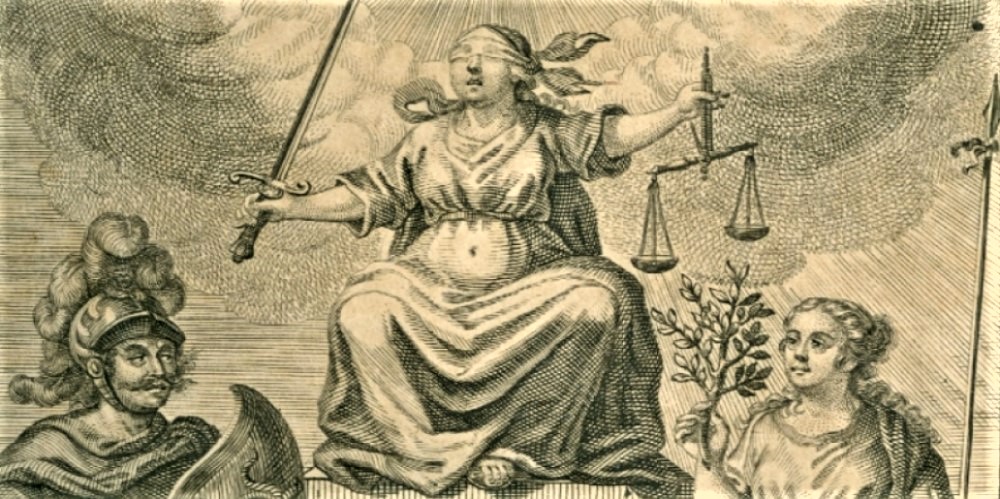
Many wrestled with this question in the past for good reason. The picture above is from a book by Hugo Grotius entitled, “On the Law of War and Peace.” In his book, he argued that international law should be based on natural law, which is derived from human reason. One of the assumed truths of natural law is the belief that moral principals and rights are inherent in human nature. These rights are believed to be revealed through human reason. You can probably guess the assumption natural law makes about the nature of man. Those who ascribe to natural law also embrace the “overlap thesis” which asserts that law and morality are intwined (they “overlap” each other) and indwell in us, and it is this indwelling that moves individuals to inherent acts of goodness. This “overlap thesis” has been a huge part of educational theory and therefore, it has become part of the fabric of life in the West. We depend on our reason for everything. We rarely do research, study the facts or take our time before making decisions these day, and it is because of the overlap thesis that we do this. We live as if we are morality and that our logic and reason are without flaws, and we can do that because we live in Wonderland where we are morality. We can only live this reality if life is about us. If we are concerned about others and seeking to live a life of honor and integrity, well, Wonderland becomes a nightmare.

When considering how we should live, there is an important question we must ask. What is the difference between good and evil? In our current discussion, this question seems to be fairly important, especially in regard to how we are to live. Are they relative? Is living for self with no concern for others an inherent act for good or for evil? If we live in our corner of the world and do not infringe on others, are we being evil or good? Depends on what you are doing, right? Can we say we are living for good when we our only concern is for ourselves? If we isolate and self protect, are those considered acts for good, even if to do both means infringing on someone else? These are all hard questions, and every one of them depends on what you consider to be good. If goodness is defined by you then the world is your oyster and there is little that would be defined as evil, but if you are a citizen and in community with others, then living your life just got more complicated because you must consider their views as much as your own. If you do that, then you are no longer in Wonderland.

Today, everyone is quick to judge others with little concern for others or even worse, little concern on whether their judgements are true. We tend to make everything personal and when we live in isolation (When I say isolation I mean either living by yourself or living in a small community where everyone holds the same absolute beliefs.), everything becomes personal, and the idea of truth becomes hard to find. What if we are wrong? What if our perception is false or there is another explanation? Can we know the intent of the heart or the motivation behind one’s actions? We cannot and yet we live as if we have that power because we are increasingly living lives that are isolated and self-centered. I don’t see a lot of self reflection, humility or accountability taking place in the world. Even when caught in a lie or in a wrong accusation, most will offer no admission of guilt, no apology and no path towards restoration. We need to only look at our own politicians for countless examples of this. For me, the issue comes back to truth. Do we care about what is true and right anymore or do we care only about ourselves?

Truth, commonly defined, is conformity to fact or reality, but what if we are our own reality? The more isolated we become, the more truth becomes relative. How can we determine what is true and right without community? I don’t think we can and in our current state, I don’t think we can expect to move closer to truth, especially when we live in Wonderland. Everywhere we look community is breaking down, which, in turn, breaks down life the way it is meant to be lived. It is community that holds us accountable and teaches us right from wrong. It is the older who teach the younger about truth through experience in community, which brings us back to the question, how are we to live?

I close with this. Dark and light are not opposites. Dark is the absence of light. I think good and evil are the same. Evil is the absence of good, but what if we are the good? Can there be evil in Wonderland? I don’t think there can, which is our problem. Today, most believe man is inherently good and evil is an after thought, but a look at culture will immediately question that thinking. Can we find truth by ourselves? Can our actions always be good if we are the judge and jury? Speaking only for myself, an emphatic no! However, I think the question, “how am I to live” is a good place to start. If you are asking yourself that question, then, I think you are stepping on the right path. If you are not, then maybe you should get off your current path. Living in Wonderland is a great thing until you become tired of yourself, and we all eventually grow weary of even ourselves. We were created to be in community! Blessings!

A Deep Dive into Artificial Intelligence

A Deep Dive into Artificial Intelligence:

What is Artificial Intelligence (AI)? According to NASA, AI “refers to computer systems that can perform complex tasks normally done by human-reason, decision making, creating, etc.” NASA states that there is “no single, simple definition” regarding AI and that is because it is changing and growing constantly. 

As I speak with people on the topic, I tend to receive two responses: one of fear and one of reckless abandonment. There are those who are extremely concerned about AI and what it will do to us as human beings. Then, there are those who can’t wait to open Pandora’s Box and see all the wonderful benefits waiting to be used. 

In the little research I have done about AI, I have discovered that, in general, there are three fundamental components of all AI Systems. There is Data, which is how a system learns and makes decisions. Without large quantities of data, there are no decisions. There are Algorithms. These are sets of rules systems use to process these large quantities of data. Then, there is Computing Power. AI systems need computing resources to process these large quantities of data through their complex algorithms. As you can imagine, there are needs for large quantities of power to run these AI systems.

As far as the history of AI, the groundwork for the idea began in the early 1900s, but the largest advances are recent. Alan Turing began exploring artificial networks in the 1950s; he published a paper entitled, Computer Machinery and Intelligence, in which he proposed a test of machine intelligence. He called this test the Imitation Game, which eventually became the Turing Test. This was a watershed moment as AL technology began to develop rapidly after this point.

Computer development began with increasing processing speeds in the 70s and 80s, producing faster, cheaper more accessible computers. During this time, the very first AI language was created, but computers were still too weak to demonstrate any kind of intelligence. The 80s were a time of growth and of increased interest in AI, and this was due, in part, to breakthroughs in research, which increased funding opportunities. The 90s produced the first functioning AI systems: the first AI to defeat a world champion chess player, AI robots, AI self-cleaning vacuums, and AI speech recognition software. In the late 1990s and 2000s, there were significant advances in AI. Automation and machine learning were used to solve problems in academia as well as in the real world, which brings us today.

There are AI systems all around us and their use continues to increase daily. Ai is used in law, medicine, education, engineering, science and more. There are enormous benefits to its use. It can solve problems and diagnosis diseases, but like anything else, with the benefits come the detriments. There are detriments, even though I have spoken to several who see none. I have my own concerns, but for today I will just address one: entropy. 

AI systems are created with entropy in mind, but it is the entropy found in thermodynamics. The second law of thermodynamics states that the entropy of an isolated system can only increase or remain constant; it never decreases. As great as AI is, it is still a created system, and it still must deal with entropy. I tend to look at entropy and its relationship with AI from the perspective of physics, which indicates that the tendency of systems is to move towards a greater state of disorder and randomness and not away from it. If I am right to look at entropy’s relationship with AI this way, what does it say about AI’s future? Is it endless? Is it immune from entropy? 

As AI becomes more a part of its own data, and by data, I mean that content which it creates that is added to the data to which it has access, what will happen to its state of entropy? Will it decrease or increase? I believe it will most certainly increase. I do see, in the distant future, an ancestral relationship with its data when its data base moves past a 50% bifurcation point. What I mean by this is that at some point in the future I see AI creating so much data that become part of the data base ( the internet) that it begins to use its own created data to make decisions. Will this matter?

I do think this will matter. What will it do to its ability to think and reason? Here is a harder question, will it be too late? What I mean by that question is will it be too late for us at this future date due to our conditioning and dependence on AI systems? If, at a future date, this ancestral state of entropy is reached and it results in AI systems suddenly providing some false information or some untrue truth, will we be able to recognize this information as false or will we be too far gone? There are hard questions not being discussed regarding AI that need to be discussed. Will we take the time to discuss them or are we too in a hurry to usher in AI as the solution to all our problems. When that day comes, AI will be the least of our worries. Until next time …  

Deconstructing Deconstructivism: Part IV

Deconstructing Deconstructivism: Part IV

            We have examined deconstructivism, but there is one question that remains: how are we to respond to it? I would suggest that any response begins by, first, coming to an understanding of instability as it is defined by deconstructivism. There are questions that come with any speculation of instability as an organic state of language. What if its organic state was, instead, something else? What if instability was merely the tension of determination? Derrida provided some support for this type thinking when he referred to the openness of instability as “aporia,” describing it as a puzzle or quandary (Jackson & Massei, 2012). What if “aporia” was that which was imposed over meaning by deconstructivism? Nothing is for certain and should not be thought of in those terms.  

Let’s begin this post, instead, with some hard truth; instability is a part of life, but it is a part of life we fight against. No one wants to be unstable, even when it comes to language. We seek clarity not confusion, especially in our communication. What do we do with confusion? We look for ways to clarify it and eliminate it, and yet deconstructivism seems, to me, to seek to keep it. I see it seeking to be the means of clarity. Do I dare go further? I think it goes beyond clarity and seeks to be “the” means of meaning. What other purpose would it have for keeping instability alive, especially in language? Let’s back up a bit and look at what instability does, if left on its own. Simply, it destroys stability. As we have studied deconstructivism, we have referenced its interaction with norms. Instability undermines stability, especially when it comes to stable norms. Derrida advocated that an important part of the process of deconstructivism was to keep asking questions, which is a theoretical device used to keep meaning and language from falling into a sameness, which is never seen as a critical tool of analysis or as positive. Sameness is never welcomed in critical analysis and always viewed with suspicion and as bias. 

Derrida saw both language and thought as living in what he called binary opposition, which he suggested was a confirmation of the instability of language. He saw language relying on opposing concepts like good/evil, true/false and happy/sad to sustain itself. He did not see these as part of the natural state of language but as constructions imposed on meaning and language by human beings. What is language if not a tool of communication for human beings? I do not see language as entity unto itself; I see it strictly as a tool used by human beings to communicate. In my reading of Derrida, I did not get the sense that he saw language in the same light as I see it. He saw these binary oppositions as existing within a dangerous possibility: that one term would be given the privileged status over the other term, thus affecting the natural state and balance of language. He claimed that this privileged status (one term over the other) prevented meaning from “disseminating out beyond its initial intended meaning” in multiple directions, which assumes language is not a tool but an entity unto itself. One question I have regarding binary oppositions is this one: do they not define each other? Is not dark the absence of light? Is not false the answer that is not the right answer? What is the alternative if these binary oppositions are removed? I don’t see them as constructions of human beings but instead, as observations of human beings. Human beings did not create dark or truth or even good. They observed its presence or its absence through, in many cases, its binary opposite.

When it comes to communication, I do not seek to protect two binary opposed meanings, at least not when I am seeking to be clear in my communication. Communication, for me, is determining shared meaning for the purposes of effective and clear communication. It is understanding meaning and embracing the same meaning. Did Derrida see language impacted by context or was he afraid of the impact of context? I am not sure. Derrida claimed to have seen language and thought as indecideable (his word), a term he used to describe meaning as having no clear resolution, which, from my perspective, leaves language in one place … in a state of confusion, which could also be referenced as instability. Is this what he saw or is this what he needed language to be for deconstructivism to grow and thrive? How we see and respond to deconstructivism will do one of two things: it will either feed it or starve it and kill it. 

Deconstructivism if often referenced with terms like unpacking, destabilizing and undermining in regard to its interaction with norms, which it would define those that are stable as assumptions, as binaries and as privileged. These are intentionally negative terms designed, in my opinion, for them to be unpacked or destabilized. But, again, what if the theory of deconstructivism is wrong when it comes to norms? What if instability is not a natural state but instead, one created for the purposes of destabilizing those norms that are stable? If this is the case, then we would need to confirm through a dialectic method whether deconstructivism is viable or not. When it comes to literary theory, deconstructivism operates in literary theory by encouraging us to read literature closely but with skepticism, questioning binary oppositions, resisting final interpretations and embracing ambiguity. When we put all these words together—skepticism, questioning, resisting and ambiguity—what do we get? These words encourage doubt, challenge authority and embrace uncertainty, which could be summed up in one word, instability. The question then becomes does deconstructivism identify instability or produce it? 

Considering this question, I think we must, first, understand deconstructivism for what it is. I am not advocating that it produces instability, but I am say that there does exist a possibility that it does. Therefore, we cannot assume that it does, nor can we assume that it does not. It is important to understand that any disagreement with its principles—its skepticism of fixed meanings, rejection of absolute truth and tendency towards destabilizing established frameworks—if not done critically and constructively will be engaging it in the very manner being criticized and result in confusion or ambiguity, which is exactly what deconstructivism wants and, in many ways, needs. In this series, I have tried to provide a picture of this theoretical position from different angles for the purpose of understanding. Ignorance is offering criticism of that which we do not understand without understanding; analysis is offering constructing critical analysis in a thoughtful, respectful and knowledgeable manner. Back to our question, how do we respond to deconstructivism?

Let’s begin by seeking to understand what we believe and subjecting our own beliefs to the same analysis to confirm whether our beliefs are true or not. So many of us are unwilling to do that but must be willing to do that if we are seeking truth. We must, next, understand that our perceptions, as right and as true as they feel, are only our perceptions. They are not reality or even true, at times. Sometimes they are true and other times they are not. Most of the time they are built and re-enforced by someone else’s perceptions, which should be analyzed as well. For example, I have been advocating in this series in subtle ways that one of the weaknesses of deconstructivism is its lack of focus on the pragmatic reality of communication. To communicate, we need “shared linguistic and cultural frameworks,” and my example of that is language. English speakers do not communicate well in other parts of the world if they are monolingual or unwilling to engage in the language of the region in some way. If they expect everyone to speak English and have a very superficial view of communication, then they will struggle to communicate because they are allowed instability to reign and seek no action to clarify. There are other aspects of communication like culture, attitude, countenance and a willingness to engage and communicate. If none of these are engaged, communication will be lacking and remain ambiguous and confused. That sounds nothing like the state of communication needed to effectively communicate, and yet, that is a practical example, albeit simple, of deconstructivism at its simplest level.   

As we engage deconstructivism, and you will engage it, it will be helpful to you to recognize it. How will you do that? Let’s start with its tendency to blur all distinctions. Not only will it seek to destabilize stable norms, but it will blur clear distinctions which tend to lead to relativism, which is another sign of the presence of deconstructivism. Where do we see this? Right now, the most prominent place we are seeing this is in the blurring of the genders, male and female. This is clear indication of the presence and the impact of deconstructivism, but it is also an opportunity to address deconstructivism’s weakness when it comes to practicality and real-world applications. While there is a blurring of the genders (per deconstructivism) there is not a blurring of the product of this burring, which is contradictory and an opportunity to determine its validity that we need not miss. Again, our response depends on our ability to identify the presence and impact of deconstructivism and then respond respectfully and lovingly to it inside its own theoretical methodology. This means we must understand it, something most of us are unwilling to do. It is helpful and intelligent to read and study both sides of an issue. As difficult as this is to do, to really understand and respond well, we must do this. Another tendency of deconstructivism is its push towards ambiguity, which is not applicable in several vocational situations, especially in areas like medicine and engineering. We should not blindly and emotionally reject deconstructivism outright because of these two examples but use them by applying them back on top of deconstructivism as a means of pointing out weaknesses, gaps and breakdowns and asking questions.

Deconstructivism is a critical theory that is used in academics effectively in micro-situations, but its struggles, like most academic theory, begin when it is applied in culture in real-world macro-situations or used to push an agenda and change behavior. Any theory, good or bad, if applied in similar situations, will produce similar results. We should respond as civilized respectful human beings with a critical eye towards its application in wrong settings to learn more about it and use it to pursue truth. In the right settings, it is effective in rooting out bad theory and paving the way for good theory, but in the wrong settings, it quickly becomes a hammer akin to propaganda used by those with malicious intent to inflict their ideas on others via power, and that is not considered ethical nor critical analysis.  This concludes this series on deconstructivism. I hope you enjoyed it. Until next time …     

Derrida, Jacques. (1988). “Derrida and difference.” (David Wood & Robert Bernaconi, Trans.). Evanston, IL: Northwestern University Press. (Original work published 1982).

Epistemology: Knowledge, Understanding or Both

Epistemology: Knowledge, Understanding or Both

Have you ever said, “I do not understand?” I am sure you have, but have you ever thought about what it means to understand? It seems so basic a concept that everyone should understand what it means to understand, but do we? Do we understand in the same way as we used to understand? Is understanding someone the same as understanding something? This post explores understanding through the lens of philosophy.  

It is fascinating to read that this concept of understanding, in philosophy, has been “sometimes prominent, sometimes neglected and sometimes viewed with suspicion,” as referenced in the Stanford Encyclopedia of Philosophy (SEP), which was my main resource for this post (Grimm, 2024). As it turns out, understanding, or as it is known in philosophical circles, epistemology, differs depending on time frame. Who knew? 

Let me start with the word “epistemology,” which was formed from the Greek word episteme, which, for centuries, was translated as knowledge, but in the last several decades “a case has been made that ‘understanding’ is the better translation” (Grimm, 2024). This is due, in part, to a change in the semantics of the word “knowledge.” That change was prompted by a shift towards observation as the primary means of obtaining knowledge, which is not so much a change in understanding as it is in the semantics of knowledge. But, should that change how we define understanding?

The SEP references theorist Julia Annas, who notes that “episteme [is] a systematic understanding of things” as opposed to merely being in possession of various bits of truth. We can know (knowledge) what molecular biology is, but that does not mean that we understand molecular biology. There is a clear difference between knowing something and understanding something, or at least there used to be. Both Plato and Aristotle, according to the SEP, considered “episteme” as an “exceptionally high-grade epistemic accomplishment”. They both viewed episteme as both knowing and understanding. The Greeks and most of the Ancients valued this dual idea of understanding and yet, according to the SEP, subtle changes in the semantics of the word took place over time, moving the semantics of episteme from knowing and understanding to just knowing, which, in my opinion, allowed observation a more prominent role regarding understanding. The question is, did observation improve our understanding of understanding? 

There are many theories on why this shift in the semantics of understanding occurred, but it did occur. My concerns do not center on the “why”, but instead, they center on the impact of this shift on present understanding. The idea of understanding went through a period in the past where its overall importance diminished and was replaced by the idea of theorizing, which is not understanding but speculation. According to the SEP, theorists throughout history have proposed various theories about understanding, and most theories did two things: they pulled us away from the original idea of understanding and pushed us towards a focus on self. It was self that was understanding’s biggest threat in the past and it is self that continues to be its biggest threat presently.

When I read that understanding was neglected in the past, I struggled to make sense of why it was neglected. Who would not want to understand? It was only when I understood that, at the time, understanding was thought to be primarily subjective and psychological, with a focus more on an understanding that was familiar, that it made more sense to me.  Familiarity is the idea of being closely acquainted with something or someone. Regarding familiarity’s impact on understanding, it pushed it towards self and away from the dual idea of knowledge and understanding. This push mutated understanding into what equates to an opinion, making it foundationally subjective, that is, until it bumped into science. In the world of science, understanding, or as it is often referenced, epistemology, was forced to move away from subjectivity and towards objectivity to interact with positivism, which was foundationally dominate in science until recently. 

According to the SEP, the notion of a subjective understanding inside epistemology was, rightfully, downplayed in the philosophy of science due, in part, to the efforts of Carl Hempel (Grimm, 2024). Hempel and others were suspicious of this “subjective sense” of understanding and its interaction with science. According to Hempel, “the goodness of an explanation” had, at best, a weak connection to understanding, especially regarding real understanding. Hempel’s point was that a good explanation might produce understanding but then again, it might not but it would still be familiar and seem like understanding. That was not objective, which was needed in science. The work of Henk de Regt made a distinction between the feeling of understanding and real understanding. He argued that “the feeling is neither necessary nor sufficient for genuine understanding.” His point, which seems straightforward, was that real understanding had little to do with feeling. Feeling is not scientific nor is it objective. It is always rooted in self, which is not understanding. 

Understanding is thought to be a deep knowledge of how things work and an ability to communicate that knowledge to others. This presented a question: what is real understanding? According to the SEP, there are multiple positions regarding this one question. It is interesting to note the presence of “luck” in positions of understanding, with one position asserting understanding as akin to full blown luck (the fully externally lucky position). This is where I defer from the SEP and dismiss the idea of luck altogether. These positions assert, in subtle ways, understanding as a pragmatic product-oriented method; all that seems to matter is that you understand, which, by all indications, would not be true for true understanding. True understanding is being able to explain to others in detail the understanding you understand. The fully external lucky position is rather pragmatic and contrary to this idea of understanding. It seems to stop at one’s understanding and does not consider that to truly understand, one must be able to pass on the understanding one understands to another. 

The contrasting position argues that one needs to understand in the “right fashion” in the right manner to understand again, and for me, the word “again” is key. In other words, understanding, to be considered as understanding, always needs to be replicated in a way that can be communicated to others so that they understand, and to do that one must understand the process every time and not just one time. The first position, for me, violates the duality of understanding and knowledge. This is important because, for me, it is the duality that completes understanding. To understand a concept, one must know what the concept is and understand how it works. The first position, the fully externally lucky position, blends knowledge and understanding into something that loses the semantics of both, pushing understanding into a pragmatic area where understanding becomes almost tangible, discounting the process in favor of it as product. This is not understanding but a lower form of knowledge. True understanding is always a process that explains how the product became, how the product works and how the products is applied. 

There are those who argue that understanding does tolerate “certain kinds of luck.” These philosophers hold positions that understanding can be “partly externally lucky.” Is it me or does luck have no place in understanding? If luck has any place in understanding, then that understanding is not understanding but a stumbled upon form of knowledge. No one stumbles onto a medical degree nor the knowledge needed for it. Most would not equate this as the proper application of their position, but understanding builds on itself, and if it does that, then, this application is not as stretched as it would seem. I believe the idea of understanding goes beyond the discussion in this post. It is an esteemed element of our humanity. It is who we are as human beings, and a large part of what makes us a human being.  

There are those—and the number grows daily—who no longer value understanding nor want to spend energy doing it. They consider it an antiquated process and no longer needed because we have technology, specifically, we have AI to do all our understanding for us, right? But do we? Does AI help us understand or does it only provide explanations? Are explanations understanding or are they something else? I believe understanding is distinctly human. I believe it is how we interact and build community. Maybe we don’t need to understand chemistry (I think there will always be a need to understand chemistry and everything else.), but we will always need to understand each other because we all are different. 

If we no longer strive to understand the things that we do not know, how will we ever understand anything or anyone? Will we even want to understand in the future if we no longer seek to understand in the present? Will we become conditioned to enjoy being isolated and introverted? That seems sad and not human. This idea of understanding is much more complex than most realize. The issue is not just one of episteme but one of humanity, at least to me it is. Think long and hard about understanding because once you lose it recovering it will not be easy. Thanks for reading! Until next time …   

Grimm, Stephen, “Understanding”, The Stanford Encyclopedia of Philosophy(Winter 2024 Edition), Edward N. Zalta & Uri Nodelman (eds.), URL = <https://plato.stanford.edu/archives/win2024/entries/understanding/&gt;.

How Do We Know What Is Real?

How do we know what is real?

I took a trip back to where I was raised to visit family and friends. It was a wonderful trip but quick and too short, but that is sometimes life. It was good for my soul and even better for my mind. I loved all the conversations I had. I loved listening to how others arrived at their own points of view. Some of us still hold the same values and have adapted to life in some of the same ways. Others hold different values and have adapted to life in different ways. Why? One of the subjects that came up was reality and how many different versions of reality are out there now. As I was driving back home, a question came into my mind—how do we know what is real? —and I could not shake it. 

My standard practice when I get one of these questions is to go poking around those people I respect, read or follow and see what they think. In my latest search, I stumbled upon a reference to an article with an interesting title, so I looked it up and read it. The article was in Psychology Today, which, for me, is not one of my usual references, but the title was too inviting. The article, “How Do We Know What Is Real?” By Ralph Lewis, M.D., was well worth my time and maybe worth yours too. Before I get into the article, let me set some foundational timbers for this post.   

First, let’s be clear; we experience the world through our five senses; that is given. Second, it is best to experience the world with all five of our senses. Most agree on that point as well. It is the way most of us live and we give it little thought. We just do it. Point three: Most theorists would call this experience subjective and question its reliability, but Lewis points out that “subjective perception” is still a crucial source of data for almost everyone. We rely on it every day as we live our lives. Consider science, even its practices and methods incorporate senses, i.e., observation, which is technically considered subjective and yet still a foundationally part of the scientific method. Dr. Lewis writes, “Science is just a method to minimize the distorting effects of our perceptions and intuitions and to approximate a more objective view of reality.” This is intuition and it is and should be greatly valued. You use it and so do I. It is the primary focus of this post. Most professionals use it. They depend on their own “trained” intuition to do their job. Doctors, financial advisors, plumbers, teachers, engineers and many others, all use trained intuition to excel in their vocations. 

But here is the issue I want to focus on; trained intuition is not universal absolute truth nor is it reality. It is a form of discernment that allows us to problem solve. It is assumption and inference developed through our education and training that works with who we are to solve issues. It is also based on our ideology which is a composite of our beliefs and values. This makes it uniquely ours, and it tends to work only for us. But this means that we often see our intuition and as reality. In some respects, it is, but it is not ultimate reality for us. The more success we experience the more egocentric we become, and this puts us in a position to think our reality is everyone’s reality. It never is. Your doctor may have an intuition about why you are sick, but that is the result of his or her interaction with you and your issue. At best, it is a temporary situational reality that works for your current situation, but that is as far as it can go. As Lewis states, “But it [intuition] can be completely off base” and lead even experts astray.” Lewis continues, “We have to be aware that our intuitions and firmly held assumptions may be completely wrong.” This leads me to a question. Where does intuition lie? The answer is the brain. 

The brain is a “well-honed but imperfect virtual reality machine,” according to Lewis. We don’t have a brain; we are a brain. Our brains produce subjective perceptions which are representations of our external world—our very own form of virtual reality. According to Lewis, we can be confident that most of the time these subjective perceptions that our brains produce are faithful representations of our actual external world. Social cues are just one example of our brains making a subjective perception. In most instances, we are right, but I think we have all experienced a time or two when we were wrong. 

Our brains, according to Lewis, rely on patterns, approximations, assumptions and best guesses. Our brains often take shortcuts, fill gaps and make predictions and all of these things are based upon our intuition which flows from those subjective perceptions. Lewis is clear; subjective perceptions are real, but they are not what they seem, even to those of us who own them. The brain is a “confederation of independent modules,” all working together. Lewis writes regarding this, “The vastly complex unconscious neuronal determinants that give rise to our choices and actions are unknowable to us.” 

The brain just works, and it works well due to the subjectivity of our experiences, but, as real as they seem, they are not reality for us, and they cannot be reality for us. The more successful we are the more our tendency will be to think that our reality is everyone else’s reality, which, again, is when we get in trouble. When we push our intuition as if it is reality, then we will think it is reality. When this happens, we merge our intuition with our existing ideology, and they become one. We will always find others who share and reinforce our ideology, then it is our ideology that becomes our reality. This tends to isolate us inside our ideology which becomes our ultimate reality. This is the Land of Oz and not reality at all. This is where real issues arise in the form of narcissism and nihilism.

Lewis goes into mystical experiences and hallucinatory or dissociative experiences to make his point. He posits that these experiences seem so real to those who have them that they believe that they have discovered a transcendental reality. They have not discovered an alternative reality. They have merely experienced the power of a chemical or drug or the power of suggestion. The brain thrives because of subjectivity, but that subjectivity makes it vulnerable to external influences like drugs and persuasion. We would be naive to assume that our subjective perception of the world was anything but that, and yet this is where many are today. There is no longer a concern about doing the right thing, working hard, having integrity, honor or even telling the truth. The only concern right now is for self … to be right. We are in a war of opinions, and everyone is armed with their own editorial comments. The battles wage because the winners get to declare what is true, until the next battle comes, and then, the cycle starts all over again. This is our world today and determining what is real is no longer determining what is true. Our elections have revealed that, have they not? How do we know what is real? I think the better question might be, do we care about what is real? Until we do, we will never determine what is real.

The Rise and Fall of Western Civilization: Part II

Part II: Western Civilization and Christianity

We, in the West, love our freedom, our liberty and all the choices afforded to us. We love free speech, the right to an education and class movement. We vote, are free to be critical and free to believe different things, if we choose. All of these “rights” are ours, at least we believe that they are ours. There is just one minor problem: these rights we claim as ours are found only in the West and nowhere else. They are not really ours but on loan to us from the West, which begs the question, why, then, is the West in decline?

I ended my last post suggesting a connection between Christianity and the West, and in this post, I am going to defend that suggestion. Whether you believe in its truths or not, and you are free to do both in the West, there is no denying the impact Christianity has made, not only on the West, but on the entire world. Many of the beliefs, the values and the traditions we hold dear came to us in the West and from the West, and most of those came to us, like it or not, from Christianity.  

When Christianity entered the world, it came into a world that was a mixture of Roman, Greek and Jew. There were three, Rome, Athens and Jerusalem, major civilizations in the world at the time, all trying to conquer each other, but it was Christianity, according to Gregg, that did the conquering. It made the Jewish God of Abraham available to both the Romans and the Greeks while also appropriating and transforming much of the Jewish thinking into a synthesis of reason and revelation. It was Christianity that changed the world by granting rights to those who had never had rights and introducing change that applied to all people. These ideas morphed into what is known as the West and “Western” thought today. According to Gregg, all of it came out of Judaism through Christianity. It was Christianity that introduced three major ideas that were new and radical; it was these three ideas that contributed to the development of this distinct “Western” culture and “Western” mindset. 

These three ideas were distinct to Christianity and, as we shall see, versions of them were foundational to Western Civilization. First, reason was viewed as divine, which suggested that the world was created by a Holy God and had order and purpose. Second, there was the idea that all human beings had reason and could employ it with assistance in redeemable ways to know truth, including the moral truth of a Holy God. And third, this Christian revolution started by Jesus Christ emphasized a new form of freedom that the world had never seen before. It was a freedom that unfettered all human beings from rulers and their power and provided them a means to a Holy God and to their own betterment. These three ideas changed the entire world and forms of them took root and became foundational to the West as we know it today. 

Those three Christian ideas that changed the world have morphed into three tenets of Western Civilization that we assume to be our own natural rights. They have become a bit distorted over time, but they are still very much alive and active today in the West. We assume they are distinct to the West and products of the West when their geneses are rooted in Christianity. We don’t’ think about them. They are ours, and we assume that they will always be ours because we possess them and have always possessed them. They are part of our normal, our worldview and our paideia if you will. These three ideas are distinct to Western Civilization, and yet they are even more distinct to Christianity, although they are better known by their Western nomenclature. What are they? Well, you will recognize them because they are you and me. These three ideas are three rights we take for granted and call our own; they are the right to an education, the right to a democratic way of life and the right to personal freedom. Each one came to us, not from the West, but from Christianity and along with a host of other “norms” now residing in the West.  

Those three ideas created a revolution of sorts that changed the entire world. They gave everyone power that had only been reserved for kings and queens of old. They put totalitarian regimes and those like them on notice, offering something else, a better form of government, and as much as we want to, we cannot ignore their connection to Christianity. It was Christianity that was affirmed as “the true philosophy” by Clement of Alexandria and lauded for its “integration of faith and reason.” It was Christianity that produced churches, hospitals and schools, including the university, which was founded for the training of the church’s clergy and for the pursuit of truth for the sake of truth. This one product (the university) was a statement on the change that Christianity brought to the world. You can find the university in almost every country in the world today and in its vision, you will find a pursuit of wisdom and knowledge. This educational pursuit was a pursuit that the world had never had the liberty, the ability nor the desire to pursue until this Christian revolution, and all of it was rooted in a belief and in a conviction that there is a Creator God who created a world of order that could be known. Today, our colleges and universities have all but forgotten this connection, but they owe their very existence to Christianity.  

There is wonderful book entitled, The Dying of the Light, that traces the origins of all colleges and universities in the United States. The striking point about this book is that almost every college or university in this country was originally the product of a denomination … the product of some form of Christianity. The Congregationalists, the Baptists, the Presbyterians, the Lutherans, and the Catholics … every denomination that created a colleges or university is in that book and almost every single college or university that was created in this country is in that book. The point not to miss is that these institutions of higher learning were created, in part, due to a mandate from a Holy God and a conviction that this God created a world of order that could be known and should be known, which prompted a curiosity and a desire to learn more about this God and the world he created. One author put it this way, “It [Christianity] launched an age that saw the world as characterized by order, that the human mind can comprehend and a world that merits study simply because it is the world of God.” So, when we talk about the West, in most instances, we are taking about Christianity and its impact on the world. 

It is the West that ushered in the study of science, mathematics and medicine. It is the West that employed democracy in real time and presented it as a better more copious option. It is the West that concerned itself with poverty, slavery and racism, albeit imperfectly. No other country, people group, religion or mindset offered anything close to what the West has offered to the world. It is the West that has taken its advances and advanced itself for better or worse, and while it has had its share of issues, indulgences and mistakes, it has still provided the world with so much. This is Western Civilization and the Western mindset all rolled up into this innocuous phrase we use without a second thought, and today, we find it close to death. Why? In my next post, I begin to examine its fall and death. Until then …  

The Rise and Fall of Western Civilization

Part I: The Development of the West

I recently read an article about the decline and fall of the West, which produced a single thought in my mind in response to this article … Are we living through what many are calling the decline of the West or has the West already fallen? These two questions produced more thoughts and prompted me to do a little reading on the subject. In several articles I read one book was referenced more than all others, The Study of History by Toynbee. It turns out that this is not just any book but, by most accounts, a masterpiece when it comes to Western Civilization. Let me explain why. 

Arnold Toynbee suggested in his book that the West was already in sharp decline. Why did he do this? The Study of History is a multi-volume study of civilization, in which Toynbee studied twenty-one different civilizations across the span of human existence and concluded that nineteen of those twenty-one collapsed when they reached the current moral state of the United States, but here was the shocking part for me: He first published The Study of History in 1931, and in 1931 he posited that the West was in sharp decline and was, according to him, “rotting from within.” Toynbee died in 1975, but I wonder what he would think of our culture today. Are we living in a culture rotting from within or is it already dead?

With this post, I begin a series on the West with the goal of answer the question, is the West in decline or has it already fallen? There are several other excellent books devoted to this topic. Oswald Spengler wrote The Decline of the West, Christopher Dawson wrote Religion and the Rise of Western Culture and Tom Holland wrote Dominion and each author grappled with the same concept regarding the decline of Western Culture. Is Western Culture dead or is it in decline? Let’s find out together. First, let’s explore how the West came to be.   

I begin with Samuel Gregg and his book, Reason, Faith and the Struggle for Western Civilization, which is also excellent when it comes to our topic. In his book, he offers his account of the West, which is like the others but also nuanced with some differences. Gregg argues that Western Civilization was conceived in a marriage of Jerusalem and Athens. His answer is like many others and yet he posits that Western Civilization was born through a marriage of “faith and philosophy” in a version of Christianity born in the West that embraced and applied both faith and reason as one. He sees this “one” coming out of ancient Judaism, which he suggests was a synthesis of both faith and reason as applied in the living of life in a new way. Life was no longer about survival, at least not in the West; there were advancements that made life better and allowed progressions in thought and religion. Gregg states that Judaismde-divinized nature” and was the first worldview/religion to completely reject the ancient idea that kings and rulers were divine and everyone else was to be under them. Judaism, unlike all other religions around it, offered the world a new king. Its rejection of the old idea was through a new view of the cosmos that was spiritually oriented. Judaism saw the cosmos as part of the created order of a universe created by a Holy God and because the universe was created by this Holy God it had order and intelligence and was not formless chaos as all others saw it. 

There was good, in time and space, and hope and all was not lost, according to Judaism, which was a much different narrative of the world than most other historical and religious narratives of the time. What Gregg was proposing was that in Judaism the Jews found a liberation of sorts of the cognitive from time and space. Judaism affirmed that there was a good God in heaven who was a Holy Creator God and that human beings were part of his created order, and not merely interchangeable parts of a larger machine. Human beings were seen as created in the image of this Creator God; they had purpose and were given responsibilities to live as moral beings in this created order. This was a radically different idea than all other ideas before it and what first makes Western Civilization unique. This was a vastly different worldview and would be distinctly western and a foundational mark of Western Civilization. 

The merging of Athens and Jerusalem cannot be underestimated as to its impact on Western Civilization and the Western mind, especially regarding our own current modern Western mindset in the United States. It is the United States that has been the pseudo-capital of Western Civilization for many years now, and it has been the United States that has served as the poster child of the West. The United States has impacted the West, including the Western mindset, more than most. And, now it is this mindset that has become compromised as referenced in part by Alan Bloom in his book, The Closing of the American Mind. It is the American mindset that was so free and so creative that now seems to be more vulnerable and more impacted than all others by the attacks against it. Bloom, in his book, attacks the moral relativism that he claimed was now in control of the colleges and universities. The very freedom brought to us by the West was the very thing being transformed before our eyes. Again, Bloom published his book in 1987, but he appeared to be saying some of the same things. The West, often seen through its colleges and universities, was in decline and dying back in 1987 according to Bloom.  

Back to Gregg, he references that Athens brought both contributions and obstacles to human thinking. It was Athens that was known for its skepticism, its irrationalities and its philosophies; most of them stood in stark contrast to the distinct and different worldview of Jerusalem (Judaism). So, how did they merge when all indications are that they should have clashed? The merging of Judaism and Greek thought, according to Gregg, predates Christianity, which is marked by the birth, death and resurrection of Jesus Christ. There can be no denying the impact of Jesus Christ on the world regardless of your belief about him. Prior to Jesus Christ, educated Jews were more than familiar with Greek thought and moved easily back and forth between Hellenistic and Jewish thinking. This was due to purely pragmatic reasons as the Romans controlled the world and therefore controlled thinking. The Romans were borrowers and refiners. They invented little of their own, but they borrowed from those they conquered and bettered what they borrowed. The Romans allowed those they conquered to keep certain elements of their own culture if they accepted the elements of the Roman culture considered important. It was the Jews who were different than all other cultures; it was the Jews who had this One God who refused to bow down to any other god. Both the Romans and the Greeks viewed the Jews as barbarians. Why? Ironically, it had little to do with their religion and more to do with their thinking and their disposition. The simple answer was that they were not Roman or Greek; the better answer would be to say that they were not Western prior to Christianity. So, there it is … a connection between Christianity and Western Civilization. In my next post, I will explore this connection, but until then …    

Critical Theory: Part VI

Critical Theory: Part VI

Critical Theory as the Norm

We have now come full circle to the point where the theory is to be normalized. As Horkheimer and others developed this theory, the initial intentions, I believe, were rooted in standardizing it in ways that positioned it to become “normalized” in culture. To do this positivism and interaction with it had to be addressed; it was, for all intents and purposes, foundational to almost everything … science, philosophy and even worldview. Horkheimer, in his essay, intentionally presented Critical Theory as if it had positivist intentions; he wrote, “In so far as this traditional conception of theory shows a tendency, it is towards a purely mathematical system of symbols. As elements of the theory, as components of the propositions and conclusions, there are ever fewer names of experimental objects and ever more numerous mathematical symbols.” While it appeared in this statement that Horkheimer embraced positivism, we learn later in his essay that he did not embrace positivism as it was, but as it needed to be for Critical Theory to assume its dominant position in culture. He saw the positivism that he encountered in much the same light as capitalism, as that which was “dominated by industrial production techniques,” or by the bourgeois, and as that which needed change.   

To combat the positivist dominance he encountered, Horkheimer, as I highlighted in an earlier post, destabilized traditional theory, which was foundational to positivism, allowing Critical Theory the needed space to surpass positivism. To do this, he believed that Critical Theory must be capable of doing two things: it must push traditional theory to view culture within a historical context, which I discussed at length earlier on why this was important, and its critique must incorporate all the social sciences. Horkheimer explained that a theory can only be considered “a true critical theory if it is explanatory, practical and normative,” but to do this required the presence of all social sciences in its foundation and its practice. His theory must explain social issues through practical means in responses that stay inside the parameters of the field addressed, much like traditional theory, but it also must speak to and address all of culture to change it. This was “critical” theory and Horkheimer and others created it to be much different than traditional theory. 

By offering a “critical” theory rooted in all social sciences that addressed a field while speaking to and addressing all of culture, Horkheimer presented a better and more improved theoretical option, but for whom? His “critical” theory was constructed to present Marxism as the norm and position it to assume the dominant positions of culture. Through his “critical” theory, he deconstructed “traditional” theory and its production for one reason; his perception was that traditional theory failed to address power and the status quo through the social sciences. Horkheimer presented Critical Theory as a theory that not only addressed power and the status quo but would use the former to deconstruct and the latter to fundamentally change the foundation of traditional theory, creating the means for Critical Theory to engage and transform culture.  

Traditional theory has long been confined to the field it served, and it worked best inside the parameters of that specific field because its goals were confirming true propositions within specific fields. Critical Theory, while technically not part of science, was built to interact aggressively with all fields, including science, for greater purposes. Its interests extended beyond specific fields and into culture itself, positioning itself as dominant over all fields for the purpose of changing culture and the norms of it. Critical Theory was to interact with all of culture through power structures where it assumed the dominant position. Its goals were not confined to one experiment or one field; instead, they were much larger and more broad, purposeful and directed at cultural transformation. 

Traditional theory had always focused on coherency and on the distinction between theory and praxis within intimate settings. It followed the Cogito in its view of knowledge, embracing the idea that knowledge was grounded in self-evident propositions, which Horkheimer used to introduce the idea of individual genius into the concept of traditional theory. Traditional theory typically explained facts through the application of universal truths or laws by subsumption that either confirmed or denied the truth proposition proposed. Horkheimer, as I discussed, posited that the “universal” part of the theoretical equation was rooted in the individual and not in the process, which rooted traditional theory in time and space, leaving it exposed. To confirm truth, traditional theory willingly partnered with positivism, rooting itself in an objective process, which had historically been considered the better option of confirming scientific investigative truth. Traditional theory would defend a scientific truth through empirical confirmation which embraced the idea of an objective world where knowledge was confirmed through empirical means, thought to be a mirror of reality. This view was not only rejected by Critical Theory but overrun and changed by it. 

Horkheimer and, for the most part, all the Frankfurt School, rejected the notion of the objectivity of knowledge due to its historical and social foundation, which, ironically, came courtesy of Horkheimer’s hand and was used later to normalize Critical Theory. Horkheimer wrote, “The facts which our senses present to us are socially performed in two ways: through the historical character of the object perceived and through the historical character of the perceiving organ.” In other words, Horkheimer, with this statement, was confirming that it was the individual genius of the observer that made traditional theory work, which positioned it in time and space, allowing it to be overrun by the “better” and more dominant Critical Theory. Traditional theory, with its roots in an objective view of knowledge, was now susceptible to Critical Theory because of its objectivity, which was now grounded in the time and space of the individual and not in the dialectic process of theory. This made traditional theory historical, which exposed its past dominance, making it as vulnerable to the criticisms of Marxism as everything else. Critical Theory, for Horkheimer, was that which would solve the issue of the “partiality” of the “culturally impacted” observer and of the past dominance of the oppressors; for Horkheimer, it was Critical Theory that would free individuals from what he saw as their entanglement in a social embedded perspective of interdependent oppression. 

Traditional theory, historically, had been evaluated through practical implications with no real practical consequences of significance outside its field; knowledge, as a mirror of reality, was more a “theoretically-oriented” tool than anything else, which clarified knowledge as a product and one that was objective. Critical theory was presented as “the” theory, void of any kind of bias towards knowledge that is objective; it presented itself as that which considered knowledge through functional relationships to ideologies and societal liberties. Considering this perception, knowledge becomes what Critical Theory needs it to be … societal critique, cultural action and subjective, directly impacted by the dominant and ultimately a means to transform reality. This is where we find ourselves today, living in a reality that is being transformed before our eyes. So, how do we recognize Critical Theory as we live each day?

Six Ways to Recognize Critical Theory:

Here are six ways to recognize Critical Theory in everyday life. First, Critical Theory views language as a social activity and as a vehicle of ideology so the adage, “sticks and stone may break my bones, but words will never hurt me” is wrong to Critical Theorists. Words will hurt you and are considered harmful to advocates of Critical Theory therefore, they need to be attacked and treated as acts, and those inside Critical Theory will treat them accordingly. Words will be attacked and treated as criminal acts. Second, there will be no rules associated with anything rooted in Critical Theory for one purpose; it is Critical Theory that is the ultimate authority, and it makes all the rules. If norms are being assessed and critiqued through Critical Theory, almost anything goes. Stealing, vandalism, rioting, and fighting are all justified if they are manifestations of the oppressed who are “rightfully” pushing back against their oppressors. Who are the oppressed? Well, they are anyone who has not been in a position of power in the past regardless of their personal efforts. Third, those critiquing and assessing generally have authority even if they have no experience in the area that they are critiquing and assessing. Their authority comes from believing and rooting themselves in Critical Theory, which is ultimately “the” authority over all fields and all theories. For example, a political philosopher critiquing a medical procedure with no formal medical training will have more authority than the medical professional due to the authority of Critical Theory. We can expect to see more of this if Critical Theory continues to rule. 

Continuing, fourth, there will generally be hypocrisy associated with any movement made under the authority of Critical Theory. For example, those condemning wealthy company CEOs and their high salaries who produce a product and provide viable employment to many will, with the same breath, embrace professional athletes and celebrities who are, in most cases, much wealthier than company CEOs but produce no product and contribute little to society other than entertainment. This phenomenon is a fascinating study waiting for someone to take the time to address it. Fifth, any movement in Critical Theory will trump tried and true established theories and truths in science, medicine or philosophy. It will be Critical Theory that pushes the agenda and the change in the field and not expertise or experience. We see this taking place in government, law and even medicine. And, finally, Critical Theory sees everything as embedded power structures existing in a binary world of oppressed and oppressors. Everyone is either looking to oppress or being oppressed. Everyone is either bias in some way or the victim of some sort of bias directed against them. Dominant norms that are good for society will be condemned, not on their merit or quality, but because they have existed in a dominant position for too long. Overall, we must remember that Critical Theory has as its foundation Marxism, and it will always have Marxist’s tendencies which identify it. Each of the examples I have presented have one thing in common: all of them are Marxist in nature. 

This is the world in which we live, and it is a Critical Theory world … for now! One thing I know, all things eventually come to an end. The Babylonians, The Roman Empire, the Greeks … all of them came to an end at some point and so too will Critical Theory. When that day comes, and the history for this movement is written what will it say?  

This concludes my series on Critical Theory. I could spend the next year on this one topic, but all things must come to an end; it is time to move on to something new. Thanks for reading and remember, thinking matters!     

Critical Theory: Part V

Critical Theory: Part V

The Deconstruction and Development of a Theory That Is Critical  

I have now arrived at the point where I will pull back the layers of development regarding Critical Theory. Theory, before Critical Theory, had, as part of its composite, elements that were analytically oriented towards analysis with a distinct dialectic tendency. With this dialectic tendency, theory was considered a well-substantiated explanation of an aspect of the natural world. It required fluidity with an analytical orientation which allowed theorists, especially those in science, to make predictions based upon it being testable under controlled conditions in experiments. In the case of philosophy, theories were evaluated through principles in abductive reasoning and pushed to withstand scrutiny; they were used to test a thesis though the development of an anti-thesis, which was thought to confirm whether the original thesis was true or false. This element of theory was, for Horkheimer, problematic as the dialectic was not only rooted in science but also a benefactor of positivist protection. It was perceived as a process that revealed true scientific tendencies through objective means (positivism). Horkheimer recognized that theory, left untouched, did not have roots or tendencies towards Marxism nor would it ever have any of those tendencies unless its foundational structure changed. 

Horkheimer began the deconstruction of general theory by making a connection between theory and society, which pulled a distinctly social element into the perception of theory. He established this connection through what he called the savant or the specialist. This was an important step in the deconstruction of theory; he wrote regarding the specialist, “Particular traits in the theoretical activity of the specialist are here elevated to the rank of universal categories of instances of the world-mind, the eternal Logos.” His point was to establish that it was the individual (a member of society) that was the universal when it came to the theoretical (theory) because, according to Horkheimer, the universal was not theoretical or dialectic; it was, instead, individual genius. It was this push towards individual genius that also established theory as historical. He explained that the decisive elements of theory were nothing more than those activities of society, which are “reduced” to the theoretical through the activities of individuals in society, and in the case of theory, the activities of a specialist or of individual genius were activities of society. This tied theory to the social through the individual (either as a specialist or through individual genius), and it was the individual that rooted theory in the historical through the time and space occupied by the individual.  

In his union of theory and the individual, Horkheimer created a bridge from the theoretical to the social via the individual through individual genius, but it was the specialist whose activity he labeled as “the power of creative origination.” This activity, to a Marxist, was production, which Horkheimer labeled “creative sovereignty of thought,” which reinforced that even the individual’s thoughts were social and historical. This effectively removed scientific theory from its privileged and protected positivist (objective truth) position and reduced it to a social action. This was a line in the sand for Horkheimer … a risk he was willing to take. The risk—attacking the legitimacy of all other theories grounded in the scientific through his new “critical theory—was well worth it for him. Coming out of World War II and the oppressive reign of the Nazi war machine, he believed people were open to this radical change he proposed, especially if it “appeared” to bring back the civil liberties and the freedoms they had lost. 

For Critical Theory to live beyond its inception, it would need the idea of theory (the theoretical) to be re-cast as a different perception with a different semantical interpretation, one that embraced Critical Theory without requiring Critical Theory to embrace old ideas of theory, change to them or be compromised by them as applied by science. This new theory Horkheimer proposed had to exist as dominant while bringing change to the theories it encountered in ways that pushed them towards tendencies that were critical and Marxist, and the only way to do this was for it (Critical Theory) to be authoritative. When encountering all other theories it had to be “the” critical theory in each interaction. From my perspective, I do not believe this could have happened at any other point in history; after World War II and the Nazi regime’s widespread oppression, Horkheimer saw an opportunity and took it.  

Horkheimer, to usher in this change, pushed the theoretical to the point of instability, which produced doubt, setting it up to be re-established as “the” critical theory to remove the doubt that was now there. Theory, for Horkheimer, was now where it needed to be; it was no longer theoretical in any protected sense but instead, it was a true means of production. Its perception was now more a social function or an individual decision than anything theoretical, which made it part of production, which he labeled as a “production of unity,” which reduced production to that of a product. Horkheimer never saw production as something that produces a product; he saw production only as a product of culture, manifesting in the same ways as other cultural products. For him, it had to be a means of production that could be controlled by Marxism. If production was no longer a process of “becoming,” then it would be open to “becoming” something new, something with Marxist tendencies, especially if it was firmly entrenched in the social and the historic. As a product that was social and historic, it would now be oriented towards individual tendencies (the savant or the specialist), opening it up to cultural changes and semantical shifts with distinctly Marxist orientations. 

As a product, the process of production was now categorical, easily manipulated and positioned to be re-formed in a different light. Horkheimer’s attack comes full circle, when he wrote, “In reality, the scientific calling is only one, non-independent element in the work of historical activity of man, but in such a philosophy the former replaces the latter.” Linking theory to history allowed it to be supple in much the same way history was, which positioned theory to be pliable … more open to revisions, changes and the influence of propaganda, which would allow it to be impacted by the orientations of scholars and theorists addressing it in much the same way history was addressed. This pliability that was now attached to scientific theory was no longer fluid in any natural sense but mechanical in every aspect of its movement. Its movements were intentional, which allowed it to be manipulated through the power functions of those overseeing it. It would become dependent on individuals and their interpretations, orientations and contexts and it would no longer be dialectic. This created space for Critical Theory to move into and take over the theoretical through the individual.  

As I read Horkheimer’s essay, his attack on the theoretical was on full display; he saw all dominant theories and philosophies, as well as those objects we perceive as natural—cities, towns, fields, and woods—as bearing the marks of man and shaped by man’s oppression. They were products of society to him, the means of production and in a perfect Marxist world, equally distributed to all and not left to the bourgeois to manage and control. He was clearly now viewing theory, through a distinctly Marxist lens, as social and historical. Theory was part of society and tainted in all the same ways; Horkheimer wrote regarding society, “The existence of society has either been founded directly on oppression or been the blind outcome of conflicting forces, but in any event not the result of conscious spontaneity on the part of free individuals.” This one statement about society was also to be applied to theory, prior to his deconstruction of it. He saw society as that which was built intentionally with ill intentions. He wrote regarding this thought, “As man reflectively records reality, he separates and rejoins pieces of it, and concentrates on some particulars while failing to notice others.” Those concepts of recording, separating and rejoining are conscious intentional actions impacted by the beliefs and values of those individuals determining the recorded, separated and rejoined. Horkheimer bemoaned the intentionality of society and saw its structure as intentionally created to give the bourgeois everything at the expense of everyone else, and yet he used it to deconstruct theory and recreate it as Critical Theory.  

What Horkheimer initiated so many years ago has come to fruition. Horkheimer has essentially replaced theory with a “critical” theory that is analytically and distinctly Marxist. He took the theoretical, and its dialectic orientation and replaced its praxis with a Marxist one. The authoritative nature of theory, which has been assumed, especially in science, to possess an objective ability to confirm what is true, has now been taken over by a Marxist orientation with intentions oriented towards Marxist truisms. It is Marxist tendencies that are now dominant inside theory. They have been reconfigured to analyze other non-Marxist theories in critical ways … to cast doubt on them until they are overrun by this new configured “critical” theory. In the end, they either submit to it or die. This is Critical Theory; it was created to be “the” critical theory of all theories and to leave Marxism in a dominant position in science and ultimately in society. This is where we find our world today … right where Horkheimer and his colleagues had hoped it would be. It is Critical Theory that drives the ideas in our colleges, pushes the bills in our government and changes the norms in our culture and every idea, bill and norm has tendencies that are critical and distinctly Marxist. As we look at our culture and ask, how did we get here? There is but one answer … Critical Theory! Stay tuned for the next installment of this series. Until then, remember, thinking does matter!   

Critical Theory: Part IV

Critical Theory: Part IV

The Creation of “Critical” Theory

In my last post, I suggested that Horkheimer, to create his new “theory” had to re-create the general idea of theory itself. I posited my own assertions, which, if I am honest, are based strictly on my reading of his essay and my own convictions formed from that reading, which is my attempt to stay inside the spirit of Critical Theory. I tried to limit my secondary sources and keep his essay front and center with little to no outside interference. Right or wrong, I am left with my own assertions; whether they are corroborated by others or even valid seems to me of little consequence considering what I have read so far in his essay. 

In a world of Critical Theory, one of the first impressions that came to me was this one: there are no rules. I need only to assert my ideas in persuasive sincere ways and that should be enough, but that is problem. It should never be enough; It should require more because, like it or not, they are my perceptions and those will always be based on me. It is the same with Marxists, Idealists and Pragmatists; beliefs and values always turn into perceptions. The important point is not to assert your perceptions as true but to determine whether your perceptions are true. Let’s jump right into this post with my own assertion.

My initial assertion regarding Horkheimer’s work on theory begins with this thought: to make it “critical” would require it be fully “critical” from all angels and for all situations. The only way I see this being accomplished is if Critical Theory becomes the dominant theory over all other theories. Regardless of the validity of my claim, to answer that question I must examine, in detail, his attack on theory, or the theoretical (I reference it at times this way to clarify it from the categorical or the practical), because whether right or wrong, it reads as an attack to me. My perception is impacted by his statements; for example, he wrote, “The traditional idea of theory is based on scientific activity as carried on within the division of labor at a particular stage in the latter’s development.” Here Horkheimer seemed to direct his attack against theory by linking traditional theory directly to the action of the individual engaged in the theory, and in doing so, he presented the idea that the scientific action of a theory was no different than any “other activities of a society.” What I believe he was positing was that the individual action of employing a theory was, in substance and essence, no different than the individual action of a teacher, a coach or any other person acting according to their own convictions as a member of society; they are all social actions, which, in a subtle way, places science in a position to be overrun by Marxism. 

I do not believe his point here was to destroy theory but, to keep it in a state of flux to be used for his purposes. I believe he meant to link current theory to the individual for the purposes of giving the individual power over the theoretical process, which ultimately was a connection to the means of production via the individual. Inside Marxism, the individual and their actions would always be considered a means of production. Regarding this, he wrote, “… the real social function of science is not made manifest; it speaks not of what theory means in human life, but only what it means in the isolated sphere in which for historical reasons it comes into existence.” In this one statement, he reinforced his reduction of science to that of a social function and presented it with Marxist tendencies: as a means of production. With no pressure to defend his assertion, he proceeded to “deconstruct” out the “positivist protection” that science enjoyed, which would always present it as true and never as a means of production.   

The result of this deconstruction was a reduction of the theoretical to a position where it would meet all the requirements to be a means of production, but he also does something else that was equally important. He plants into the discussion a subtle historical reference (“historical reasons”). This historical reference completes this reduction of science, from that of a theoretical process with positivist protection (my phrase) to one that was now an action resulting from an individual choice in time and space. This is important because, as a historical reference, the reduction of science was complete, He had moved it out of the theoretical realm and placed it firmly into the social realm, where it will be at the mercy of Marxism as a means of production.

Horkheimer next took aim at society, which he viewed from a distinctly Marxist perspective. He defined society, as “the result of all the work” of all sectors of production in culture. His negative view of capitalism stemmed from his belief that it was the bourgeois in a capitalist state who would be the ones benefitting from the labor of everyone in society, which, for him, was categorically unfair and oppressive. This categorical oppressiveness, for Horkheimer, even extended to all ideas and thoughts of a society. For Horkheimer the necessity of re-establishing the conception of theory in a Marxist tradition was priority one in his development of a new “critical” theory fully capable of competing against those theories already established and dominant. For it to have a chance it needed a cultural foundation that would welcome it and allow it to grow and to have that foundation, he would have to destroy the ideas of capitalism, which operated on ideas like supply and demand and Smith’s invisible hand, which would be almost impossible to control from a Marxist position. He would borrow the radical doubt of Descartes to accomplish this task.  

Horkheimer understood that every dominant theory, once doubted, would be less dominant and more vulnerable. For Critical Theory to take hold it had to be the critical lens used in analysis of all other theories and part of that critical analysis had to be doubt, which once used in analysis, by Critical Theory was left attached to the theory analyzed. Horkheimer’s goal was that one day Critical Theory would be the dominant worldview, but the current state of science, with its theoretical roots in qualitative and quantitative methodology, would destroy Critical Theory if it were not first destroyed. For Horkheimer, this was his motivation for his attack on the concept of theory. It was also why he used the radical doubt of Descartes in his critical analysis of theory to change it and then recreate it in the image of Critical Theory.

In his essay, Horkheimer dictated how theory was to be recreated semantically and culturally to reflect Marxist beliefs, and then he labeled this theory as “critical” and used it for critical analysis over all other theories. Horkheimer hoped to accomplish two tasks with his recreation of theory: he would eliminate the original idea of theory, which was a threat to Critical Theory, and recreated it in the image of Marxism. Second, he would use this recreated and reconstructed theory as vehicle to deliver Critical Theory in ways that would assert it as a worldview and as dominant. As we look out at our world, what do we see today? We see those dominant theories of the past willfully submitting to the whims and desires of Critical Theory. 

It is Critical Theory that has become the lens of critical analysis, leading the charge to canceling dominant theories of the past and open the cultural door for new theories to come rushing in and these theories connect with no other theories. They make no sense when it comes to science or even medicine and yet, the take hold, are defended and are profoundly impact culture. We need only to look back and ask a few questions. When it comes to Critical Theory, where is dialectic thought? What about the antithesis? We see those theories of the past cast into the darkness of doubt by the shadow of Critical Theory, and they either align with or, in some cases, are replaced by Critical Theory or they fade away and die.  

This is our world today. It is a world where Critical Theory has become more dominant than we even realize, and that is by design. My next post will explore how theory became “critical” theory, with the hope of educating all of us in ways that will help us identify Critical Theory and its impact. Until then …