
Part I: Semantics
I have had this question about education for some time. I thought it was a simple one, but I soon found that it was not. My problem—I wanted a simple answer. But there doesn’t appear to be one. Defining education is hard. I believe it is now harder than it ever has been. Why? Well, first, I believe modern education is a painted and soiled version of itself and second, I believe it has strayed so far from its true self that most of us have no idea what it is anymore. I see modern education buried under mounds of fads and trends. I have no real rational reason to make such a statement, but, just the same, the thought will not leave me.
The idea of education fascinates me. I still marvel at the process and recall with fondness my own educational experiences. I loved all my schooling and I have had a lot; some might say too much. I loved the small town two-room schoolhouse, my grammar and middle school experiences. I loved being bused to the large city high school, my high school experience, and of course, I loved my college experiences: who wouldn’t love those. The idea of high school has always fascinated me. Students, teachers, lockers, sports teams, class changes, hallways … the whole thing was an amazing experience for me. I saw it as its own little eco-system of which I was a part. I thought the process was as close to perfection as one could get. Then, I messed it all up and became a teacher. I went from the front of the curtain to the back of it and have never been the same. What I found behind the curtain smashed my rose-colored glasses into a thousand tiny pieces.
From my very first day as a teacher, I saw teaching as a craft and a practice; it was something to be honored and respected. I walked into that first class ready to change the world. I still remember my classroom: lots of space, large windows and a big teacher desk in the corner overlooking the student desks that sat under its shadow. That first day I learned a lot and every day after that one. I wanted to be better, and I wanted better for my students, so I read and studied. I talked to my fellow teachers. I talked with my administration. I observed those with more experience. I worked in different schools and in different roles and kept learning. As the years went by, things, both good and bad, happened to me. I woke up one morning and I realized something—this thing I was doing was not really education. It was something else.
What is this thing that I have dedicated the better part of my life to? If it’s not education, what is it? I can’t condemn it based on feelings, can I? That is not very educated of me, is it? Yet, that is what I am doing; I am acting on this sense that what I was doing was not really education but something else. It was, for me, two steps forward and two steps back. It was walking knee-deep in the mud and sense of lostness. No one cares about my opinion. No one even knows who I am. Why should I care? Well, I do. It matters to me. Should it matter to you? That is up to you, but you have experienced education in some of the same ways that I have. It has impacted who you are.
The adage I am using, painted and soiled, is a product of my time in education and the things I have seen over the years. I believe some of what has been piled on top of education over the years has been intentional (painted) and some of it organic (soiled). Some of it was good, but a lot of it was bad. What proof do I have to make such statements? Well, none; it is only speculation right now, but I want to find out more and that means something, even if it means something only to me. Someone once told me if you want to discover hard truth, you must be willing to go backwards. Sometimes going backwards is difficult, but speculation will reign if you never go backwards. When you do stop, turn around and go backwards, you will be on a different path. That is a start. It is also a form of freedom. The process of seeking, even if you never find anything, is freedom and worth every minute you spend on it, at least it is for me. So, let’s stop, turn around and begin the back peddling by exploring education’s etymology.
I found that this strange wonderful English word “education” is derived from two Latin words dating back to the middle of the 16th century, which is my first step backwards. The first of the two Latin words is educo, which is also found in the forms of educare, educavi and educatum. It is generally defined as “to bring up,” “to rear,” “to guide,” and “to direct.” These imply a process akin to the rearing of children either by a family or in a community. There are suggestions that this educo, as an action, has more in common with raising children than teaching children, which intimates that education, in the past, was broader and included values, beliefs and morality as part of its composite. This may surprise us, but it should not. This process was not confined to children; it was extended to adolescents and adults, especially when seeking and needing guidance, which, again, suggests something beyond subjects.
There is another idea that this Latin word conveys. While it does contrasts ideas of schooling, it also complements processes of schooling. As an idea, it is more analogous to a generation-to-generation cultural transfer of information akin to that which would be found in secluded civilizations where elders transfer their history to the next generation of leaders. This transfer is not of subjects but of beliefs, values and even traditions. It conveys a view of the world as true and right. This word, “educo,” implies an extension of learning into the broader culture and community. The use of “educo” does intimate a school setting, but, as I referenced earlier, it also intimates something beyond that setting. Its existence depends on its balanced relationship with all other learning, which is not limited to formal instruction. The implication is that learning is communal and cultural.
There is a second Latin word found in the English word of education, and that word is educere, which is the more common of the two. It is also found in the forms educo, educere, eduxi and eductum. It is defined in the following ways: “to draw out,” “to lead out,” “to raise up,” “to bring up” and “to rear a child.” From this word, we draw closer to current semantics associated with education; one author referenced that educere presented education as “a slow and skillful process of extracting the latent potentialities of comprehension and dedication, in contradistinction with indoctrination,” which is akin to a process of teaching students a core body of knowledge. Sound familiar? This word does push back on the idea of education as indoctrination, instead, embracing the educational ideal of freedom of selection. But there is a difference. Freedom, in educere, is presented as part of the process of education; whereas today, freedom is presented and perceived as a product of education.
When both Latin words come together to form the word, education, ideas of nourishing or rearing are more pronounced than ideas of teaching, but both are there. There is the presence of instruction, but it is systemic to the process and coupled with the idea of rearing or raising. Several authors referenced that the English word education could refer to both the process of training and the product or results of training, which has more to do with 16th century semantics than 21st century ones. The Latin also suggests that this idea of education is less formal instruction, more rearing and raising and more intimate. It is something beyond a teacher, a classroom or even subjects; it is something more relational and more familial. This paints a different picture than the education we have today, and yet, it is still not clear to me.
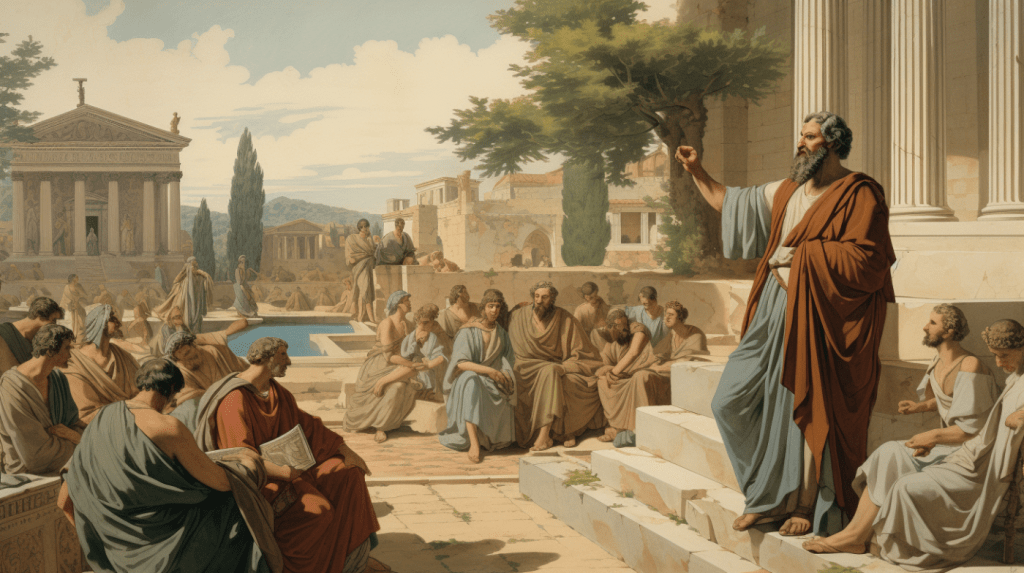
The etymology does go back to the 1500s and the Latin word educationem, which was defined as “upbringing or training.” It was this word that was the source of the Middle French word for education that gave rise to our English word, which entered the English language around 1530. This pulls us closer to the origins of education, but the picture is still murky. We need to go back farther, back to the Greeks, to Aristotle, and to 300 BC. Will that be far enough back? Only time will tell. Until next time …
Discover more from Bridge Roe: Where Thinking Matters
Subscribe to get the latest posts sent to your email.
 Bridge Roe: Where Thinking Matters