
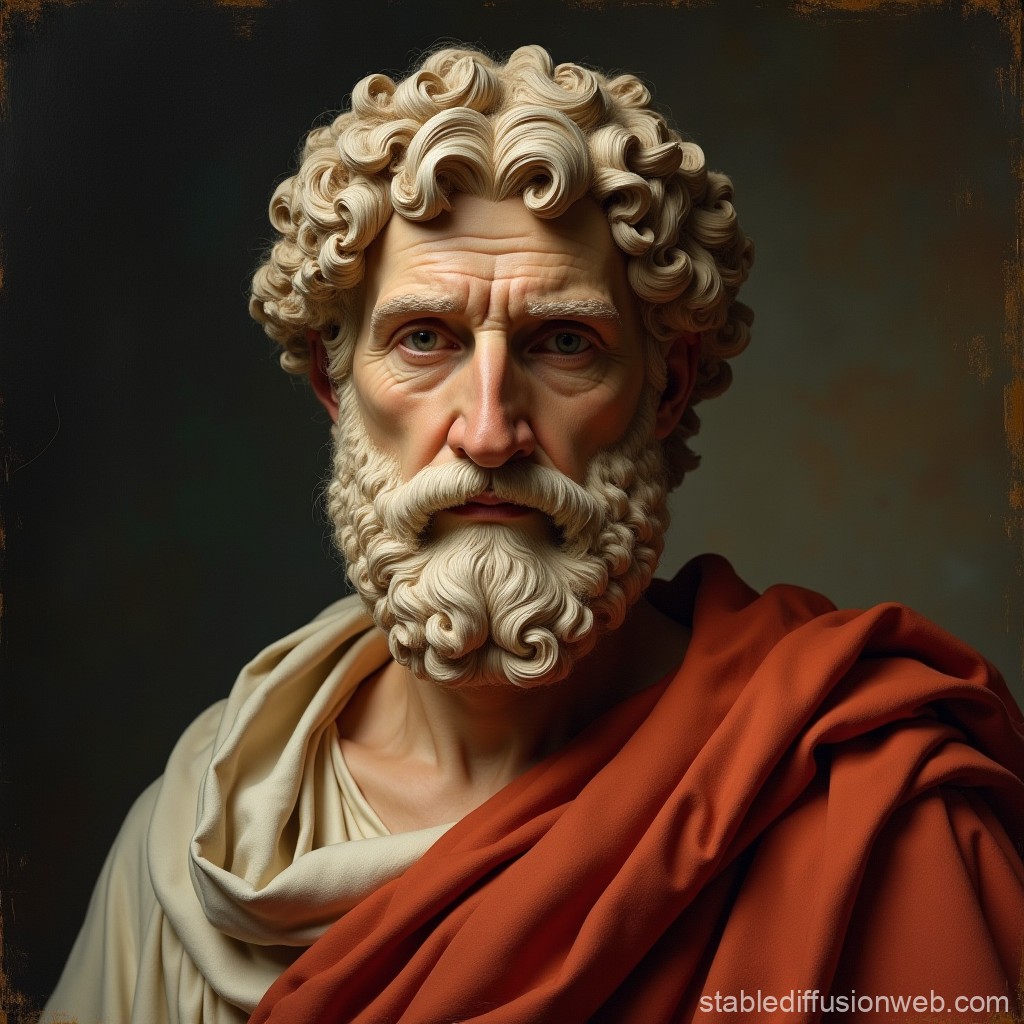
A Portrait of Aristotle
Part III: Aristotle’s Nicomachean Ethics
In his Nicomachean Ethics, Aristotle presented four principles that I believe clarify his thoughts on education and provide more information in my quest to discover what education truly is. It was Aristotle’s belief that through these four principles human beings think and learn and would think and learn “all the more.” A picture of what education is supposed to be is beginning to form. Let’s get started.
The first principle he called Anamnesis, which loosely translated means reminiscence or recollection. In the Greek, it is literally “a calling to mind.” As a concept, it suggested that we acquire knowledge externally, but we also have it inherently within us. Both were important and both were meant to interact with each other. Therefore, processes of introspection and reflection were considered important as both were manifestations of this interaction. These processes today are considered higher ordered thinking, but to Aristotle, they were foundational and necessary to all learning. Anamnesis, for Aristotle, was many things but it was primarily for the sake of remembering; he also thought it had secondary uses, as also that which facilitated, perceived, imagined, thought and understood. The proper aim of Anamnesis was the establishment of a truthful relationship between the representation (present) and the represented (past) through the interaction of the external and the internal leading to “the” truth.
The second principle was termed Experience, which was thought, by Aristotle, to be required for understanding. A person with experience was one who had acquired external knowledge through interaction over time with one’s environment. It was one who engaged in the education for life. Experience was also that which developed coping skills, an appropriate attitude and a sense of the situation. Experience, to Aristotle, was not a knowledge of universals that could be memorized and applied but instead it was a knowledge of particulars, specifics, much like theories or axioms, regarding the way the world work. Aristotle saw culture and the environment through a lens of particulars and not universals, which speaks to his views on both. Experience, for Aristotle, took the form of the recognitional and the practical. It was not one over the other; it was both. He saw experience as compatible with general facts and was clear; understanding cannot be obtained through reason (inherent) alone; it required more. This idea of experience was not limited to the cognitive (inherent); it also required the engagement of one’s entire being (external), and the interaction of the two.
The third principle was habituation (ethos). This is an important principle as it reflects Aristotle’s belief that we are what we repeatedly do. Aristotle believed that learning, like life, was a process that was active and moving. He argued that virtuous behavior—he saw life as needing to be lived in virtuous ways— was not just something learned, a good idea or even an intellectual pursuit; it was living through consistent practice, moral training and learning, which he thought required intentionality. We live according to what we believe, and we tend to act according to those beliefs with intent. There is personal responsibility applied to each of us and it flows out of our intent. This idea of intentionality was prominent in Aristotle’s thoughts on education and in his other areas of study as well. Believing alone was not sufficient; reactions and feelings were not sufficient. According to Aristotle, we must be actively engaged with and ultimately embody the values we believe. We must live them and be them or they do not exist in us and are not us. They instead become items we carry like luggage and apply situationally. Values alone without consistent application were more emotion than education, more ideas than virtues. To be educated, Aristotle believed one must live that which they believed, which he saw as living virtuously. The implication was that if we did not live the values we believed, then we did not really believe them or worse, they were not worthy of emulation. Living a life without virtues was living uneducated, less civilized and more barbaric.
The fourth and final principle was practical wisdom. Aristotle believed that sound judgment and ethical decision making are the products of a synthesis of theoretical knowledge and real-world application. Practical wisdom was the manifestation of being an educated being. This was a blend of the cognitive (inherent) and the physical (external) coming together in the form of experience, which Aristotle saw as habitation manifesting as deliberation. This was education to him. Deliberation is long, conscious and careful consideration; it is applying those principles that you believe are true and right, that you have become convinced over time through scrutiny and analysis are true and right. Practical wisdom requires deliberation to discover the best course of action for a given situation. It is not a reaction or a quick decision. Deliberation was the result of the first three prior principles applied in full. To deliberate, Aristotle believed, was to function as an educated person.
As I examine Aristotle’s ideas on education I see a balance between two conflicting concepts: theory and practice. Aristotle believed that true education required engagement with knowledge inherent (internal and a priori) and knowledge external (experience) to become wise, but dwelling only in one area or the other was not wisdom to Aristotle. Wisdom was a balance between the two; knowing something was not the same as living the something that you know. We find these same beliefs present in his ideas on pedagogy. He believed teaching required personalized instruction, active engagement, and the cultivation of wisdom; all focused on the learner and not the teacher and yet, he considered the teacher vital to the learning process.
To many of us, these concepts are strange. Our perception of education is as a door. Education is the key that unlocks that door and on the other side of that door is a wonderful world of opportunities that await us. But that is not the picture that Aristotle paints. Education for him, was much different. It seemed more like maturity or growth, more a norm than a privilege. It seemed to be something common and necessary to human beings much like food and water. It was individual but for the sake of community. It was almost as if community would not happen without it. There is more to explore and discover as this quest for the origins of education continues. Until next time …
Discover more from Bridge Roe: Where Thinking Matters
Subscribe to get the latest posts sent to your email.
 Bridge Roe: Where Thinking Matters