Existentialism: Part 1

Existentialism: The Current Moral Order, Part 1

Are you anxious about the world in which you live? You are not alone. It seems to be all the rage these days. The media bombards us with negative ideas like global warming, melting glaciers, terrorism and global conflicts. They tell us that these things are happening for the first time in our history … that we are the reason for them. Some defy logic while others defy science and yet all are to be accepted without question. Whether they are right or wrong, is for another time, but the facts are that there is little positive in our news these days and even less in our world, at least according to those who are supposed to know these things. Why? 

This begins a series of post that will attempt to make sense of the world in which we live because it is a different world than the one in which I was raised as a child. It seems to me that the change that has taken place over the last ten years is radically different than other cultural change over a similar time frame. I, and I am sure all of you, just don’t know who to believe these days. Who do we trust? The media … the government … medicine … science … the church … all have given us reasons to doubt them, but is it the institutions themselves or is it something else? I think it is something else. I think something has changed in who we are and in the world in which we live. 

My theory begins with our current state, which is this, we live in a world currently dominated by existentialism, which has replaced Christian morality as the foundation for all thought and feeling. It is a stark contrast to the Christian morality or the Christian faith of the past, but in a sense, it is also similar in that it is every bit faith itself in that it is most difficult to explain in tangible terms. In this series, I will try to explain it in ways that we all have experienced to come to a better understanding.  

Most existentialists believe it (existentialism) cannot be explained; it can only be lived. As far as philosophies go, it is one that bases conduct on a belief that must be chosen as an act of faith, due to the belief that no objective moral order exists, independently of or external to human beings. There is no school of thought, no statement of belief nor is there a set of core values to follow. We, human beings, are morality. Our souls, feelings and ideas are to serve us as our own morality. Everyone must live in a way that affirms their beliefs in an authentic way that is rooted in who they are as their own human being. Authenticity is the objective, but it is different for each person. It is a bit like throwing mud at the wall if you will. What sticks today may not stick tomorrow or even be there and every wall is different. 

Existentialism is obsessed with individuality and how we choose to live as individuals. It seeks to reinforce our individuality, which seems positive, but in that individuality, we give up commonality and true community. If you are wondering what’s missing … wonder no more, it is community. It is missing in government, medicine, science, academia … and the list goes on and on. Republicans cannot mix with Democrats or risk losing the next election. Liberals cannot mix with conservatives; Christians cannot mix with atheists … the divide is wide and there are seemingly no planks to bridge the gap. Existentialism has come along and pronounced the gaps as good and given everyone their own island.  

There are many issues but the larger more egregious one, for me, is the thought existentialism produces. It is not higher categorical thought, nor does it have anything to do with dialectic thought, for which so many philosophers advocate or at least used to advocate. Existentialism just wants you to exist in the moment; it believes it is the moment that is the best means of living authentically. To live in the moment is to live for yourself, your choices and your desires. Thinking of others is not condemned but it is not advocated either. If it is authentic for you, great, but if it is not authentic for you, then that too is fine. There is no shame or guilt in this world. There is no personal responsibility nor is there fault. This is the world in which we live and it affects all of us. 

In a very non-existential way, I would love to hear all of your thoughts, especially those that are different. I still believe in a dialectic way of thinking which is why I am putting my thesis out there for all to see. The only way to confirm it as valid is to measure it against an antithesis or two, which are comments and ideas that are different. This is higher categorical thought and why it matters!    
Do We Still Have Common Sense?

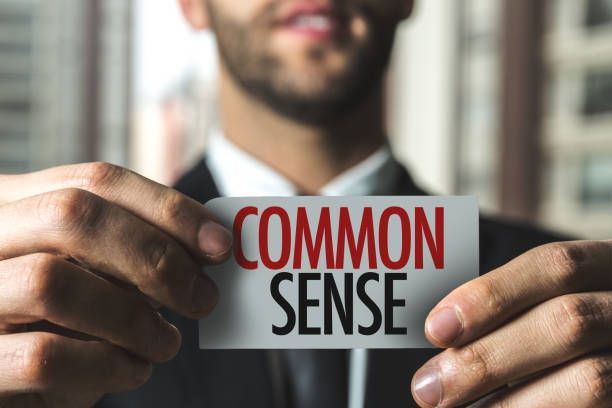
Common Sense sign card

The other day, in the middle of a conversation, the idea of common sense was presented as something all but gone in our culture. The subject came and went too quickly. It was only after, upon reflection of the conversation, that it came to my mind, and I couldn’t dismiss it. It stayed with me, prompting me to do a little digging as to its origins and to its current reality.

Let’s establish, first, that common sense is not a liberal or a conservative mindset. It is not a particular worldview or political position. I think many of us look at the absence of common sense as positional; to have it one must hold a certain position, usually a position that aligns with our position. That is not common sense.  

The origin of the phrase is found with a school of philosophy, which is said to hold the notion that we should begin our thinking with the fixed beliefs of mankind and move on from there. This phrase or notion, whatever you want to call it, was first penned by Aristotle who believed that all living beings have nourishing souls, but it was only human beings who possessed a rational soul. He believed it was only this rational soul that perceived. Aristotle proposed that every act of perception involved a modification of one of the five senses that then interacted with one’s entire being, when engaged with one of the fixed beliefs associated with all human beings.

Aristotle saw one’s perception as provinces of sensation and believed that human beings perceive by means of difference between the polar extremes contained within each sense. For example, he saw these provinces of sensation as a “kind of mean” between two extremes as in the difference between soft and loud in sound or bitter and sweet in taste. His inference was that human beings perceive by means of difference, but he believed that one sense cannot perceive itself. According to a host of theorists, Aristotle speculated that there must be an additional sense or a “common sense” that coordinated the other senses. He suggested that this “common sense” instituted a perception that is common to all the other senses yet one condensable to none of them. 

Most theorists agree that this common sense, referenced by Aristotle, was not a sixth sense or an additional sense; instead, it was more a sense of difference or a unity of the senses that manifests together when considering something of significance, a fixed belief, if you will, engaging all five senses, which in turn act collectively on one’s being. 

Mention common sense today and most default to the ideas of practical judgement and social awareness as both relate to an individual being living in a world with all beings, but there is a deeper implication … the one with which we started. Do most still have common sense? Or is there still a need for common sense? Both questions have implications socially and culturally. 

First, are there any commonly accepted fixed beliefs to which almost everyone, even in their differences, agree or acknowledge? It is thought that agreement or acknowledgement of these fixed beliefs manifest common sense but if there are a dwindling number of fixed beliefs … what happens to common sense? I am proposing that culturally there is indeed a diminishing number of commonly accepted fixed beliefs but that is due to all individual beliefs being given positions of acceptability. The question not yet answered is this one: does the acceptance of all individual beliefs still produce common sense in the same way a communal acceptance of a fixed belief did in the past?  

When was the last time you heard common sense referenced? I can’t say that I have heard the phrase in quite some time. As I look out at our world, I see an absence of common sense but does anyone else? Common sense seems, to me, to be an individual trait produced by communal membership. Does the absence of common sense signal an absence of community or an absence of something else? I am thinking of submission or empathy, two areas I see less of these days. 

The idea of common sense was the sense that kept you “in the middle of the road,” if you will, kept you connected with all others with your differences intact. It was this “common” amid all your differences that you shared with your fellow men and women in ways of connect-ability. It connected you with others and allowed you to keep your differences while connecting with others who were themselves different. It was “common sense” that tolerated individual differences for the sake of the collective whole. Over time, some individual differences became acceptable to our collective common sense, but what happens when all differences are given equal status of acceptability? Well, first, we lose the need for common sense, and second, I am not entirely sure, but my sense is that we lose something important … something communal … something distinctly human.    

I would love to hear your thoughts? Hit the comment section with them because thinking matters! 

The Changing Context of Wisdom

Aristotle once said, “All men by nature desire to know,” which is a statement about being human. What he was saying is that we—human beings—have a built-in thirst to know … to gain knowledge. Is this still the case or was Aristotle mistaken?

To support his statement, Aristotle referenced our senses and our love for them. That has not gone away; I would actually propose that we are more in love with them now than we have ever been. We love to see, taste, hear and feel. We are sensual beings and even more so today. Our senses contribute to our thinking. We input information through our senses, but do we still use all of them?

Consider this: many of us use computers, laptops, iPads and cell phones to think. I, myself, now write on a laptop, which is a change from years ago when I was a pencil and paper thinker. I can’t do it anymore. I need to type on a computer to think. What does that do to the input of information? Well, it actually reduces the use of my senses down to two: sight and sound, with one (sound) delayed. What does this mean when it comes to wisdom?

Wisdom is many things; it is the use of one’s knowledge and experience to make good judgement. It is the ability to make good judgements. Wisdom, ultimately, is the ability to discern, which is a higher ordered form of thinking. What are we discerning when we discern? Well, we are discerning right from wrong, the good from the bad and the wise from the foolish. Can we do that with our senses only?

Can you see right and wrong? Can you hear it or feel it? How about taste it or smell it? Do you just know? Many of us would never admit to being able to do any of this and yet, we say all the time … I feel this is right or I feel that is the wrong thing to do. The fact is alone, your senses are not enough to determine anything. Aristotle thought senses would be dangerous if they became an end in themselves, but is that not where we are today? Do our senses drive us in all that we do? Where do they fit when it comes to experience? I think right now they trump experience, but is that a good thing?

Aristotle saw both experience and the senses as vital to wisdom, which is why he valued the artisan. He saw the artisan as knowing both the how (experience) and the way (sense). Wisdom is not just feeling; it is also not just factual. It is a blend of both, but both do not come together naturally; they need help. How do the senses become married to knowledge? The answer is through the spiritual. We are spiritual beings whether we believe in a Divine Being or in atheism.

Wisdom is a balanced blend of the senses and experience held together by the spiritual through values and beliefs, but I am proposing that wisdom’s context is changing. Why? Well, I believe the context of wisdom is affected by the predominant beliefs and values of the day, which have changed radically in the last ten years. In the past, those were some form of a Christian moral standard, but today, they are more existential, which affects the context of what is wise. What it means to be wise today has changed a lot. Wisdom is now associated with ideology, certain beliefs and certain values. We say we are more tolerate but we are less. We say we are more open but we are more closed. We have less freedom, less excellence, less leadership and way more excuses.

This all comes back to the context of what is wise, which is much different than it used to be and because it is different, who we are as human beings is different. Does it matter? I believe it does, but that is a discussion for another day. For now, thinking matters and today’s thinking involves wisdom. Think about your thoughts on wisdom … have they changed? If so, why? Love to engage with your comments. Until next time …

Tragedy Tends to Confirm

As the sun sits in a cloudless sky today, it bares no resemblance to the sky of last week. Last week many of us experienced rain and wind like we have never seen. We became isolated from our world as many of us struggled to find the normal that was just beyond our grasp. And, yet, today, things are slowly returning to normal, for some of us, which prompts me to present a few thoughts.

In the midst of our recovery, the world went on, which prompts a question: what did we see and what did we learn? Well, here are a few lessons I learned. The government is not God and cannot be seen as supernal, especially when it comes to natural disasters. As much as things change, they do stay the same. If you think you have it bad all you need to do is look over at your neighbor. At the end of the day, we all have too much stuff! And, finally, if you need help and ask for it, someone will reach out and give you a hand.

I am very thankful to live where I live. I have a great church, great neighbors and a great school. Yes, the government is made of people just like me, but they have risen to the challenge and I am thankful for them. I am not concerned about their party or ideology; I am only concerned about their concern for the citizens who elected them, and at the end of the day, all I can ask them to do is their best.

Government is made of people, and whether you are red or blue … I hope you will agree that when it comes to people, despite our wishes, people are pretty much the same. So, what have I noticed about government lately. Well, the more things change the more they stay the same. The idea of government solving all of your problems is probably not a good thought and an even worse plan for the future. You see the government is not a for-profit entity. It makes no product and therefore makes no money. All it does is spend your money.

The problem I have seen in goverment in the last 5-7 years is a growing incompetency. Before you get upset, this growing incompetency is not confined to red or blue; it is purple and applies to both sides of the aisle. Let stop before going too far and ask this question: what produces excellence? I mean if you had to guarantee excellence how would you do it? I know what my answer is, but what is yours? Think about it for a minute, and if your answer is government then point me to excellence produced by government. I am not sure you can, but it’s not their fault. It’s our fault.

What produces excellence? Where do you find it? Here is a hint: Find an example of excellence, any example and go backwards until you determine what produces it. My next post will give you my answer, but I would love to get your answers! Leave them in the comments!

So, what truths have I learned in the midst of tragedy. Well, here are a few!

  1. Science is no more the answer than it was 50 years ago.
  2. Meteorologists are never wrong(What’s the difference between partly cloudy and partly sunny?).
  3. There is always hope!
  4. During times of tragedy, we learn quickly who people are.
  5. Blaming this storm on global warming is lazy science. It is impossible to determine the cause of anything in the midst of tragedy.
  6. There is something to be said of a good neighbor!
  7. Churches are always there filling the gap in times of tragedy.

What have you learned? I would love to hear your thoughts! I believe we learn from each other. The path to right thinking is full and occupied! Let’s learn and think together. Until next time …

The Tragic Response of Media

Photo by Pixabay on Pexels.com

The horrific school shooting in Uvalde, Texas was yet another reminder to all of us that there is something wrong in our country, and yet as horrific as this tragedy was, there are responses that maybe just as tragic. 

A prominent newspaper recently offered a response that might serve as such an example. One author in this newspaper wrote a piece that was highly critical of those who turn to faith in God in the aftermath of such tragedies. The author suggested that the Christian faith is to blame as it enslaved people to terrible laws in this country for centuries. A reminder that a few of these “terrible laws” actually allow this columnist the right to publish such statements at such an inappropriate time. 

One does not have to read too far into the story to discover the true intent of the article and the reason for the slander of the Christian faith when the author expresses concern that the Christian faith would be “a distraction” from gun control. The author speculated, offering no supportive or collaborating documentation, that the intent of conservatives was to push the conversation about these mass shooting away from gun control and towards God, which brings up a good question, is this really about guns?

Let me begin by saying that I do agree there are some needed changes in gun policies across the nation. That much is clear, but the issue is clouded by the politicizing of these tragedies. Each time a tragedy like this happens both sides re-energize their bases to either attack or protect the Second Amendment. The issue, for me, is not the gun, but something deeper. There is a hopelessness running rampant in our people … a hopelessness that produces despair, anger and rage. That hopelessness will not be solved by gun control or lack of gun control. 

These issues will not disappear until politics are put aside and real solutions are explored and it will take both sides to do this. Both sides must stop looking at every issue as a means to an end in regard to their own power. Continuing to politicize issues like these is disrespectful to the families affected by these senseless tragedies. The brazen political attacks mere hours after these tragedies reveal a little something about each side, if we are paying attention, and to be honest, both sides are banking on the fact that we are not paying attention. 

The issue has many facets to it with guns being one of those facets, but gun control will no more solve this issue than sofa control will solve the issue of obesity. There are other facets like hopelessness, escalation, anger, race, poverty and family that are as important if not more important, and yet no one is talking about any of those issues. Why not? Could it be that none of those issues will bring votes, power or money?

A Relevant Quote

Photo by Markus Winkler on Pexels.com

Here is another great quote although there is a bit of controversy associated with it. The quote has been attributed to George Orwell and his book, 1984. The quote is not found in the book nor is there any documented instance of Orwell every uttering these words. However, the quote is too good to ignore so here it is.

“During time of universal deceit, telling the truth becomes a revolutionary act.”

Very appropriate for our present times!

The Latest News: The Disinformation Governance Board

Photo by Pixabay on Pexels.com

Comments on the News: 

This week Homeland Security Secretary Alejandro Mayorkas announced that a Disinformation Governance Board had recently been created to combat online disinformation. 

Whether you lean left or right, this should alarm you if you care about freedom. Let’s start by addressing the timing of this announcement. I do not believe in coincidences so the timing of this happening immediately following Elon Musk’s purchase of Twitter makes the timing suspicious. There is no denying that Twitter was censoring expression prior to Musk’s purchase, and we do not know yet what Twitter will be like under Musk, but there is hope that expression will once again be free. 

When it comes to expression, there are only two choices; it is either free or it is not. It is a fallacy to suggest that freedom can be governed; it cannot. Governance is control according to a prescribed standard. What Twitter was doing prior to the Musk purchase was not freedom of expression but the control of information. If you want to control the distribution of information I do not have a fundamental problem with that if you present it as the control of information. 

Words do mean something and a case in point is the word “disinformation;” it is a poor choice if you ask me (I know, no one has asked me.). Defined, it is “false information which is intended to mislead, especially propaganda issued by a government organization over a rival power or the media.” Semantics are important and the semantics of this word produce a few questions. Is there such a thing as false information in an age relativism? Who gets to decide intent? Can we truly discern intent? Propaganda, according to the semantics of the word disinformation, is that which is issued by the government over a rival power or the media, which presents a dilemma … is the government’s oversight of disinformation—as defined, an oversight of its own intention to misled in regard to information—possible? 

But again, I refer back to the idea of governing freedom. If you are governing freedom it is not freedom. You can protect freedom; you can protect those who are free; you can even protects the rights of freedom, but as soon as you start to govern freedom and decide what is freedom and what is not, there is no longer freedom. 

Failing to see that this Disinformation Governance Board(DGB) is a power grab means your ideology is currently in power, and that is fine. All is fair in love and war, but let’s avoid addressing the issue as one of freedom. It is clearly not an issue of freedom or even an issue of ideology; the issue is power and the desire for more of it. 

I would encourage us to read our history because we are on a very dangerous path and if we stay on it the future of our country, which includes its diversity, is at risk because diversity is the first thing to disappear when one ideology controls all others. Here is what we know about history if we read it. Those in power currently will not remain in power forever; they never do. History and culture operate like a pendulum; the more you push the pendulum one way the more it will swing back the other way, and it will always swing back the other way … eventually. The goal is for there to be a balance in life, but the more power one side accumulates the more that side wants things according to its ideology. This equates to pushing that pendulum, and again, just like a true pendulum, the more you push it one way the more it swings hard the other way, and it will eventually swing hard that way one day.

There is no way to come to a logical conclusion that the purpose of the DGB is to protect freedom of expression. It is clearly to protect the interest of an ideology so let’s avoid insulting the intelligence of the populace by presenting it as a means of protecting freedom of expression. It may be many things but it is definitely not that.

Defective Worldviews: The Door to Pseudo-Reality

Photo by Roman Kirienko on Pexels.com

Part Four: Our Response

In the past, to live in community meant that we had to know who we were and what we believed and valued. Community granted each of us the right to be different and to have our own unique worldview. Today, individual difference no longer matters and different worldviews are not welcomed. It is culture that is king and we are its servants in this new world of pseudo-reality. 

Living in pseudo-reality reduces life to reactions. There is a “testing of the waters” to determine the pressure points of culture and an expectation to adjust to those points. We can’t stop looking at our phones, checking Facebook and Twitter and updating our status … each is a means by which we adjust to culture. And, each adjustment makes us more insular, more addicted to ourselves and more comfortable with the external impact of culture on us. We have slowly become conditioned to live a life that, to be honest, is something less than human.

Socrates taught us long ago that failing to examine one’s own life renders it worthless, and yet, most of us don’t even consider self-examination anymore. We are too busy pointing out the flaws others, forgetting that we are just as flawed. Not too long ago we were admonished to be tolerant of everyone, to strive for equality and to fight for freedom of expression, and yet, today, we fight for none of these things … in fact, we are now encouraged to fight against them. There is no longer tolerance, only judgement; those stiving for equality no longer want it, and freedom of expression has been exchanged for a specific cultural vernacular to which everyone must submit or risk severe consequences. And yet, we are still told that this is freedom. I don’t see freedom; I see something very different.

What we are seeing today is a total capitulation to culture. Each day we test the “proverbial” waters and then, we adjust our lives accordingly. This reduces our life to daily aberrations which pull us further away from who we really are—providing us no comfort and certainly no purpose—while pushing us towards something less than human. We have actually stop thinking and become a reiteration of our culture.

Sadly, culture has vanquished the individual worldview and declared it defective. We now live in a pseudo-reality that is plastic and one dimensional … one that positions us into a constant state of anxiety due to our daily struggle of determination, which is, in essence, the process of getting. We must get our values and beliefs from culture. We must get our worldviews from culture. We even get our language from culture, and whether we realize it or not, we now get our approval from culture as well. We have become so conditioned to getting that we are losing our ability to give, except when it comes to worldviews, which we have given to culture without much of a fight. 

Giving is a distinctly human action; it is one that separates us from all other creatures. Without our own unique worldview, we are reduced to that of an animal seeking a survivable habitat. In the animal kingdom, it is the habitat that is king and all animals submit to it. Sound familiar? We actually have stepped back into time, back to the daily struggle of survival, but instead of fighting for food and water we are now fighting for our soul and our humanity. 

All hope is not lost however! There are answers and all of them begin where this journey began … with worldviews. How you see and perceive the world will determine who you are in the world. Understanding how worldviews work and that they are under attack is a good first step but it is only one step; there are other steps and each of them are difficult. The next step is perhaps the most difficult. We must understand the power education has over our worldviews because, like it or not, education has a lot to do with who we are today.

The foundation of your worldview began way back in grammar school when you were taught math and English by a teacher who also taught you something else … what is right and true. Every school, no matter its orientation, teaches from a view of the world which defines what is right and true for its students. Worldviews begin at home but they are always built in conjunction with schools because every child goes to school. 

As parents, we trust our schools with our children in regard to academics, but what about beliefs and values? Have you ever asked whether the school’s beliefs and values, which the school presents as true and right, align with your beliefs and values? The dirty little secret that no one wants to talk about is this one: as soon as your children reach middle school, if they participate in just one extra-curricular activity, they will spend more waking hours at school than they will with you at home.

Back to Socrates, he proclaimed that when we examine our lives we are living lives worth living, but the exam he referenced is not a one-time exam; it was a constant and thorough examination process that was to be lifelong. I think part of what Socrates was referencing was the refining process of worldviews. When we examine our lives we must examine them in regard to who we are and where we fit in this world. We must be willing to make changes, reinforcing some beliefs while eliminating others, but this is all to be done internally as we interact with others, learn from others and grow with others.

A consistently examined life is one that is truly free. It is a life that is reflective and not one that is constantly reactive. A life worth living gives more than it gets. It seeks to understand others. It is humble and different. What is the answer to this attack on individual worldviews? Examine your life to determine whether you are living a life worth living, engage the world with who you are in a humble loving way and embrace the old biblical adage that it is better to give than to receive (or get) and then you will understand why worldviews are so important, why defective worldviews are so destructive and what makes you truly human. Here’s a hint … it is not culture.   

Defective Worldviews: The Door to Pseudo-Reality

Photo by Quintin Gellar on Pexels.com

Part Three: Reality

In our last post, we established that each worldview is a set of beliefs lived out in the world in response to others and their worldviews. All worldviews require a commitment on the part of each individual in order to be lived out in the world. Worldviews not only define who we are but they also provide each of us with a sense of community, a sense of purpose, a set of values and more … and they do this through our commitment to them and our refinement of them.   

We demonstrate who we are through our worldviews. The consistency of living out a worldview actually reinforces our worldview, which develops who we are from the inside out. As we live out our worldview we refine it, deepening some beliefs and eliminating others; this refining process allows us, over time, to develop a sense of who we are and an assurance that we do have a place in this world, and it all happens internally.

What happens when worldviews are defective? We begin to look outside of ourselves for worldview answers, which reverses the process. What was an inside-out process, that positively impacted us, becomes an outside-in process that is a detriment to us, manifesting as irrational behavior searching for the consistency that is now absent. Defective worldviews create anxiety and confusion in us due to an external dependence on culture. Instead of refining beliefs and values internally, we are now constantly searching externally  for our beliefs and values, reacting in emotion to each situation and doing it differently due to our actions now being impacted by our emotions and different situations.

The neat clean internal process of worldview development is now a muddled multi-layered messy external process. The consistency found internally is not found externally as culture is a multi-faceted changing landscape of diverse and peculiar ideas that are always shifting. Culture will ultimately provide us the worldview we seek but it will always be provisional and short-lived as more change will soon come, as it always does with culture, providing no solace nor the consistency we seek. 

A defective inconsistent changing worldview rooted in culture undermines our common sense, changes our moral orientation and destroys our empathy for others. We become negative, judgmental and unsympathetic. Our tendency is to live for ourselves in response to the culture through our emotions. It is our emotions that become the means of determining cultural change and as we continually adjust to those changes  and that continuous adjustment impacts us deeply. A focus on emotions erodes away a factual objective reality, producing a subjective pseudo-reality that is now needed to support and feed our emotions, which have taken the place of beliefs and values. 

A  pseudo-reality is not real. It is pliant, inconsistent and situational. There are no absolutes in pseudo-reality. Truth is elastic and changes with each situation, which are impacted by power structures, theories and trends. The only consistency is change and nothing makes sense because there is no need for anything to make sense in pseudo-reality. Inconsistency is the only rule. Everyone seemingly has power which, in essence, gives no one power. In pseudo-reality every situation and circumstance is its own reality with its own set of rules. This turns everyone into a judge with no forgiveness or concern for others.  

Worldviews of the past die in pseudo-reality because they need to be refined and require an objective consistent reality for such a process. What brought us comfort through an internal refining process that sought consistency through clarification is no longer viable in a pseudo-reality. Pseudo-reality is a subjective ever-changing reality that seeks to fill our need for a worldview—and each of us needs a worldview—with itself.

Pseudo-reality adjusts to each situation and circumstance and through this process of adjustment places itself at the center of our lives because it is the only constant we know. There are no objective beliefs or values in pseudo-reality only emotions and they are always changing and reacting depending on the situation or circumstance. Where beliefs and values were deeply held and grew toward consistency, emotions, instead, are reactive, temporal, selfish and always inconsistent. They will never consider others and always be erratic and mutable. This is the world at our doorstep. How do we deal with this world? Stay tuned for our final installment of this four part series.