
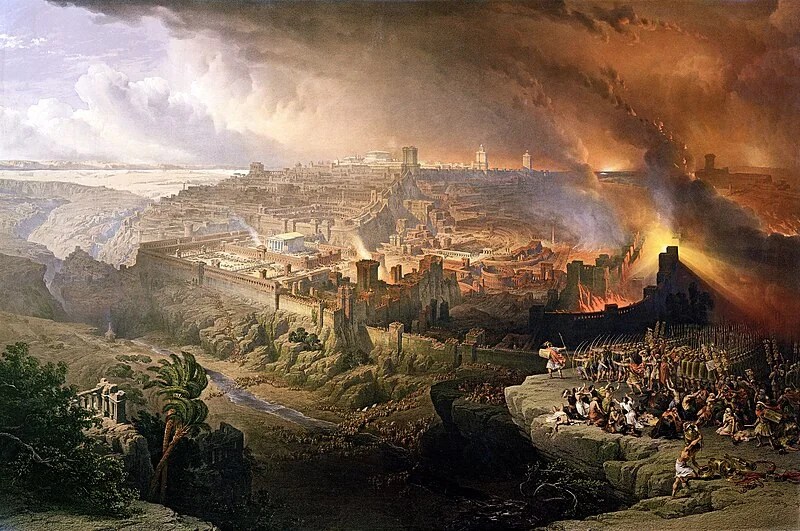
The Roman siege of Jerusalem in 70 C.E.
Part III: The Beginning of the End
Many consider the “West” a nebulous term with no meaning and no history and yet most consider it in decline. As I have referenced, when Oswald Spengler published his epic, The Decline of the West, he posited that the West “wasn’t just in decline; it was being dragged under.” His thesis was that all “cultures” go through a process of birth, blossoming, fruit production and withering to the point of death. The withering phase he called “civilization” because he associated it with a process within the withering phase of excess, debilitation, loss of identity and finally, death. Spengler first published his masterpiece in 1918, and at that time, he saw the West in the withering stage. As he pointed out, the beginning of the withering stage is excess. When civilizations reach the point of excess they become fat; that is not a point of celebration but one of warning. Spengler saw the West at this stage, which forces us to consider a question we would rather not: where is the West now?
Let’s be clear: the West is not a country, nor does it have geographical boundaries, but it does have a birth, and because it has a birth, it will ultimately have a death. Its birth, according to Spengler, occurred with the fusion of German nobility and the Western Roman Empire, as Spengler saw his native Germany as part of the West. Others point to the marriage of Athens and Jerusalem, but all are references to the merging of the two known worlds at the time into something new and different. Spengler thought the West “blossomed” in the Italian Renaissance, bloomed in the Baroque period and produced its greatest fruit in the 19th century. Gregg posited that the Enlightenment was one example of its fruit, but fruit is only good for a time; eventually it rots.
The Enlightenment, most would say, was not united with Christianity but instead at odds with it. Gregg rejects that idea and any idea that the Enlightenment advanced individual reason at the expense of personal faith. He acknowledges the rise of and focus on reason, but he also points to examples of reason and faith coming together for good during the Enlightenment. He presents one important Enlightenment figure in support of his supposition: Sir Isaac Newton. It was thought that Newton wrote his Principia Mathematica in response to the “materialist assumptions” of Rene Descartes and his views on planetary movements. Newton believed that the entire cosmos, including planetary movement, were governed by a Holy God and his divine providence. It was his faith that drove him to study the world and understand it. Many Enlightenment thinkers considered religion as superstition, but others, like Newton, did not.
As far as products of the Enlightenment, the founding of America is often referenced as one of its greatest. While there is evidence to support this assertion, there is also evidence, i.e., its foundational documents, that tell another story; one where its founders grounded virtue and human morality in reason bathed in a belief of divine goodness. Those Enlightenment ideas that were at odds with the Christian faith coincide with the rise of reductionism and the scientific method as both were coming of age at this time. It was reductionism and modern science that attacked faith, presenting it as incompatible with reason, for the purpose of crowning reason as the only king.
According to Gregg, there were two claims that severed the reason of Enlightenment with the Christian faith; the first was the belief that there was no fixed human nature, which clashed directly with the Christian belief of a sinful human nature. The second claim—that the only true knowledge was scientific knowledge from the scientific method—contradicted the Christian belief that all knowledge belonged to a Holy God. Gregg argues that both claims isolate science away from faith and subvert all belief in God. Science and faith were presented as mutually exclusive with science celebrated and faith mocked, but, quite unintentionally, the position science claimed and occupied alone would eventually subvert science and reason. We only need to look at current culture and the presence of Critical Theory as proof. It cares nothing for science or reason; it only cares for itself. There is no logic or scientific methodology; it alone is king and ruler. I would like to posit one notion to consider from this point forward: As the Enlightenment was attacking the Christian faith, it was also attacking itself; it just did not know it.
The ideas and principles it deployed eventually came full circle and were deployed against it. Reason, the scientific method and humanism, all used by the Enlightenment to directly benefit itself, were critiqued, undermined and turned against it by other movements like Romanticism, Idealism, Rationalism and Postmodernism. They revealed that the limitations and exclusions the Enlightenment sought to eliminate from the world were alive and well inside its own ideas, in part, due to its own nature. It is this nature that was, in my opinion, adopted, manipulated and used by Critical Theory to assert itself in the West as the new authority. It is Critical Theory that now pushes the West to the brink of decline and death.
Stay tuned for the last post in this series as I discuss where the West is now. Until then, remember thinking matters!
Discover more from Bridge Roe: Where Thinking Matters
Subscribe to get the latest posts sent to your email.
 Bridge Roe: Where Thinking Matters