The Disappearance of Deference: Dissolving Morality

Part IV: The Disappearance of Deference: Dissolving Morality

Full disclosure: this one is a bit long, but the subject matter demanded the length. My apologies.

When it comes to morality, Aristotle believed that moral principles were ingrained into one’s character by past actions “done in right ways and with right attitudes.” These past actions would come from community from those older and wiser. All of this could only take place in communities of differences where morality was much more than a list of wrongs and rights. This was, as Aristotle asserted, ingraining moral principles into one’s character through repeated physical actions done in community with others who would either confirm or correct. It was the action that revealed the morality. Aristotle believed that communal interaction with those older and wiser was how we would recognize the right application for the situation, which, for him, was a form of morality, but none of it mattered without the action. We are born into and live within communities for a reason; we are raised in families with parents; we are taught in schools by teachers and eventually we work and submit to others in vocation, and all of it develops in us a moral sense. The process of maturity, including the development of morality and the ability to reason, involves communities of difference and our interaction with them.

It is important to note the role that action plays in cognitive recognition and moral development. I see this as evidence in support of the importance of communities of difference, which supports Aristotle’s assertion of the relationship between reason and desire, but it would render Kant’s views of reason as merely practical null and void. There is ample evidence to support Aristotle’s notion that a gap exists between reason and desire. This gap between reason and desire has an important distinction; a smaller gap, the more likely we are to think in moral and practical ways, and the more inclined we are to have deference. This smaller gap would also indicate that reason was impacting desire, which is moral in context. A wider gap, the less likely we are to think in practical or moral ways and to have deference, but the issue does not stop there. A wider gap also indicates that we are more likely to reach a point of malicious intent when it comes to morality, due, in part, to reason and desire operating autonomously with little to no impact on each other. 

As sensual people, desire will trump reason if they act independent of each other. In this situation, it will be our desire that pushes us to the point of narcissism and even madness when it comes to morality. Every decision, including moral ones, will be rooted in self, which turns our selfish desires into our own morality. In this moral state, there is no greater good, no concern for others, no empathy and certainly no deference. Our morality and our desire become one. We become hostile to anyone who does not share our ideology, our thoughts or reason as we do, which pushes us to seek community with only those who are like us. We join homogenous groupings that we think share our ideas and beliefs, which seems to confirm our rightness and everyone else’s wrongness, but the opposite is true. These groupings become our morality and determine our thoughts, ideas, and values. In these groups, we think one dimensionally, do little to no thinking on our own and repeat the groups as our own. We do not think in a dialectic way, and our morality becomes narrow and skewed.  

In this moral state, decisions are not based on a greater good or on a concern for others; instead, decisions, policies and even laws are based only on the morality of the group and their explicit ideology or worldview, manifesting through our own perception. It is our perception that becomes our truth, and all thoughts, ideas and decisions are based upon it, which are not original but merely an extension of our grouping. In this moral state, we feel safe and right because we are surrounded by those who share our morality, and our perceptions are always true and right as long as they are rooted in the morality of the grouping. The concept of a greater good dissolves along with empathy for others and all that is left is power. At this point, Aristotle would see this situation as a complete moral failure due to it being based on desire alone. He would see it as a failure to think practically and reason rightly because every situation would be perceived according to one’s own internalized values and for one’s own personal gain, which would come at the expense of all others and any kind of general good. There would also be a personal cost. In this situation, there is no growth or maturity; there is no development. There is only sameness, bitterness, and cynicism.

Sadly, I see this situation playing out before us today. In this moral state, internalized personal values become one’s morality and the main means of reason which form their own reality. In one sense, it is a shared reality with those in the grouping, but in another sense, it is a lonely and isolated place where one feels trapped; to think different thoughts is to commit treason to the grouping. This is devastating because the grouping has become family. It is welcoming and accepting, but only of those who align with its morality and ideology. This causes a loss of a proper perspective on the world and gives way to an isolated and egocentric approach to life. In such a moral state, one’s perceptions are flawed as they become skewed and narrowed, leaving only room for the grouping’s own ideology and morality. Perception instead of reason merges with desire evolving into something masquerading as morality used in moral ways.  

Perception, for Aristotle, was a psychophysical state, which lead him to this idea of akrasia (Please return to my first post for a reminder of what this is.) which revealed the importance of physical action to morality. When a thought moves us to action, we believe and value that thought to the point that we act on it, which is the physical part of morality. Aristotle thought an individual’s actions were not solely defined by their circumstances, thoughts, or ideas but they also included the actions produced by these thoughts and ideas. These physical actions were powerful and moral. For Aristotle, this narrow egocentric view of the world would be unlikely and unable to produce any moral action on behalf of others; it would only be able to produce action for the benefit of self. We are an egocentric people, and our morality is an ongoing fight between the desire to be selfish and the conviction to be selfless, which Aristotle recognized as the battle between reason and desire. 

Aristotle thought that this polarized immoral state was the result of desire dominating reason. For him, it was a lack of character development, which was needed to withstand the temptation of self, that allowed this immoral state to thrive. As people, we will always battle the temptation to be selfish, but it is a battle meant to be fought in community with others who are different and not in isolation on our own. In isolation, especially morally, there will be no means to fight this temptation and to develop the character required to withstand it. It is the relationship between the circumstance of the immediate situation and the circumstance of the particular or the “perfect form” that are the battle lines in the fight to develop the character needed to ward of those temptations. He considered these communities of difference as the proper environment needed to win these battles. 

Aristotle referenced that the battle between reason and desire was difficult because all states of practical thought converge at the same point, which obscured the differences between those who speak of judgment, understanding, practical wisdom and reason with those who possess judgment, understanding, practical wisdom and reason. When we only speak of these issues and no longer act on them, we will never possess them, and they will never become ours to use. These situations indicate that reason and desire are operating independently from one another, and discernment, which is a product of a right relationship between reason and desire and is morally necessary for practical thinking and deference, is no longer being produced, leaving us in an ongoing moral dilemma. 

The answer to this moral dilemma is phronesis, which is roughly translated as practical wisdom, prudence, and sound judgment; it could also be considered deference. For Aristotle, it was this phronesis that acted as intellectual virtue, allowing individuals to make right choices in difficult situations for the greater good, but it was produced only in communities of difference, which is where we learn about virtue. It is virtue that is necessary for phronesis (or deference). Phronesis cannot exist without virtue, and virtue needs phronesis to be developed. For Aristotle, phronesis was the “eye of the soul” and enabled a person, who was virtuous—this virtue came from those past actions done in right ways with right attitudes in community—to do what should be done in a situation, and, if necessary, do it at the expense of person’s selfish desires. It was phronesis that pushed akrasia to the side and replaced it, but again, this could only be developed in communities of difference.  

This phronesis was not about following a set of rigid rules or an explicit ideology; instead, it was more akin to respecting and allowing reason and desire to work as perception and experience, and together, they would serve as the means to finding the “golden mean,” which, for Aristotle, was the appropriate middle or moderate response. Where have all the moderate responses gone? This golden mean does not come from within us, but instead, it comes from outside of us, from others, from community, and from our own internalizing of our interactions with differences. Phronesis, in a virtuous person, gives that person the ability to recognize the right action for the situation in much the same way a coach would coach players. It would be akin to a coach using knowledge, experience, and sense to determine how to prepare players in practice to perform well in a game. This would come from your own knowledge and your own experience developed by someone who mentored you. It would also come from your own sense for the game, which would be based upon how you internalized your past knowledge and experience with your current situation.  

Aristotle compared this phronesis to prudence, which is also analogous to deference. While deference is not practical thinking per say, it does begin in the same right position … an openness to the right action for the situation at the expense of self, which would make its nature moral. Aristotle suggested that when we act morally, we act with courage. Courage is an action made that is right even if it come as the expense of our own desire. He stated that to act this way would require our perception of the action to function as an instantiation, which is a form of courageous behavior (the perfect “form”). In a way, he was saying that acting in moral ways is acting in courageous ways because it is acting for good at the expense of self. It is how reason and desire come together to make a good decision. Sometimes that decision will also be our desire, but many times it will not. 

Aristotle saw practical thinking as a kind of moral temperament, in part, due to the need practical thinking has for selfless action of the individual. This selfless action, according to Aristotle, was a learned action in community and could not be produced in moral isolation by desire alone; it required reason and virtue. Kant suggested it was a priori while Aristotle a posteriori, in part due to the need for virtue. Aristotle believed that passions (desire) alone, which isa priori, could not respond in right ways because of their sensual, self-centered, and innate nature. They are rooted in who we are as people, in our daily desires. However, he also believed that virtue could only be acquired through a process of intentional conditioning through training in communities in possession of virtue, and yes, you guessed it, these communities would need to be communities of difference.

This opens another line of thinking altogether regarding virtue. I will tackle that subject next time. Until then …

The Disappearance of Deference: The Changing Nature of Reason

Part III: Reason

In my last post, I submitted a thesis regarding who we have become as human beings. We are egocentric; we live in communities of sameness and deference is slipping away from who we are. Has reason also changed? To find that answer we need to go back to Aristotle and start with his thoughts on reason. 

Aristotle claimed that abstract forms of reasoning—and most reasoning begins in abstract form—are impossible without imagery; imagery used in reasoning tends to be concrete and come from community. Aristotle suggested that this “imagery” presented a “particular” that the thinker used as an example to measure a thought; he called this imagery a universal (a standard) used to adjust and correct one’s thoughts. One way to think about these particulars or universals would be as if they are akin to Plato’s perfect “forms.” The particular or the form was thought to be the center of cognition, especially when we think about moral ideas. It was a baseline of sorts on which to measure our initial thoughts and perceptions, but, according to Aristotle, these standards do not come from within us; instead, they come from outside of us, from community and the morality and differences found there. It is community that is part of the development of practical thinking and of reason, and, for me, deference is the gate that allows for that development.

But if all ideas are a priori, as many assert today, then reason would also be a priori, which makes little sense if we consider Aristotle’s ideas on reason as accurate. If reason is a priori, it would mean that these particulars, or forms, would no longer function as universal standards because we would no longer interact with community in the ways of the past, which would reduce their impact on us. Our interactions would be primarily with communities of sameness, which would no longer provide moral baselines. Instead, we would seek these communities for confirmation and encouragement, especially if the only communities we engage are those who share our same ideology. In such situations, we would no longer reason; instead, our thinking would be an extension of our own ideology and come in isolated chunks or pieces extending from our own thoughts and in support of our own thoughts. We would not rationalize or even contemplate; we would simply act or not. Everything would be personal to us because every thought would place us at the center. Every thought counter to ours would be perceived as hostile and threating because, in essence, they would be. 

Change, correction and accountability would be our enemy, which means we would keep repeating the same mistakes and never grow or mature. There would be no such thing as a general good because we would have no concern or need for such a good; our only concern would be for our own good. Every thought and action would extend out from us and be rooted in who we are. We would be offended more than encouraged; everything would be personal, and gossip and rumor would serve as a means of confirmation and promotion of our own ideas and thoughts. Thinking this way would not produce any kind of truth or morality, but instead, produce irrationality, dysfunction, and chaos, leaving those who think this way always seeking power and offended if they do not find it. The idea of good would be mangled and reduced to plays of power; the ideas extending from these people would only have two purposes: accumulate power or reluctantly submit to those who have power. There would be no need for respect, deference, truth, or morality. There would be no learning and certainly no reasoning. There would only be divisions, insults, lies and everyone would be watching out only for themselves. Excellence would evaporate and any idea of morality would be considered weakness because every situation would be a play for power, which would be selfish and pragmatic, with morality considered a weakness. Any moral decision for sake of others would be crushed and used for the sake of self.   

With abstract thought, even in this situation, we would still first seek clarification and understanding about an idea before we moved it to action, which is still a form of learning and reasoning, but if we no longer interact or embrace any kind of difference, then, there would be no way for that difference to impact us. Our actions would be reduced to reactions in ways that either benefited us or submitted to the most powerful good at our own expense. Our actions would be reduced to only reactions, which would be purely pragmatic and practical. Any new situation would force either our reaction, which would be based upon an old situation, a power play, if we had power, or our submission to the most powerful idea, but there would be no practical thinking or reasoning as those elements necessary for both would no longer be part of who we are. In each new situation, our own personal good would be the goal. We would no care for others, the greater good or doing what is right.

The absence of practical thinking, according to Aristotle, is ultimately a failure to be moral when we should be moral, which is what separates human beings from all other beings. It would also be a failure to reason properly. Reasoning, practical thinking … both, for Aristotle, were moral in nature. Our tendency, according to Aristotle, is to be too easily swayed to be general in moral situations for selfish purposes, which is what is produced when we live in a world void of deference. Is this not what we see playing out before us in culture? In such a moral state, we would make the choice that is beneficial to us, regardless of its application or situation to others or the greater good. Deference, respect, and concern for others would be gone. The only issue that would matter to us would be our own well-being and this would come at the expense of the greater good and of others. 

The even more disturbing part is that the morally right decision would mean very little to us. We would see it as weak and lacking excellence; we would even present it as a poor decision when it was merely a decision against us. Our response would either be to submit to the decision or invoke our own power to sway the decision toward us. I would question whether we, in this moral state, would even recognize how morally upside-down or selfish our decision was, in part, due to who we had become as a human being. Would the general good be general or even considered good anymore? I am not sure. Would there be a right way to do things, or would that merely be a distant memory? 

Do you recognize any of this? It is the path that we are on. Politicians, entertainers, athletes … all with power and all looking out only for themselves at the expense of everyone else while lecturing the rest of us on what we should be doing. If truth is relative and merely a means to a personal end, then there is no moral basis on which to lecture anyone anymore. There is no good and evil. There is only self. What would be the first sign that our culture is on this wrong path? In my opinion, it would be the disappearance of deference.

This concludes this section, but there is another one the way. Until then … 

Deconstructing Deconstructionism: Part II

Deconstructing Deconstructivism: Part II

Looking at the process of deconstruction through the lens of deconstructivism is a bit like looking at the world through the eyes of Alice as she looks at the world through the looking glass; you can see shapes and colors, but nothing is clear. Derrida explained the process of deconstruction in a curious way when he stated that, “[it] acquires its value only from its inscription in a chain of possible substitutions, in what is too blithely called a context” (Derrida, 1985, p.2). Derrida presented deconstructivism as an organic act of creation found inside language, but he also presented it as that which was only determined by the context of its use. It is this one word, “only” that provides deconstructivism its protection, which is its ambiguity. Contexts are different and always changing. If deconstructivism is creation determined by the context with which it interacts inside language, then it is never the same and always evolving into something different. My point is that the process of deconstruction is an action of instability acting on that with which it interacts. This we do know. What we do not know is whether its interaction is an act of imposition or of revelation? 

I would like to suggest that the use of the term “organic” is an intentionally heavy term, and more calculated than not. Derrida claimed that he did not create deconstruction but found it as it was, always “going on around us,” which, interesting enough, was in the same state in which he claimed to have found language and meaning. They both, according to Derrida, were found … as unstable in their natural and true state, which begs the question: is instability their nature and true state? Were they found unstable before their interaction with deconstructivism or as the result of their interaction with deconstructivism? This is an important point because we know that there is instability in the world; what we do not know is whether this instability is organic, manufactured or a combination of both, especially when it comes to language?

Each morning, you and I awake to an unstable world. You can feel it just like I can. I am old enough to remember the stability of the world years ago. Sure, there were issues but there was decency and common sense; there is now tension and instability in their place. Both are now norms, replacing the stable ones of the past. It is disconcerting to me that stability is now perceived as a negative in relation to language and meaning. Words have meaning and will always have meaning. That should never change and yet, it has. In the next several paragraphs, I will present a case that deconstructivism, like its cousins, Marxism and Critical Theory, is intentionally providing the means to deconstruct stable norms and replace them with unstable ones for one reason: power.

Jackson and Mazzei, in their book, Thinking with Theory in Qualitative Research, describe their views of deconstructivism, which are directly linked to Derrida’s views. Jackson and Mazzei quoted Derrida when they wrote, “Deconstruction in a nutshell is the tension between memory, fidelity, the preservation of something that has been given to us, and, at the same time, heterogeneity, something absolutely new, and a break” (Derrida, 1997, p.6). The process of deconstruction is now an accepted part of qualitative research. It creates tension which allows it to be analytical, but it also needs this tension for itself. The process of deconstruction required tension to become an organic part of language, but to maintain this status it also needed man to be perceived as a threat to it because, like every other theory, there will be men and women who challenge it, as there should be.

Derrida thought—and I think he is right on this— that we (human beings) perceive tension as negative and seek to move away from it or eliminate it whenever we can, which would be detrimental to deconstructivism. Derrida understood that, as people, we tend to reject tension and seek stability, especially in our language. This would destroy the process of deconstruction. Derrida wanted tension … he needed tension, and he needed it to be embraced and accepted as a natural part of meaning and language, but he knew that would only happen if instability was language’s true and natural state. Jackson and Mazzei posited that deconstructivism’s presence will be where we find “unsettling,” or a “ruffling” of current normative structures (Jackson & Massei, 2012). This is part of the analytical nature of research, and part of the process of deconstruction, which began as theory, but has now extended into everyday life. Tension and instability, which are part of our world, are presented as evidence of the presence of the process of deconstruction, which I acknowledge, but what I struggle to acknowledge is that both are also presented as evidence of the true and natural state of language. 

What I believe instead is that the process of deconstruction is acting upon language, producing both tension and instability. It would be akin to me making the case that all trees exist in the natural state of being cut down, which I label as downcut. When they stand erect and grow, I label this as an imposed will upon them and not organic to them; instead, their natural and true state is downcut. My evidence in support of my theory is my ability to take my ax and chop down a tree. As the tree falls to the ground, I present it as evidence of the presence of downcut and as evidence of a tree’s natural and true state. Is that evidence of its natural state or of me (downcut) acting upon that tree with my ax? Is this unsettling or ruffling of a stable norm an indication of the presence of the process of deconstruction or is it simply change, adjustment or the imposed will of the process of deconstruction on that with which it is interacting? This is the confusing world of deconstructivism and why it is worth exploring. It is a roller coaster ride with plenty of ups and downs. There is much more to address. Please come back for the next post as I continue to try and deconstruct deconstructivism. Until then … 

Derrida, Jacques. (1988). “Derrida and difference.” (David Wood & Robert Bernaconi, Trans.). Evanston, IL: Northwestern University Press. (Original work published 1982).

The Rise and Fall of Western Civilization: Part III

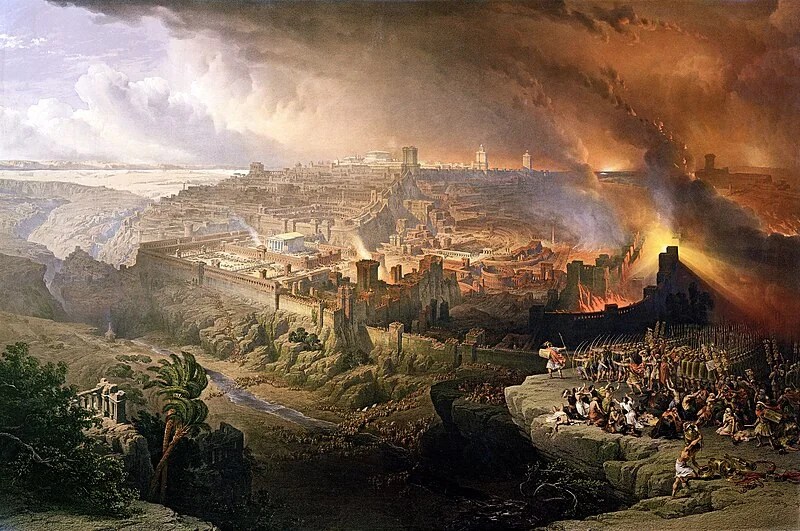
The Roman siege of Jerusalem in 70 C.E.

Part III: The Beginning of the End

Many consider the “West” a nebulous term with no meaning and no history and yet most consider it in decline. As I have referenced, when Oswald Spengler published his epic, The Decline of the West, he posited that the West “wasn’t just in decline; it was being dragged under.” His thesis was that all “cultures” go through a process of birth, blossoming, fruit production and withering to the point of death. The withering phase he called “civilization” because he associated it with a process within the withering phase of excess, debilitation, loss of identity and finally, death. Spengler first published his masterpiece in 1918, and at that time, he saw the West in the withering stage. As he pointed out, the beginning of the withering stage is excess. When civilizations reach the point of excess they become fat; that is not a point of celebration but one of warning. Spengler saw the West at this stage, which forces us to consider a question we would rather not: where is the West now? 

Let’s be clear: the West is not a country, nor does it have geographical boundaries, but it does have a birth, and because it has a birth, it will ultimately have a death. Its birth, according to Spengler, occurred with the fusion of German nobility and the Western Roman Empire, as Spengler saw his native Germany as part of the West. Others point to the marriage of Athens and Jerusalem, but all are references to the merging of the two known worlds at the time into something new and different. Spengler thought the West “blossomed” in the Italian Renaissance, bloomed in the Baroque period and produced its greatest fruit in the 19th century. Gregg posited that the Enlightenment was one example of its fruit, but fruit is only good for a time; eventually it rots.

The Enlightenment, most would say, was not united with Christianity but instead at odds with it. Gregg rejects that idea and any idea that the Enlightenment advanced individual reason at the expense of personal faith. He acknowledges the rise of and focus on reason, but he also points to examples of reason and faith coming together for good during the Enlightenment. He presents one important Enlightenment figure in support of his supposition: Sir Isaac Newton. It was thought that Newton wrote his Principia Mathematica in response to the “materialist assumptions” of Rene Descartes and his views on planetary movements. Newton believed that the entire cosmos, including planetary movement, were governed by a Holy God and his divine providence. It was his faith that drove him to study the world and understand it. Many Enlightenment thinkers considered religion as superstition, but others, like Newton, did not.

As far as products of the Enlightenment, the founding of America is often referenced as one of its greatest. While there is evidence to support this assertion, there is also evidence, i.e., its foundational documents, that tell another story; one where its founders grounded virtue and human morality in reason bathed in a belief of divine goodness. Those Enlightenment ideas that were at odds with the Christian faith coincide with the rise of reductionism and the scientific method as both were coming of age at this time. It was reductionism and modern science that attacked faith, presenting it as incompatible with reason, for the purpose of crowning reason as the only king.   

According to Gregg, there were two claims that severed the reason of Enlightenment with the Christian faith; the first was the belief that there was no fixed human nature, which clashed directly with the Christian belief of a sinful human nature. The second claim—that the only true knowledge was scientific knowledge from the scientific method—contradicted the Christian belief that all knowledge belonged to a Holy God. Gregg argues that both claims isolate science away from faith and subvert all belief in God. Science and faith were presented as mutually exclusive with science celebrated and faith mocked, but, quite unintentionally, the position science claimed and occupied alone would eventually subvert science and reason. We only need to look at current culture and the presence of Critical Theory as proof. It cares nothing for science or reason; it only cares for itself. There is no logic or scientific methodology; it alone is king and ruler. I would like to posit one notion to consider from this point forward: As the Enlightenment was attacking the Christian faith, it was also attacking itself; it just did not know it. 

The ideas and principles it deployed eventually came full circle and were deployed against it. Reason, the scientific method and humanism, all used by the Enlightenment to directly benefit itself, were critiqued, undermined and turned against it by other movements like Romanticism, Idealism, Rationalism and Postmodernism. They revealed that the limitations and exclusions the Enlightenment sought to eliminate from the world were alive and well inside its own ideas, in part, due to its own nature. It is this nature that was, in my opinion, adopted, manipulated and used by Critical Theory to assert itself in the West as the new authority. It is Critical Theory that now pushes the West to the brink of decline and death.  

Stay tuned for the last post in this series as I discuss where the West is now. Until then, remember thinking matters!  

The Rise and Fall of Western Civilization: Part II

Part II: Western Civilization and Christianity

We, in the West, love our freedom, our liberty and all the choices afforded to us. We love free speech, the right to an education and class movement. We vote, are free to be critical and free to believe different things, if we choose. All of these “rights” are ours, at least we believe that they are ours. There is just one minor problem: these rights we claim as ours are found only in the West and nowhere else. They are not really ours but on loan to us from the West, which begs the question, why, then, is the West in decline?

I ended my last post suggesting a connection between Christianity and the West, and in this post, I am going to defend that suggestion. Whether you believe in its truths or not, and you are free to do both in the West, there is no denying the impact Christianity has made, not only on the West, but on the entire world. Many of the beliefs, the values and the traditions we hold dear came to us in the West and from the West, and most of those came to us, like it or not, from Christianity.  

When Christianity entered the world, it came into a world that was a mixture of Roman, Greek and Jew. There were three, Rome, Athens and Jerusalem, major civilizations in the world at the time, all trying to conquer each other, but it was Christianity, according to Gregg, that did the conquering. It made the Jewish God of Abraham available to both the Romans and the Greeks while also appropriating and transforming much of the Jewish thinking into a synthesis of reason and revelation. It was Christianity that changed the world by granting rights to those who had never had rights and introducing change that applied to all people. These ideas morphed into what is known as the West and “Western” thought today. According to Gregg, all of it came out of Judaism through Christianity. It was Christianity that introduced three major ideas that were new and radical; it was these three ideas that contributed to the development of this distinct “Western” culture and “Western” mindset. 

These three ideas were distinct to Christianity and, as we shall see, versions of them were foundational to Western Civilization. First, reason was viewed as divine, which suggested that the world was created by a Holy God and had order and purpose. Second, there was the idea that all human beings had reason and could employ it with assistance in redeemable ways to know truth, including the moral truth of a Holy God. And third, this Christian revolution started by Jesus Christ emphasized a new form of freedom that the world had never seen before. It was a freedom that unfettered all human beings from rulers and their power and provided them a means to a Holy God and to their own betterment. These three ideas changed the entire world and forms of them took root and became foundational to the West as we know it today. 

Those three Christian ideas that changed the world have morphed into three tenets of Western Civilization that we assume to be our own natural rights. They have become a bit distorted over time, but they are still very much alive and active today in the West. We assume they are distinct to the West and products of the West when their geneses are rooted in Christianity. We don’t’ think about them. They are ours, and we assume that they will always be ours because we possess them and have always possessed them. They are part of our normal, our worldview and our paideia if you will. These three ideas are distinct to Western Civilization, and yet they are even more distinct to Christianity, although they are better known by their Western nomenclature. What are they? Well, you will recognize them because they are you and me. These three ideas are three rights we take for granted and call our own; they are the right to an education, the right to a democratic way of life and the right to personal freedom. Each one came to us, not from the West, but from Christianity and along with a host of other “norms” now residing in the West.  

Those three ideas created a revolution of sorts that changed the entire world. They gave everyone power that had only been reserved for kings and queens of old. They put totalitarian regimes and those like them on notice, offering something else, a better form of government, and as much as we want to, we cannot ignore their connection to Christianity. It was Christianity that was affirmed as “the true philosophy” by Clement of Alexandria and lauded for its “integration of faith and reason.” It was Christianity that produced churches, hospitals and schools, including the university, which was founded for the training of the church’s clergy and for the pursuit of truth for the sake of truth. This one product (the university) was a statement on the change that Christianity brought to the world. You can find the university in almost every country in the world today and in its vision, you will find a pursuit of wisdom and knowledge. This educational pursuit was a pursuit that the world had never had the liberty, the ability nor the desire to pursue until this Christian revolution, and all of it was rooted in a belief and in a conviction that there is a Creator God who created a world of order that could be known. Today, our colleges and universities have all but forgotten this connection, but they owe their very existence to Christianity.  

There is wonderful book entitled, The Dying of the Light, that traces the origins of all colleges and universities in the United States. The striking point about this book is that almost every college or university in this country was originally the product of a denomination … the product of some form of Christianity. The Congregationalists, the Baptists, the Presbyterians, the Lutherans, and the Catholics … every denomination that created a colleges or university is in that book and almost every single college or university that was created in this country is in that book. The point not to miss is that these institutions of higher learning were created, in part, due to a mandate from a Holy God and a conviction that this God created a world of order that could be known and should be known, which prompted a curiosity and a desire to learn more about this God and the world he created. One author put it this way, “It [Christianity] launched an age that saw the world as characterized by order, that the human mind can comprehend and a world that merits study simply because it is the world of God.” So, when we talk about the West, in most instances, we are taking about Christianity and its impact on the world. 

It is the West that ushered in the study of science, mathematics and medicine. It is the West that employed democracy in real time and presented it as a better more copious option. It is the West that concerned itself with poverty, slavery and racism, albeit imperfectly. No other country, people group, religion or mindset offered anything close to what the West has offered to the world. It is the West that has taken its advances and advanced itself for better or worse, and while it has had its share of issues, indulgences and mistakes, it has still provided the world with so much. This is Western Civilization and the Western mindset all rolled up into this innocuous phrase we use without a second thought, and today, we find it close to death. Why? In my next post, I begin to examine its fall and death. Until then …  

The Rise and Fall of Western Civilization

Part I: The Development of the West

I recently read an article about the decline and fall of the West, which produced a single thought in my mind in response to this article … Are we living through what many are calling the decline of the West or has the West already fallen? These two questions produced more thoughts and prompted me to do a little reading on the subject. In several articles I read one book was referenced more than all others, The Study of History by Toynbee. It turns out that this is not just any book but, by most accounts, a masterpiece when it comes to Western Civilization. Let me explain why. 

Arnold Toynbee suggested in his book that the West was already in sharp decline. Why did he do this? The Study of History is a multi-volume study of civilization, in which Toynbee studied twenty-one different civilizations across the span of human existence and concluded that nineteen of those twenty-one collapsed when they reached the current moral state of the United States, but here was the shocking part for me: He first published The Study of History in 1931, and in 1931 he posited that the West was in sharp decline and was, according to him, “rotting from within.” Toynbee died in 1975, but I wonder what he would think of our culture today. Are we living in a culture rotting from within or is it already dead?

With this post, I begin a series on the West with the goal of answer the question, is the West in decline or has it already fallen? There are several other excellent books devoted to this topic. Oswald Spengler wrote The Decline of the West, Christopher Dawson wrote Religion and the Rise of Western Culture and Tom Holland wrote Dominion and each author grappled with the same concept regarding the decline of Western Culture. Is Western Culture dead or is it in decline? Let’s find out together. First, let’s explore how the West came to be.   

I begin with Samuel Gregg and his book, Reason, Faith and the Struggle for Western Civilization, which is also excellent when it comes to our topic. In his book, he offers his account of the West, which is like the others but also nuanced with some differences. Gregg argues that Western Civilization was conceived in a marriage of Jerusalem and Athens. His answer is like many others and yet he posits that Western Civilization was born through a marriage of “faith and philosophy” in a version of Christianity born in the West that embraced and applied both faith and reason as one. He sees this “one” coming out of ancient Judaism, which he suggests was a synthesis of both faith and reason as applied in the living of life in a new way. Life was no longer about survival, at least not in the West; there were advancements that made life better and allowed progressions in thought and religion. Gregg states that Judaismde-divinized nature” and was the first worldview/religion to completely reject the ancient idea that kings and rulers were divine and everyone else was to be under them. Judaism, unlike all other religions around it, offered the world a new king. Its rejection of the old idea was through a new view of the cosmos that was spiritually oriented. Judaism saw the cosmos as part of the created order of a universe created by a Holy God and because the universe was created by this Holy God it had order and intelligence and was not formless chaos as all others saw it. 

There was good, in time and space, and hope and all was not lost, according to Judaism, which was a much different narrative of the world than most other historical and religious narratives of the time. What Gregg was proposing was that in Judaism the Jews found a liberation of sorts of the cognitive from time and space. Judaism affirmed that there was a good God in heaven who was a Holy Creator God and that human beings were part of his created order, and not merely interchangeable parts of a larger machine. Human beings were seen as created in the image of this Creator God; they had purpose and were given responsibilities to live as moral beings in this created order. This was a radically different idea than all other ideas before it and what first makes Western Civilization unique. This was a vastly different worldview and would be distinctly western and a foundational mark of Western Civilization. 

The merging of Athens and Jerusalem cannot be underestimated as to its impact on Western Civilization and the Western mind, especially regarding our own current modern Western mindset in the United States. It is the United States that has been the pseudo-capital of Western Civilization for many years now, and it has been the United States that has served as the poster child of the West. The United States has impacted the West, including the Western mindset, more than most. And, now it is this mindset that has become compromised as referenced in part by Alan Bloom in his book, The Closing of the American Mind. It is the American mindset that was so free and so creative that now seems to be more vulnerable and more impacted than all others by the attacks against it. Bloom, in his book, attacks the moral relativism that he claimed was now in control of the colleges and universities. The very freedom brought to us by the West was the very thing being transformed before our eyes. Again, Bloom published his book in 1987, but he appeared to be saying some of the same things. The West, often seen through its colleges and universities, was in decline and dying back in 1987 according to Bloom.  

Back to Gregg, he references that Athens brought both contributions and obstacles to human thinking. It was Athens that was known for its skepticism, its irrationalities and its philosophies; most of them stood in stark contrast to the distinct and different worldview of Jerusalem (Judaism). So, how did they merge when all indications are that they should have clashed? The merging of Judaism and Greek thought, according to Gregg, predates Christianity, which is marked by the birth, death and resurrection of Jesus Christ. There can be no denying the impact of Jesus Christ on the world regardless of your belief about him. Prior to Jesus Christ, educated Jews were more than familiar with Greek thought and moved easily back and forth between Hellenistic and Jewish thinking. This was due to purely pragmatic reasons as the Romans controlled the world and therefore controlled thinking. The Romans were borrowers and refiners. They invented little of their own, but they borrowed from those they conquered and bettered what they borrowed. The Romans allowed those they conquered to keep certain elements of their own culture if they accepted the elements of the Roman culture considered important. It was the Jews who were different than all other cultures; it was the Jews who had this One God who refused to bow down to any other god. Both the Romans and the Greeks viewed the Jews as barbarians. Why? Ironically, it had little to do with their religion and more to do with their thinking and their disposition. The simple answer was that they were not Roman or Greek; the better answer would be to say that they were not Western prior to Christianity. So, there it is … a connection between Christianity and Western Civilization. In my next post, I will explore this connection, but until then …