Education, Painted and Soiled: Part V

Education, Painted and Soiled:

Part V: True Education 

In 1916, John Dewey referred to education as “a social process—a process of living and not a preparation for future living.” While I think Dewey got many things about education wrong, I think he got this one right. Education is a social process. It is life and for a lifetime, but defining it seems to limit it. Definitions are ends for the means they serve. Education, for me, cannot be put into a box, nor should it be, which suggests that I am engaged in a fool’s errand. Let’s find out. 

Aristotle implied that education was not formal instruction nor was it just knowledge; it was much more, but what was it? For Aristotle, it involved developing both intellectual and moral virtues through practice and experience, and it was for a specific purpose, to produce flourishing human beings. This idea of human flourishing was, for Aristotle, the ultimate telos, i.e., the end goal, for all human beings, but this telos implies something else about education.

In this post, I will look at education from one last angle with the hope that I see something that makes sense to me. I want to look at education from the perspective of how we experience it. One author I recently read referenced Erich Fromm and his distinction between having and being. This is as good of a lens as any other to use. Fromm defines “having” and “being” as modes of existence and as different ways of understanding ourselves, the world in which we live and those living in this world with us.

According to Fromm, “having” is concerned with ownership and possession with a focus on controlling; “being,” on the other hand, is rooted in love and concern with a focus on shared experience and productive activity. Being engages the world while getting seeks to possess and control the world. Fromm saw these as two modes of human existence: the mode of having and the mode of being. The mode of having perceives everything as a potential possession while the mode of being perceives self as the carrier of certain properties and abilities.

Fromm thought “having” emphasized a duality between the owner and the thing owned. It was a view of the world with self at the center and all other things arranged in a circle around self. They are distinct from self and their relationship to self is only through their ownership by self. Being is about those qualities that merge with our existence … skills that belong to us that we can exercise, but these skills cannot be taken from us. They are part of us. They are ours. What Fromm proposed was that we have a choice on how to live. Do we live lives having or being? Fromm emphasized that there was a difference between a society set to live for people or for things. Where did that difference take root? I think you know the answer. 

Looking at education through the ideas of “having” and “being” clarify some things for me. In one sense, education can be something possessed as in, “I have a degree.” In this sense, education is one of those things to be possessed by self. It is part of the circle of stuff surrounding self, but then in another sense education can become part of us in the sense of “being” educated. If education is merely a paper on a wall, then, yes, there is a chance that I could lose that piece of paper, but if I am educated and continue to be educated then I lose nothing and gain everything. 

This approach forces me to confront my pursuit of education. I have been looking at education as something to define, but I have learned that such an approach is misaligned and the pursuit untenable. Education is not a thing to possess but instead it is a part of being, of who we are, or at least it should be. If education is as Dewey says—a social process—then we must treat it as a social process. Education, then, is like other aspects of our social world. It is akin to the interaction of family. It is friendships and courtships. It is an evening with friends, a day at work or even a family vacation. How do we define these things? The quick answer is we don’t because they are part of who we are as social beings. We learn these things over the course of a lifetime, starting as children. We are taught by our parents, progress into school and then into college. We eventually have our own children and start the cycle all over again. 

If education is “being” then it will define who we are more than we care to admit. It is not a neutral process but one that will impact us. In the same way that our parents defined who we are as children, education will have the same impact if we grant it the right. The push to educate your children at younger ages—there are many K4 programs out there—is a push to replace your impact on your own children with an educational one. This impact is masquerading as knowledge, either a core body of knowledge or a survey of chosen content. There is a hidden curriculum inside this content, and that hidden curriculum is this: every teacher and school teach from a perspective of the world which they will present to your children as true and right. Do you know what perspective of the world your school presents to your children as true and right? Many schools will claim that their focus is only on knowledge and content. Well, that is a perspective of the world, is it not? Shouldn’t you be the one who defines what is right and true for your four-year-old?  Do your beliefs and values align with the beliefs and values of the school your children attend? These are good questions to have on your mind when considering educational choices.

As I close this series on education, let me sum up what I have learned. First, education is not just content. It is so much more and no matter how hard we try to make it just about content, it will never be just about content. Two, education is not one dimensional. It is multi-dimensional, and it is always social. Aristotle presented the idea that education is about the posture of wisdom, heath and morality and a lifetime of movement, and there are implications if he is even a little right. Third, the foundation of education is morality whether one cares to admit that or not. Fourth, education will change culture. If we do not understand this aspect of education, then we are doomed to be overrun by those who do. To change culture, you must gain control of the schools. History tells us that there are many who have understood this and used this understanding to their benefit. Fifth, with great wisdom comes great responsibility. One does not gain education for only knowledge’s sake. Education provides power. Finally, education is a social process. It is akin to life and something we should engage for our entire lives in a manner akin to friendships, marriages and families. We work at these over the course of our lifetimes. We should do the same in our educational interactions. 

There is much more to address inside this topic of education, but for me, this concludes this series on education. Remember, thinking matters and so does education. Until next time …   
The Rise and Fall of Western Civilization: Part III

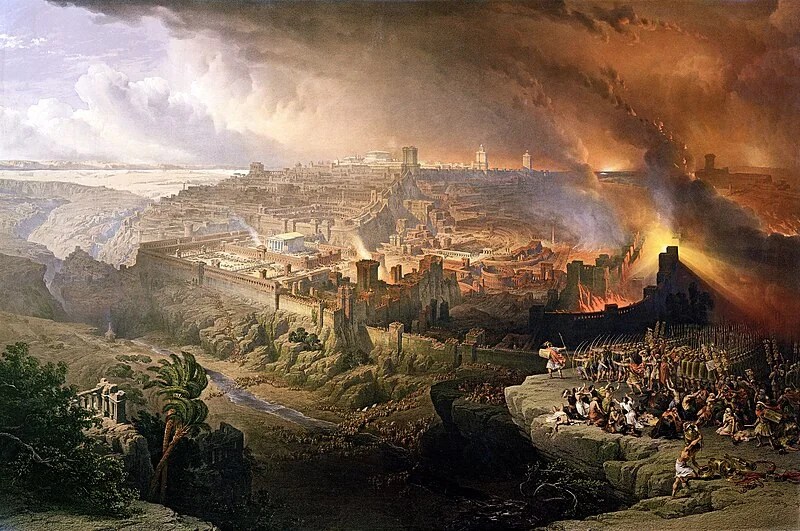
The Roman siege of Jerusalem in 70 C.E.

Part III: The Beginning of the End

Many consider the “West” a nebulous term with no meaning and no history and yet most consider it in decline. As I have referenced, when Oswald Spengler published his epic, The Decline of the West, he posited that the West “wasn’t just in decline; it was being dragged under.” His thesis was that all “cultures” go through a process of birth, blossoming, fruit production and withering to the point of death. The withering phase he called “civilization” because he associated it with a process within the withering phase of excess, debilitation, loss of identity and finally, death. Spengler first published his masterpiece in 1918, and at that time, he saw the West in the withering stage. As he pointed out, the beginning of the withering stage is excess. When civilizations reach the point of excess they become fat; that is not a point of celebration but one of warning. Spengler saw the West at this stage, which forces us to consider a question we would rather not: where is the West now? 

Let’s be clear: the West is not a country, nor does it have geographical boundaries, but it does have a birth, and because it has a birth, it will ultimately have a death. Its birth, according to Spengler, occurred with the fusion of German nobility and the Western Roman Empire, as Spengler saw his native Germany as part of the West. Others point to the marriage of Athens and Jerusalem, but all are references to the merging of the two known worlds at the time into something new and different. Spengler thought the West “blossomed” in the Italian Renaissance, bloomed in the Baroque period and produced its greatest fruit in the 19th century. Gregg posited that the Enlightenment was one example of its fruit, but fruit is only good for a time; eventually it rots.

The Enlightenment, most would say, was not united with Christianity but instead at odds with it. Gregg rejects that idea and any idea that the Enlightenment advanced individual reason at the expense of personal faith. He acknowledges the rise of and focus on reason, but he also points to examples of reason and faith coming together for good during the Enlightenment. He presents one important Enlightenment figure in support of his supposition: Sir Isaac Newton. It was thought that Newton wrote his Principia Mathematica in response to the “materialist assumptions” of Rene Descartes and his views on planetary movements. Newton believed that the entire cosmos, including planetary movement, were governed by a Holy God and his divine providence. It was his faith that drove him to study the world and understand it. Many Enlightenment thinkers considered religion as superstition, but others, like Newton, did not.

As far as products of the Enlightenment, the founding of America is often referenced as one of its greatest. While there is evidence to support this assertion, there is also evidence, i.e., its foundational documents, that tell another story; one where its founders grounded virtue and human morality in reason bathed in a belief of divine goodness. Those Enlightenment ideas that were at odds with the Christian faith coincide with the rise of reductionism and the scientific method as both were coming of age at this time. It was reductionism and modern science that attacked faith, presenting it as incompatible with reason, for the purpose of crowning reason as the only king.   

According to Gregg, there were two claims that severed the reason of Enlightenment with the Christian faith; the first was the belief that there was no fixed human nature, which clashed directly with the Christian belief of a sinful human nature. The second claim—that the only true knowledge was scientific knowledge from the scientific method—contradicted the Christian belief that all knowledge belonged to a Holy God. Gregg argues that both claims isolate science away from faith and subvert all belief in God. Science and faith were presented as mutually exclusive with science celebrated and faith mocked, but, quite unintentionally, the position science claimed and occupied alone would eventually subvert science and reason. We only need to look at current culture and the presence of Critical Theory as proof. It cares nothing for science or reason; it only cares for itself. There is no logic or scientific methodology; it alone is king and ruler. I would like to posit one notion to consider from this point forward: As the Enlightenment was attacking the Christian faith, it was also attacking itself; it just did not know it. 

The ideas and principles it deployed eventually came full circle and were deployed against it. Reason, the scientific method and humanism, all used by the Enlightenment to directly benefit itself, were critiqued, undermined and turned against it by other movements like Romanticism, Idealism, Rationalism and Postmodernism. They revealed that the limitations and exclusions the Enlightenment sought to eliminate from the world were alive and well inside its own ideas, in part, due to its own nature. It is this nature that was, in my opinion, adopted, manipulated and used by Critical Theory to assert itself in the West as the new authority. It is Critical Theory that now pushes the West to the brink of decline and death.  

Stay tuned for the last post in this series as I discuss where the West is now. Until then, remember thinking matters!  

The Rise and Fall of Western Civilization: Part II

Part II: Western Civilization and Christianity

We, in the West, love our freedom, our liberty and all the choices afforded to us. We love free speech, the right to an education and class movement. We vote, are free to be critical and free to believe different things, if we choose. All of these “rights” are ours, at least we believe that they are ours. There is just one minor problem: these rights we claim as ours are found only in the West and nowhere else. They are not really ours but on loan to us from the West, which begs the question, why, then, is the West in decline?

I ended my last post suggesting a connection between Christianity and the West, and in this post, I am going to defend that suggestion. Whether you believe in its truths or not, and you are free to do both in the West, there is no denying the impact Christianity has made, not only on the West, but on the entire world. Many of the beliefs, the values and the traditions we hold dear came to us in the West and from the West, and most of those came to us, like it or not, from Christianity.  

When Christianity entered the world, it came into a world that was a mixture of Roman, Greek and Jew. There were three, Rome, Athens and Jerusalem, major civilizations in the world at the time, all trying to conquer each other, but it was Christianity, according to Gregg, that did the conquering. It made the Jewish God of Abraham available to both the Romans and the Greeks while also appropriating and transforming much of the Jewish thinking into a synthesis of reason and revelation. It was Christianity that changed the world by granting rights to those who had never had rights and introducing change that applied to all people. These ideas morphed into what is known as the West and “Western” thought today. According to Gregg, all of it came out of Judaism through Christianity. It was Christianity that introduced three major ideas that were new and radical; it was these three ideas that contributed to the development of this distinct “Western” culture and “Western” mindset. 

These three ideas were distinct to Christianity and, as we shall see, versions of them were foundational to Western Civilization. First, reason was viewed as divine, which suggested that the world was created by a Holy God and had order and purpose. Second, there was the idea that all human beings had reason and could employ it with assistance in redeemable ways to know truth, including the moral truth of a Holy God. And third, this Christian revolution started by Jesus Christ emphasized a new form of freedom that the world had never seen before. It was a freedom that unfettered all human beings from rulers and their power and provided them a means to a Holy God and to their own betterment. These three ideas changed the entire world and forms of them took root and became foundational to the West as we know it today. 

Those three Christian ideas that changed the world have morphed into three tenets of Western Civilization that we assume to be our own natural rights. They have become a bit distorted over time, but they are still very much alive and active today in the West. We assume they are distinct to the West and products of the West when their geneses are rooted in Christianity. We don’t’ think about them. They are ours, and we assume that they will always be ours because we possess them and have always possessed them. They are part of our normal, our worldview and our paideia if you will. These three ideas are distinct to Western Civilization, and yet they are even more distinct to Christianity, although they are better known by their Western nomenclature. What are they? Well, you will recognize them because they are you and me. These three ideas are three rights we take for granted and call our own; they are the right to an education, the right to a democratic way of life and the right to personal freedom. Each one came to us, not from the West, but from Christianity and along with a host of other “norms” now residing in the West.  

Those three ideas created a revolution of sorts that changed the entire world. They gave everyone power that had only been reserved for kings and queens of old. They put totalitarian regimes and those like them on notice, offering something else, a better form of government, and as much as we want to, we cannot ignore their connection to Christianity. It was Christianity that was affirmed as “the true philosophy” by Clement of Alexandria and lauded for its “integration of faith and reason.” It was Christianity that produced churches, hospitals and schools, including the university, which was founded for the training of the church’s clergy and for the pursuit of truth for the sake of truth. This one product (the university) was a statement on the change that Christianity brought to the world. You can find the university in almost every country in the world today and in its vision, you will find a pursuit of wisdom and knowledge. This educational pursuit was a pursuit that the world had never had the liberty, the ability nor the desire to pursue until this Christian revolution, and all of it was rooted in a belief and in a conviction that there is a Creator God who created a world of order that could be known. Today, our colleges and universities have all but forgotten this connection, but they owe their very existence to Christianity.  

There is wonderful book entitled, The Dying of the Light, that traces the origins of all colleges and universities in the United States. The striking point about this book is that almost every college or university in this country was originally the product of a denomination … the product of some form of Christianity. The Congregationalists, the Baptists, the Presbyterians, the Lutherans, and the Catholics … every denomination that created a colleges or university is in that book and almost every single college or university that was created in this country is in that book. The point not to miss is that these institutions of higher learning were created, in part, due to a mandate from a Holy God and a conviction that this God created a world of order that could be known and should be known, which prompted a curiosity and a desire to learn more about this God and the world he created. One author put it this way, “It [Christianity] launched an age that saw the world as characterized by order, that the human mind can comprehend and a world that merits study simply because it is the world of God.” So, when we talk about the West, in most instances, we are taking about Christianity and its impact on the world. 

It is the West that ushered in the study of science, mathematics and medicine. It is the West that employed democracy in real time and presented it as a better more copious option. It is the West that concerned itself with poverty, slavery and racism, albeit imperfectly. No other country, people group, religion or mindset offered anything close to what the West has offered to the world. It is the West that has taken its advances and advanced itself for better or worse, and while it has had its share of issues, indulgences and mistakes, it has still provided the world with so much. This is Western Civilization and the Western mindset all rolled up into this innocuous phrase we use without a second thought, and today, we find it close to death. Why? In my next post, I begin to examine its fall and death. Until then …  

A Christmas Tradition

A Christmas tradition of mine is to post this poem on Christmas Day. It is one of my favorite poems. It was written on December 25, 1863 by Wadsworth in response to hearing that his son, Charles Appleton Wadsworth had been wounded in a battle in Virginia.

I hope you enjoy it as much as I do. I wish all of you a very Merry Christmas!

Christmas Bells by Henry Wadsworth Longfellow

I heard the bells on Christmas Day
Their old, familiar carols play,
    And wild and sweet
    The words repeat 
Of peace on earth, good-will to men!

And thought how, as the day had come,
The belfries of all Christendom
    Had rolled along
    The unbroken song
Of peace on earth, good-will to men!

Till ringing, singing on its way,
The world revolved from night to day,
    A voice, a chime,
    A chant sublime 
Of peace on earth, good-will to men!

Then from each black, accursed mouth
The cannon thundered in the South,
    And with the sound 
    The carols drowned
Of peace on earth, good-will to men! 

It was as if an earthquake rent
The hearth-stones of a continent,
    And made forlorn
    The households born
Of peace on earth, good-will to men!

And in despair I bowed my head;
“There is no peace on earth,” I said;
    “For hate is strong,
    And mocks the song 
Of peace on earth, good-will to men!”

Then pealed the bells more loud and deep:
“God is not dead, nor doth He sleep;
    The Wrong shall fail,
    The Right prevail,
With peace on earth, good-will to men.”

Existentialism: Part 1

Existentialism: The Current Moral Order, Part 1

Are you anxious about the world in which you live? You are not alone. It seems to be all the rage these days. The media bombards us with negative ideas like global warming, melting glaciers, terrorism and global conflicts. They tell us that these things are happening for the first time in our history … that we are the reason for them. Some defy logic while others defy science and yet all are to be accepted without question. Whether they are right or wrong, is for another time, but the facts are that there is little positive in our news these days and even less in our world, at least according to those who are supposed to know these things. Why? 

This begins a series of post that will attempt to make sense of the world in which we live because it is a different world than the one in which I was raised as a child. It seems to me that the change that has taken place over the last ten years is radically different than other cultural change over a similar time frame. I, and I am sure all of you, just don’t know who to believe these days. Who do we trust? The media … the government … medicine … science … the church … all have given us reasons to doubt them, but is it the institutions themselves or is it something else? I think it is something else. I think something has changed in who we are and in the world in which we live. 

My theory begins with our current state, which is this, we live in a world currently dominated by existentialism, which has replaced Christian morality as the foundation for all thought and feeling. It is a stark contrast to the Christian morality or the Christian faith of the past, but in a sense, it is also similar in that it is every bit faith itself in that it is most difficult to explain in tangible terms. In this series, I will try to explain it in ways that we all have experienced to come to a better understanding.  

Most existentialists believe it (existentialism) cannot be explained; it can only be lived. As far as philosophies go, it is one that bases conduct on a belief that must be chosen as an act of faith, due to the belief that no objective moral order exists, independently of or external to human beings. There is no school of thought, no statement of belief nor is there a set of core values to follow. We, human beings, are morality. Our souls, feelings and ideas are to serve us as our own morality. Everyone must live in a way that affirms their beliefs in an authentic way that is rooted in who they are as their own human being. Authenticity is the objective, but it is different for each person. It is a bit like throwing mud at the wall if you will. What sticks today may not stick tomorrow or even be there and every wall is different. 

Existentialism is obsessed with individuality and how we choose to live as individuals. It seeks to reinforce our individuality, which seems positive, but in that individuality, we give up commonality and true community. If you are wondering what’s missing … wonder no more, it is community. It is missing in government, medicine, science, academia … and the list goes on and on. Republicans cannot mix with Democrats or risk losing the next election. Liberals cannot mix with conservatives; Christians cannot mix with atheists … the divide is wide and there are seemingly no planks to bridge the gap. Existentialism has come along and pronounced the gaps as good and given everyone their own island.  

There are many issues but the larger more egregious one, for me, is the thought existentialism produces. It is not higher categorical thought, nor does it have anything to do with dialectic thought, for which so many philosophers advocate or at least used to advocate. Existentialism just wants you to exist in the moment; it believes it is the moment that is the best means of living authentically. To live in the moment is to live for yourself, your choices and your desires. Thinking of others is not condemned but it is not advocated either. If it is authentic for you, great, but if it is not authentic for you, then that too is fine. There is no shame or guilt in this world. There is no personal responsibility nor is there fault. This is the world in which we live and it affects all of us. 

In a very non-existential way, I would love to hear all of your thoughts, especially those that are different. I still believe in a dialectic way of thinking which is why I am putting my thesis out there for all to see. The only way to confirm it as valid is to measure it against an antithesis or two, which are comments and ideas that are different. This is higher categorical thought and why it matters!    

Do We Still Have Common Sense?

Common Sense sign card

The other day, in the middle of a conversation, the idea of common sense was presented as something all but gone in our culture. The subject came and went too quickly. It was only after, upon reflection of the conversation, that it came to my mind, and I couldn’t dismiss it. It stayed with me, prompting me to do a little digging as to its origins and to its current reality.

Let’s establish, first, that common sense is not a liberal or a conservative mindset. It is not a particular worldview or political position. I think many of us look at the absence of common sense as positional; to have it one must hold a certain position, usually a position that aligns with our position. That is not common sense.  

The origin of the phrase is found with a school of philosophy, which is said to hold the notion that we should begin our thinking with the fixed beliefs of mankind and move on from there. This phrase or notion, whatever you want to call it, was first penned by Aristotle who believed that all living beings have nourishing souls, but it was only human beings who possessed a rational soul. He believed it was only this rational soul that perceived. Aristotle proposed that every act of perception involved a modification of one of the five senses that then interacted with one’s entire being, when engaged with one of the fixed beliefs associated with all human beings.

Aristotle saw one’s perception as provinces of sensation and believed that human beings perceive by means of difference between the polar extremes contained within each sense. For example, he saw these provinces of sensation as a “kind of mean” between two extremes as in the difference between soft and loud in sound or bitter and sweet in taste. His inference was that human beings perceive by means of difference, but he believed that one sense cannot perceive itself. According to a host of theorists, Aristotle speculated that there must be an additional sense or a “common sense” that coordinated the other senses. He suggested that this “common sense” instituted a perception that is common to all the other senses yet one condensable to none of them. 

Most theorists agree that this common sense, referenced by Aristotle, was not a sixth sense or an additional sense; instead, it was more a sense of difference or a unity of the senses that manifests together when considering something of significance, a fixed belief, if you will, engaging all five senses, which in turn act collectively on one’s being. 

Mention common sense today and most default to the ideas of practical judgement and social awareness as both relate to an individual being living in a world with all beings, but there is a deeper implication … the one with which we started. Do most still have common sense? Or is there still a need for common sense? Both questions have implications socially and culturally. 

First, are there any commonly accepted fixed beliefs to which almost everyone, even in their differences, agree or acknowledge? It is thought that agreement or acknowledgement of these fixed beliefs manifest common sense but if there are a dwindling number of fixed beliefs … what happens to common sense? I am proposing that culturally there is indeed a diminishing number of commonly accepted fixed beliefs but that is due to all individual beliefs being given positions of acceptability. The question not yet answered is this one: does the acceptance of all individual beliefs still produce common sense in the same way a communal acceptance of a fixed belief did in the past?  

When was the last time you heard common sense referenced? I can’t say that I have heard the phrase in quite some time. As I look out at our world, I see an absence of common sense but does anyone else? Common sense seems, to me, to be an individual trait produced by communal membership. Does the absence of common sense signal an absence of community or an absence of something else? I am thinking of submission or empathy, two areas I see less of these days. 

The idea of common sense was the sense that kept you “in the middle of the road,” if you will, kept you connected with all others with your differences intact. It was this “common” amid all your differences that you shared with your fellow men and women in ways of connect-ability. It connected you with others and allowed you to keep your differences while connecting with others who were themselves different. It was “common sense” that tolerated individual differences for the sake of the collective whole. Over time, some individual differences became acceptable to our collective common sense, but what happens when all differences are given equal status of acceptability? Well, first, we lose the need for common sense, and second, I am not entirely sure, but my sense is that we lose something important … something communal … something distinctly human.    

I would love to hear your thoughts? Hit the comment section with them because thinking matters!