
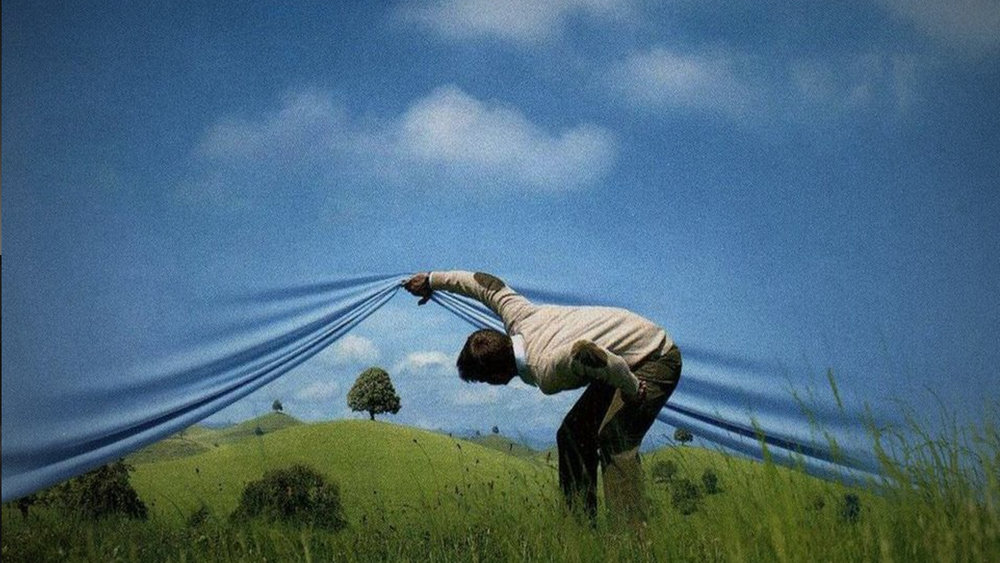
How do we know what is real?
I took a trip back to where I was raised to visit family and friends. It was a wonderful trip but quick and too short, but that is sometimes life. It was good for my soul and even better for my mind. I loved all the conversations I had. I loved listening to how others arrived at their own points of view. Some of us still hold the same values and have adapted to life in some of the same ways. Others hold different values and have adapted to life in different ways. Why? One of the subjects that came up was reality and how many different versions of reality are out there now. As I was driving back home, a question came into my mind—how do we know what is real? —and I could not shake it.
My standard practice when I get one of these questions is to go poking around those people I respect, read or follow and see what they think. In my latest search, I stumbled upon a reference to an article with an interesting title, so I looked it up and read it. The article was in Psychology Today, which, for me, is not one of my usual references, but the title was too inviting. The article, “How Do We Know What Is Real?” By Ralph Lewis, M.D., was well worth my time and maybe worth yours too. Before I get into the article, let me set some foundational timbers for this post.
First, let’s be clear; we experience the world through our five senses; that is given. Second, it is best to experience the world with all five of our senses. Most agree on that point as well. It is the way most of us live and we give it little thought. We just do it. Point three: Most theorists would call this experience subjective and question its reliability, but Lewis points out that “subjective perception” is still a crucial source of data for almost everyone. We rely on it every day as we live our lives. Consider science, even its practices and methods incorporate senses, i.e., observation, which is technically considered subjective and yet still a foundationally part of the scientific method. Dr. Lewis writes, “Science is just a method to minimize the distorting effects of our perceptions and intuitions and to approximate a more objective view of reality.” This is intuition and it is and should be greatly valued. You use it and so do I. It is the primary focus of this post. Most professionals use it. They depend on their own “trained” intuition to do their job. Doctors, financial advisors, plumbers, teachers, engineers and many others, all use trained intuition to excel in their vocations.
But here is the issue I want to focus on; trained intuition is not universal absolute truth nor is it reality. It is a form of discernment that allows us to problem solve. It is assumption and inference developed through our education and training that works with who we are to solve issues. It is also based on our ideology which is a composite of our beliefs and values. This makes it uniquely ours, and it tends to work only for us. But this means that we often see our intuition and as reality. In some respects, it is, but it is not ultimate reality for us. The more success we experience the more egocentric we become, and this puts us in a position to think our reality is everyone’s reality. It never is. Your doctor may have an intuition about why you are sick, but that is the result of his or her interaction with you and your issue. At best, it is a temporary situational reality that works for your current situation, but that is as far as it can go. As Lewis states, “But it [intuition] can be completely off base” and lead even experts astray.” Lewis continues, “We have to be aware that our intuitions and firmly held assumptions may be completely wrong.” This leads me to a question. Where does intuition lie? The answer is the brain.
The brain is a “well-honed but imperfect virtual reality machine,” according to Lewis. We don’t have a brain; we are a brain. Our brains produce subjective perceptions which are representations of our external world—our very own form of virtual reality. According to Lewis, we can be confident that most of the time these subjective perceptions that our brains produce are faithful representations of our actual external world. Social cues are just one example of our brains making a subjective perception. In most instances, we are right, but I think we have all experienced a time or two when we were wrong.
Our brains, according to Lewis, rely on patterns, approximations, assumptions and best guesses. Our brains often take shortcuts, fill gaps and make predictions and all of these things are based upon our intuition which flows from those subjective perceptions. Lewis is clear; subjective perceptions are real, but they are not what they seem, even to those of us who own them. The brain is a “confederation of independent modules,” all working together. Lewis writes regarding this, “The vastly complex unconscious neuronal determinants that give rise to our choices and actions are unknowable to us.”
The brain just works, and it works well due to the subjectivity of our experiences, but, as real as they seem, they are not reality for us, and they cannot be reality for us. The more successful we are the more our tendency will be to think that our reality is everyone else’s reality, which, again, is when we get in trouble. When we push our intuition as if it is reality, then we will think it is reality. When this happens, we merge our intuition with our existing ideology, and they become one. We will always find others who share and reinforce our ideology, then it is our ideology that becomes our reality. This tends to isolate us inside our ideology which becomes our ultimate reality. This is the Land of Oz and not reality at all. This is where real issues arise in the form of narcissism and nihilism.
Lewis goes into mystical experiences and hallucinatory or dissociative experiences to make his point. He posits that these experiences seem so real to those who have them that they believe that they have discovered a transcendental reality. They have not discovered an alternative reality. They have merely experienced the power of a chemical or drug or the power of suggestion. The brain thrives because of subjectivity, but that subjectivity makes it vulnerable to external influences like drugs and persuasion. We would be naive to assume that our subjective perception of the world was anything but that, and yet this is where many are today. There is no longer a concern about doing the right thing, working hard, having integrity, honor or even telling the truth. The only concern right now is for self … to be right. We are in a war of opinions, and everyone is armed with their own editorial comments. The battles wage because the winners get to declare what is true, until the next battle comes, and then, the cycle starts all over again. This is our world today and determining what is real is no longer determining what is true. Our elections have revealed that, have they not? How do we know what is real? I think the better question might be, do we care about what is real? Until we do, we will never determine what is real.
 Bridge Roe: Where Thinking Matters