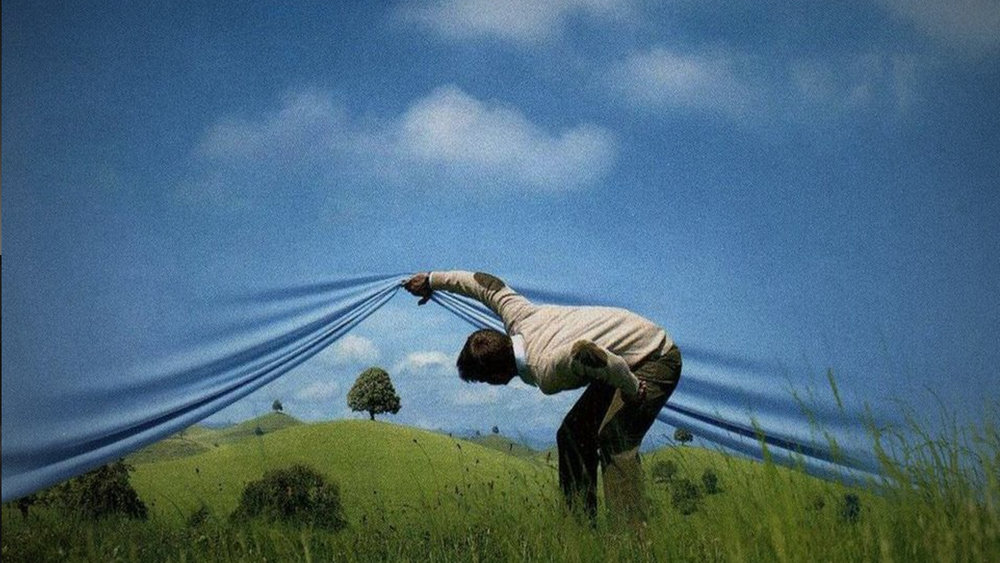
How Do We Know What Is Real?

How do we know what is real?

I took a trip back to where I was raised to visit family and friends. It was a wonderful trip but quick and too short, but that is sometimes life. It was good for my soul and even better for my mind. I loved all the conversations I had. I loved listening to how others arrived at their own points of view. Some of us still hold the same values and have adapted to life in some of the same ways. Others hold different values and have adapted to life in different ways. Why? One of the subjects that came up was reality and how many different versions of reality are out there now. As I was driving back home, a question came into my mind—how do we know what is real? —and I could not shake it. 

My standard practice when I get one of these questions is to go poking around those people I respect, read or follow and see what they think. In my latest search, I stumbled upon a reference to an article with an interesting title, so I looked it up and read it. The article was in Psychology Today, which, for me, is not one of my usual references, but the title was too inviting. The article, “How Do We Know What Is Real?” By Ralph Lewis, M.D., was well worth my time and maybe worth yours too. Before I get into the article, let me set some foundational timbers for this post.   

First, let’s be clear; we experience the world through our five senses; that is given. Second, it is best to experience the world with all five of our senses. Most agree on that point as well. It is the way most of us live and we give it little thought. We just do it. Point three: Most theorists would call this experience subjective and question its reliability, but Lewis points out that “subjective perception” is still a crucial source of data for almost everyone. We rely on it every day as we live our lives. Consider science, even its practices and methods incorporate senses, i.e., observation, which is technically considered subjective and yet still a foundationally part of the scientific method. Dr. Lewis writes, “Science is just a method to minimize the distorting effects of our perceptions and intuitions and to approximate a more objective view of reality.” This is intuition and it is and should be greatly valued. You use it and so do I. It is the primary focus of this post. Most professionals use it. They depend on their own “trained” intuition to do their job. Doctors, financial advisors, plumbers, teachers, engineers and many others, all use trained intuition to excel in their vocations. 

But here is the issue I want to focus on; trained intuition is not universal absolute truth nor is it reality. It is a form of discernment that allows us to problem solve. It is assumption and inference developed through our education and training that works with who we are to solve issues. It is also based on our ideology which is a composite of our beliefs and values. This makes it uniquely ours, and it tends to work only for us. But this means that we often see our intuition and as reality. In some respects, it is, but it is not ultimate reality for us. The more success we experience the more egocentric we become, and this puts us in a position to think our reality is everyone’s reality. It never is. Your doctor may have an intuition about why you are sick, but that is the result of his or her interaction with you and your issue. At best, it is a temporary situational reality that works for your current situation, but that is as far as it can go. As Lewis states, “But it [intuition] can be completely off base” and lead even experts astray.” Lewis continues, “We have to be aware that our intuitions and firmly held assumptions may be completely wrong.” This leads me to a question. Where does intuition lie? The answer is the brain. 

The brain is a “well-honed but imperfect virtual reality machine,” according to Lewis. We don’t have a brain; we are a brain. Our brains produce subjective perceptions which are representations of our external world—our very own form of virtual reality. According to Lewis, we can be confident that most of the time these subjective perceptions that our brains produce are faithful representations of our actual external world. Social cues are just one example of our brains making a subjective perception. In most instances, we are right, but I think we have all experienced a time or two when we were wrong. 

Our brains, according to Lewis, rely on patterns, approximations, assumptions and best guesses. Our brains often take shortcuts, fill gaps and make predictions and all of these things are based upon our intuition which flows from those subjective perceptions. Lewis is clear; subjective perceptions are real, but they are not what they seem, even to those of us who own them. The brain is a “confederation of independent modules,” all working together. Lewis writes regarding this, “The vastly complex unconscious neuronal determinants that give rise to our choices and actions are unknowable to us.” 

The brain just works, and it works well due to the subjectivity of our experiences, but, as real as they seem, they are not reality for us, and they cannot be reality for us. The more successful we are the more our tendency will be to think that our reality is everyone else’s reality, which, again, is when we get in trouble. When we push our intuition as if it is reality, then we will think it is reality. When this happens, we merge our intuition with our existing ideology, and they become one. We will always find others who share and reinforce our ideology, then it is our ideology that becomes our reality. This tends to isolate us inside our ideology which becomes our ultimate reality. This is the Land of Oz and not reality at all. This is where real issues arise in the form of narcissism and nihilism.

Lewis goes into mystical experiences and hallucinatory or dissociative experiences to make his point. He posits that these experiences seem so real to those who have them that they believe that they have discovered a transcendental reality. They have not discovered an alternative reality. They have merely experienced the power of a chemical or drug or the power of suggestion. The brain thrives because of subjectivity, but that subjectivity makes it vulnerable to external influences like drugs and persuasion. We would be naive to assume that our subjective perception of the world was anything but that, and yet this is where many are today. There is no longer a concern about doing the right thing, working hard, having integrity, honor or even telling the truth. The only concern right now is for self … to be right. We are in a war of opinions, and everyone is armed with their own editorial comments. The battles wage because the winners get to declare what is true, until the next battle comes, and then, the cycle starts all over again. This is our world today and determining what is real is no longer determining what is true. Our elections have revealed that, have they not? How do we know what is real? I think the better question might be, do we care about what is real? Until we do, we will never determine what is real.

The Uneducated Voter

As the results of this election settle into the collective minds of the country, the responses we are seeing are interesting. One of the words lobbied about in reference to the Trump voter is the word, “uneducated.” The Washington Times, The Washington Post, Time Magazine and even Sunny Hostin of The View, a Notre Dame graduate, have all labeled Trump voters as uneducated. A professor at the University of South Carolina has gone as far as calling the Trump voters stupid and “holding the rest of us hostage,” which prompts the question, what do all these people mean by the term, “uneducated?”

Well, let’s start by examining what it means to be educated. In a keynote address in 2011, J. Casey Hurley, spoke on this very issue. In his address, he gave, what many consider a solid definition of educated, he presented a six virtue definition, stating that we “know that understanding imagination, strong character, courage, humility and generosity are the six virtues of the educated person.” There are many other definitions out there and most have to do with high test scores, content, course work and degrees, but do those really define who is educated and who is not or who is intelligent and who is not?

Back to Hurley, he acknowledged that many of today’s schools “are driven by a definition that says educated people are those who score high on standardized tests.” He deems this not useful and missing the mark. Why? He goes back to the six virtue definition and acknowledges that educated people should have virtues, the question is, which ones? He proposes these six virtues for multiple reasons. They produce other virtues; they are a recipe for improving every learning situation; they provide an answer for how to teach, and finally, they are inspiring. There are many others who endorse this definition, or something like it, but the question is, are Sunny Hostin and others right in labelling Trump voters as uneducated or stupid?

Sunny Hostin was blessed to attend Notre Dame where she earned a law degree. Many of the pundits we listen to each day attended Ivy League institutions or other prestigious universities. Does attending a prestigious insitution quantify as educated? Or, does attending a prestigious institution equate to club membership? That is now a more difficult question than it used to be. In the past, the answer was clearly the affirmative due to admission and entrance requirements. These institutions were looking for the best and the brightest, but today they are merely looking for a specific ideology. Is a Harvard-educated hedge fund manager better educated than an electrician? Probably, but what about intelligence? 


The question, in my opinion, is one of equity more than intelligence. If the electrician was afforded the same opportunities as the hedge fund manager would the electrician achieve the same results? I would actually put money on the electrician to outperform the hedge fund manager. Why? Chances are the hedge fund manager was born in privilege (which is almost a prerequisite for club membership) and educated in privilege (in the club) which suggests a life with little to no struggle. How do we learn? Well, there is a good bit of evidence supporting the fact that dissonance is necessary to learning. My bet is the electrician had lots of struggle to get to the point of being an electrician, which equates to real learning, which is why I would put my money on the electrician. So, back to our issue, is it an educated thought to label all Trump voters as uneducated? Probably not; actually, the term all of these people should be using is “schooled.” Trump voters are, in general, not as schooled as Harris voters. That much is true, but that has more to do with equity than it does with intelligence.

  
Now there is something interesting about most of those connecting Trump voters to the term, “uneducated;” many of them are doing it in vile and hateful ways, which begs the question, are hateful people more intelligent than kind people. According to Psychological Science, there is research to support that those with lower cognitive abilities feel more prejudice and more bias towards others, especially those who are different, than those with higher cognitive abilities. The article summed it up with the following quote, “Hateful people are typically simple people.” Those assuming that the thoughts and motivations of those people who voted for Trump are uneducated and stupid are, in essence, exerting a prejudice and bias towards those who are different than they are … those who did not vote the same way they did. There are many idioms and metaphors to describe this but let’s just say it is hypocritical and leave it at that.

   
Are Trump voters really uneducated? Maybe, but that has nothing to do with whether they are intelligent or not. All it means is that they tend to not be educated in Ivy League institutions or prestigious institutions, which is logical considering most of these institutions hold to liberal positions and seek a liberal ideology when it comes to admissions. Sure, there may be some conservative intelligent people who attend these places, but most go elsewhere for various reasons, which brings us back to the term “schooled.” Most Trump voters probably were not schooled in Ivy League institutions or prestigious universities, but that has nothing to do with whether they are intelligent or not, which is the implication of most of those spewing these thoughts.

On matters of intelligence, when you vote for one party all the time as if that party has all the answers … well, that is a sign of something other than intelligence, and that applies to both parties. One party, one person, one ideology and even one philosophy is never right all the time. That is statistically impossible and logically improbable no matter your belief system. Pretending the dichotomy of right and wrong or true and false does not exist is not intelligent; it is actually delusional.  So, to answer the original question once and for all, the answer is no, due to a confusion of terms. The better word is schooled and the answer to that questions is yes, they are most likely not as schooled as Harris supporters, but as far as intelligence, they are as intelligent as anyone else. They may not be part of the club or afforded the opportunities of the elites, but neither issue has anything to do with their intelligence. Again, this why it is important to not let others do your thinking for you. Think your own thoughts and do your own research and you will find that your efforts will be rewarded. Thinking still matters!

Existentialism: Part VI

Part VI: Living an Existential Life

With existentialism being so abstract, how does one live inside its philosophy? This is the last question I will tackle in this series in this last post. 

I begin with a quote from Le Monde, a Parisian newspaper who attempted to define existentialism in 1945. In their December edition, they admitted that “Existentialism, like faith, cannot be explained; it can only be lived.” 

A few posts back I referenced that it is indeed more a faith than a philosophy. Why is that? One of the main reasons is that it bases conduct on a belief in individual freedom more than anything else. One is free to choose one’s own conduct, but here is the difficult part, inside that freedom there is a belief that no objective moral order exists independent of the human being. It is up to each human being to create his or her own moral order by way of living it and affirming it through their own authenticity as they live. I don’t know about you, but that seems a bit daunting. 

Existentialism, you could say, is obsessed with individual authenticity—how individuals choose to live their lives. It rests on some bold ontological speculations, about what does and does not exist. One of the weightiest speculations is the belief that there is no god or entity outside of the human being; therefore, moral values do not exist outside of the human being. There are no moral absolutes nor are there universal laws or codes of ethics that apply to all of us. Values come to us as we live our lives in authentic ways. If we live our lives as if values were given to us by God or existed outside of our being, that would amount to existential sin: it would equate to living a life refusing to face the freedom you have been given to live your own authentic life, but from where does that thought come? Is it even a valid thought if it comes to us from others? You can see the dilemma we face. This individual authenticity, it is very important to the existentialist. 

Inside an existential world, every individual is responsible for deciding, on their own, how to evaluate their choices, and it is only through those individual choices given to them by the individual freedom they have that values come, but do they? An existentialist believes that it is the action rather than the principle that creates value but is the action not principled action, especially if it applies only to the individual. To value one action as more important than any other action is to prioritize it—to set it apart as an ideal, which is value, is it not? That ideal is what we strive to achieve as we live our lives. In existentialism, it is authenticity; in the Christian faith, it is the glory of God. Is there a difference? When we choose to act in a certain way, we are choosing what we think is the right as it applies to us. Inside existentialism, we are to live for ourselves; inside Christianity, we are to live for others. The only difference is the direction; in existentialism, all actions are directed inward to self, but inside Christianity all actions should be directed outward to others.

Existentialism, as we have referenced, does not believe human beings have a pre-existing nature or character, but in many ways, it instills this belief as an existing nature. We are “existentially” free to become “self-created beings” by virtue of our actions and our choices but is that not an existing nature that must take hold of us for us to live as existentially-free individuals? We are told that we possess absolute freedom … that we are free to choose and this truth is so self-evident to us, or it should be, that it never needs to be proven or argued. Again, is that not a pre-existing nature or maybe the better word is condition. 

There is acknowledgement that no one chooses who they want to be completely. Even Sartre recognized this and he also recognized that each person has a set of natural and social properties that influence who we become, which we might refer to as social conditioning. He gave them a name, “facticity.” Here is where, in my opinion, essentialism gets a little upside down. Sartre thought that one’s facticity contained properties that others could discover about us but that we would not see or acknowledge ourselves. Some examples of these are gender, weight, height, race, class and nationality. There are others but it was thought that we, as individuals, would hardly every spend time examining these ourselves and yet, today, many spend all their time lamenting them or agonizing over them. An existentialist would describe these as an objective account not capable of describing the subjective experience of what it means to be our own unique individual. As we look out at our world, what we see is the breakdown of not only society but of existential philosophy.   

Existentialism came to age between the years of 1940 – 1945, during and after WWII, which was a unique time, especially when considering the views of freedom and choice in Europe at the time. Europe, at this time, was, in my opinion, the perfect storm for existentialism to blom and grow. Its focus on individual freedom was so very appealing to those coming out of war-torn Europe who had lost all freedoms for many years. The appeal was every bit as emotional as it was intellectual. Sartre was quoted as saying, “If man is nothing but that which he makes himself then no one is bound by fate, or by forces outside their control.” He was pushing the idea that only by exercising personal freedom could people regain the civil liberties they had lost, which, was taking advantage of the situation and the state of those coming out of the war having lost everything.   

There is a problem and a price to be paid for the freedom to do whatever you want when every you want, which existentialism advocated, and that price was steep. In such a culture, everyone gets to have that same freedom, even those who oppose your right to freedom. Coming out of a war that took everyone’s freedom, individual freedom was embraced and even needed to repair and restore, but with came a burden that we are no just realizing. There is really no such thing as individual freedom unless you live alone on a remote island. Any type of freedom, especially one advocating that every choice that is ours is ours alone will eventually affect others. There is just no way around this. 

In the situation coming out of a long war, the burden was light as our individual choices were directed at restoring those individual freedoms lost, but eventually those individual freedoms would move beyond our own individual freedoms and seek other things beyond us. The desires would extend beyond what we had and seek what we were owed and what we deserved. It is in those times that this light individual burden became heavy and hard. Sartre recognized these times and presented an explanation. He said it is in these hard times that we adopt a cover of sorts to escape the pressures of choices that extend beyond us, which he called those choices “bad faith.” He said that we used “bad faith” when the pressure of choice was so overwhelming that one pretends there was no freedom after all. Sartre would say that this is a special kind of self-deception or a betrayal of who one really, but there is also evidence that this “bad faith” was a personal betrayal of existentialism. It was a desire for more … more freedom … more liberties and more rights. Sartre would claim that this “bad faith” was merely a denial of the freedom afford to us, but who will deny freedom? He claimed that one common form of deny one’s freedom was to present excuses for one’s behavior, but is not an excuse presented in a situation as a means of justifying a wrong action knowing the right one? Again, this is another sizable hole in existentialism.

As I close this series, let me summarize the main tenets of existentialism and present a few questions to consider in response to each. 

First, true existentialists believe individuals should embrace their own freedom, and that everyone has the freedom to make their own choices and these choices will and should define who we are. The problem with individual freedom, as I have referenced, is that it often comes at the expense of someone else’s freedom, unless, again, one lives as a hermit or in paralysis. The other issue of freedom is this one: There is no such thing as individual freedom. Everyone lives in some sort of community where are choices infringe upon others, which makes most of our choices not individual.  

Second, true existentialists acknowledge the absurdity of life. They believe that life is absurd and devoid of inherent meaning which, for them, prompts individuals to create their own meaning and values through their own choice, but is this absurdity pre-existing either in culture or as a thought? It is presented as ever-present which is pre-existing unless it comes from the individual living freely in a world where everyone is living their own different life, which does make absurdity a reality. My question is this, does this individual freedom contribute to the absurdity or create it?

Third, true existentialists believe in accepting responsibility for one’s own actions. They believe, and rightly so, that with freedom comes responsibility and one should own one’s decisions and the consequences that come as the result of them. They believe doing this will empower one to live authentically and with integrity, which I am in full support of living with both, but the question is will living an existential life produce both? What we have seen is that living authentically does not necessarily lead one to live with integrity, which also suggests something else is involved in life. In most cases, integrity never reveals itself in isolation as there is no opportunity to put it in practice. Most of the time we put integrity into practice in our interactions with other when we place them as more important than ourselves. How can we do that if living our best existential life is to live an authentic individually-free life?  

And, finally, true existentialists believe in living authentically at all costs. They strive to be true to themselves and to avoid conforming to cultural or societal expectations and norms. The key to authenticity to an existentialist is to understand one’s desires and values and live in accordance with them to the best of one’s ability. This is existentialism, but is it, really? As I have pointed out there are some real issues of consistency and causation that must be addressed to make sense of this world in which we live, whether we are existentialists, Christians, atheists, agnostics or aliens.  

As I close, the idea of existentialism tends to scare most when they hear the term, but the reality is that it is another philosophy trying to make sense of the world in much the same way we are. At the end of the day, I think we all want the same thing … for the world to make a little more sense to us than it did yesterday. I hope this has been a fruitful experience for those who have joined me on this journey. I hope this has pushed you think a little deeper and to spend a little more time considering different thoughts. I hope you don’t see difference as threat, but as that friend that sees the world differently than you do. You may not agree with him, but he makes you better because he pushes you to think about the things you want even stop and think about with his prodding. Difference is not something to be afraid of if you can think. This why thinking matters … always! Blessings! 

Existentialism: Part III

Part III: Existentialism and Pavlov’s Dogs

In my last post I referenced Pavlov’s dogs and operant conditioning. That is an incorrect reference, my apologies. The correct reference to Pavlov’s dogs is classical conditioning, which is Pavlov’s foundational theory, which involves pairing a neutral stimulus with an unconditioned stimulus to elicit a conditioned response. In his famous experiment, he found that dogs naturally salivate (a conditioned response) when presented with food (an unconditioned stimulus). What does any of this have to do with existentialism? Let me retrace my steps and bit and explain the differences between operant and classical conditioning and how both become important in existentialism.  

Operant conditioning is a learning process that uses rewards and punishments to modify voluntary behaviors. In operant conditioning behaviors that are rewarded are more likely to be repeated than those that are punished. Naturally, you want to reward wanted behavior and punish unwanted behavior. Operant conditioning is based on the work of Edward Thorndike whose law of effect theorized that behaviors arise due to whether consequences are satisfying or discomforting. Thorndike’s theories were foundational to early public education in this country and are still employed in classrooms today.   

However, operant conditioning differs from classical conditioning in that classical conditioning involves stimuli paired with biologically significant events that produce involuntary and reflexive behaviors This is much different than operant conditioning which is voluntary and depends on the consequences of a behavior whereas operant conditioning depends on the event, i.e., the reward or the punishment, more than the behavior. 

As I said, existentialism, at its core, is about the individual and the individual’s choices in life. As the world becomes more connected, we run the risk of this connectivity being used as stimuli to condition us into certain behaviors. This can only take place if we exist in a bubble where our individual choices become more important than collective choices or commonalities, which I see taking place more and more. In this world, there is no longer a need for the collective or the common because most choices and beliefs are considered acceptable by the world. 

As a matter of point, anything bringing us together actually makes conditioning, both classical and operant, more difficult. The impact is less due to observational learning, where individuals within a group learn through the observation of others within the group. Groups have norms which impact conditioning due to the natural tendency and desire of individuals to adopt the norms and behaviors of the group. In that situation, individual actions are less likely to respond to conditioning due to their natural tendency to focus on the behaviors and the norms of the group in order to be accepted by the group (There is a lot of research regarding group dynamics that supports this assertion.).  

If we live more as individuals and less as a collective group or community, there is a better chance of stimuli be used to manipulated us (either with an unconditioned stimulus or with rewards or punishments), especially if our individual choices are only about us. Eventually, when we make choices and benefit from those choices, as we will when we make choices that are only for us, we become conditioned to believe that our functional order (see my last post) is our moral order when it is not. We are merely living in the moment of our functional order which seems moral due to our actions being our actions, which are the direct result of making functional choices that only benefit us. One author put it this way, “we become ‘just’ by performing ‘just’ acts” but these just acts are merely our acts,” which we believe are just because we can perform them, and they can help us attain what we want. That is not morality. 

Our actions, which we control, root us in our own individual lived existence. Again, this does not make them moral, but because they are our actions, they do something to us. That something takes on greater significance if we live in an existential world, where the individual is the focus at the expense of the community. This isolates us and makes us sensual, pushing us toward living by feelings and comfort, which both tend to be deeply intimate and emotional, while pushing us away from any kind of dissonance, which is necessary for actual learning. In this state, we are never wrong, never challenged and never confronted with new and different ideas. We become our own god, sovereign in all things, always right and unchallenged in any way.   

Inside existentialism and its focus on choices, we slowly become conditioned to think that our individual choices determine our character and impact who we are as a human being and not the other way around. Our choices, in an ideal world, should be impacted by who we are and what we believe, which tends to be impacted by our community. A community thrives when it is diverse but united, but the only way to unite a community is with a common identify. In an existential world, there is no common identity; there is only acceptable identities, which are individual, personal and isolated. This is existence and it produces emotional reactions that divides and never unites. This pushes everyone to examine everyone else with no concern for self; it also pushes us to condemn the past, judge the present and think nothing about the future. This is existentialism and where I see us presently. This concludes this post. Stay tuned for Part IV!  

Existentialism: Part 2

Part II: Existentialism and Functional Order

In this section, we dig a little deeper into existentialism. Remember, I am proposing that existentialism is our new foundation for moral order, which is not really a moral order as much as it is a functional order. Let me explain. 

Let’s start with existentialism’s obsession with individual choice. Choice … the choices we make … how we live our lives through choices … all of these are extremely important to existentialism. When we choose, we do so through our own actions, which are matters of power according to Foucault. To choose involves deliberating and, in most instances, our deliberations will only involve those things that we control. One never deliberates over time or gravity. Why? Simple, over those things we have no control. We will only deliberate over individual choices that we can control, which, by their nature, directly affect us, which I am labelling as functional.  

Inside this functional order (my phrase) the choices we make, which we view as moral (even though they are functional), we can and will control. These choices range from the concrete, i.e., where to work, to the abstract, i.e., what to believe. While these choices seemingly look and feel different, they are not. They are all rooted in who we are, and they are all choices that we can control. Therefore, by being in our control, these choices cannot be moral; they can only functional. 

These choices range from political beliefs to scientific beliefs to teleological beliefs; the choices themselves are not good or bad but they do impact us in ways that create and develop us. Let’s not be too hasty as this can also apply to moral order as well. We can turn authentic moral order into functional order in the same manner. The big issue here is operant conditioning. We can, in essence, turn ourselves into one of Pavlov’s dogs, but we will only do this if we worship our individuality and our individual choices, which is what existentialism preaches and pushes us to do.

This is the new moral order is really a functional order. Why? It is really quite simple. We will tend to choose our choices over people. The choice sits at the heart of existentialism, and it is worshiped as if it was a god. When we do this, we are actually conditioning ourselves to worship ourselves and our choices. We think thoughts like … my choices are right. My beliefs are right. My party is right. It’s the other guy who is wrong. There is just one small problem … being right every time is statistically impossible and yet, there will be some who will still insist that their choices are always right, but do not be too hard on these people. Why? Because we are these people! We all do this, especially now, because this is the world in which we live and it is the world in which we have been living in for many years. We are all Pavlov’s dogs! So, how do we deal with this? Well, that is for another time and another post. Remember, thinking matters!