The Rise and Fall of Western Civilization: Part V

Part V: Death

In my last post, I posited the idea that in the West we stopped pursuing morality in the name of freedom but that is only half the story. We stopped pursuing morality to fully embrace freedom as our new morality. This new morality functioned as the pursuit of whatever we wanted, making freedom something it was never intended to be. It became you and me at the expense of “we.” Freedom will stop being freedom when morality is removed, and when it becomes about you and me it is already gone. We, as human beings, will never stop pursuing. In most cases, we will pursue our own needs and desires, which sounds nice and sounds safe but, it eventually leads to darker places like narcissism and nihilism.

Today, we are told that we are free, and it is Critical Theory that has freed us. It has unshackled us from the chains that have bound us, but were they really binding us? What if those chains were not binding but restraining? What if they were restraining us from becoming evil, from our own demise and from excess? It is excess that the West has given to us as freedom. Let’s be clear: excess is not freedom, and it never will be, and yet, it defines us. It is our desire; it is our dream. Does having more make us free; does it make us happier? I do know that having more makes us want more, and that is not freedom. That is addiction; that is bondage. When we get more, we want more; it never seems to be enough. That sounds oddly familiar, like something else entirely … something at odds with freedom. What happens when I want something that you want? Is that freedom or are we back to a “survival of the fittest” mentality? Maybe, we never left? 

Marxism in the West has taken on many forms and addressed many issues, but it has accomplished its greatest task. It has made the West a land of individualism. We are promised everything, and we have been conditioned to believe that we can have everything. It is this promise that has become our idol, worshipped by everyone at the expense of everyone. Remember Spengler’s critique of civilization, excess was not a point of celebration but a point of concern. It was a warning bell and a flashing red light. In the West, we no longer hear the warning bells or see the flashing red lights? Why? Excess is who we are. This wanting more … it is always there, pushing us to think about ourselves, and every time we do, it is at the expense of someone else. We no longer see others. We only see ourselves. This is what excess does … others become obstacles preventing us from getting more. 

Excess has seeped into our being. It now defines our excellence and is our passion. More is better, easier and what we want most. Best is a distant memory. Excess produces no loyalty, no common sense and no honor; there is only individualism and the striving for more. When we stop and look in the mirror, we see something unfamiliar, something we no longer recognize. We have been living in this land of excess for too long. Excess has become who we are. We think it is good for us, but it is a sickness that is slowly killing us. We are no longer ashamed our actions; we no longer take responsibility for anything. We stopped seeking humility long ago. Our only concern is to get as much as we can for as long as we can.  

This is the West. Excess has replaced our desire for excellence and our concern about goodness with itself; all we want and care about is more. Sound familiar? This is you and me. This is survival of the fittest, chaos theory and AI all rolled up into one. This is what death looks like at the cellular level right before oncosis. Our concern is for ourselves at the expense of everyone else, and it is not moral, not ethical and certainly not civil. It is gluttony; it is embracing profligacy as if it is the air we breathe and the water we drink. Excess has become life to us. We have been told that we can have it all and we have believed that we could, never giving a second thought to what getting it all would do to us or do to others. Just look out your window and watch the world for a moment. What do you see? Bigger, better, more … everywhere. No one is immune. Excess is us and it is everywhere. 

It is 2025; there are few if any traces remaining of the West and its past. The Athens of old is gone and so is Rome, but there is America. It is the land of opportunity, the shining star of the West. It represents all that we could ever want. Is it the West or something else? One author put it this way: “Call American civilization brutish, materialist, or racist (it has been called all of those things), but don’t call it Western. Western civilization declined and fell a century ago, and it’s not coming back.” In other words, the West (America) is not sick; it is not in decline. It is not being rescued or revitalized. It is dead. 

The West is dead. We have been living in its decay and rot for some time now. And, to make matters worse, we killed it. That’s right and its death was due to our individualized gourmandizing. It was our wanting more … our never being content with what we have. We embraced excess without considering the consequences and, there are always consequences. We did not think it would matter, but we should have known better. We should have known that having it all was not possible; that everyone can’t be excellent, happy and wealthy all at the same time. Individual fulfillment does not produce collective excellence, community or even a future and it never will. I thought we learned this lesson over 200 years ago. Have we forgotten them already? 

It is the end of the story for the West. There is no looking back nor is there wishful thinking. Death is final. There are no second chances and no rescues. Death is death. There is now only looking forward towards a new beginning. This is the way of civilizations; instead of mourning death and avoiding it, we should embrace it because the end of one thing is always the beginning of something new. The death of the West means something new is coming, or it might already be here. It might not be what you want or what I want, but it will not be what we have known. It will be different. We have a choice. We can sit and wait, or we can be part of its development. The choice is yours; the choice is mine. Let’s hope that we make a better choice this time. Let’s hope we are together and not apart, and that we have not forgotten the hard lessons of the past as we move into new beginnings. We will need to remember them, or we will be doomed to repeat them. 

This concludes this series. I hope you enjoyed it. Until next time …  
The Rise and Fall of Western Civilization: Part IV

Part IV: Decline

My intention was for this to be the last post in this series, but the more I read the more I realized that there was more to say than could be contained in one final post. Therefore, there will be one more post after this one. Let’s get started! 

In the 21st century, we have seen many cultural changes. Tried and true traditional beliefs have been attacked, longstanding norms have been destroyed and many new ideologies have emerged. There are those who would suggest that these new ideologies are by-products of the West. Gregg would contend that these new “influential and secular ideologies” offered themselves initially as “emancipations to rationality and science,” which have always been perceived as pathways to reason. Karl Marx and his philosophy, Marxism, asserted itself as one of those pathways, but Marxism, ironically, does not value reason. Marx regarded the human mind as “extremely limited” when it came to knowing truth. His colleague and fellow Marxist, Friedrich Engels, shared this belief, believing that “ultimate truths” are rare in the natural sciences and that the final and ultimate moral truth was “the rarest of all.” Marx concluded that man’s ultimate origin and the nature of good and evil were futile pursuits not worth time or energy, forcing him to embrace a more Promethean view of man as a self-created existential being (Prometheus was a Greek god who modeled humans from clay and taught them agriculture and all the ways to live. He also stole fire and gave it to them, allowing them self-sufficiency.). Reason, or any higher ordered thinking, was not needed in a pragmatic Marxist world. What was needed, according to Marxists, was more Marxism.  

To provide Marxism to the masses, Marx and Engels created a secular more widely accepted Marxist ideology, intentionally designed with religious nuances to be presented as more a religious faith than a philosophy. Marx, Engels and other Marxists sought to replace traditional religious beliefs with Marxism, and they did it through the synthesis of faith and reason, a process already adversely impacted by the Enlightenment. It was their intent to replace faith with Marxism through the reason of the Enlightenment. Marxism was entwined with this reason to consume it and squeeze faith completely out of it, turning it into something Marxist-like. It was Marxism that was now synthesized with this new reason, which produced a Marxist worldview that could be packaged and delivered to the world. It was built to critique, not in constructive ways, but with destructive tendencies that weakened and destroyed, paving the way for it to rule. But it was built with a flaw. It assumed a particular understanding of the human condition as true and right. 

It was Nietzsche, initially, an advocate of the Enlightenment and of Marxism, who saw this flaw and the manifestations of it. He, ultimately, rejected the Enlightenment, the reason it produced and the Marxism it embraced, recognizing that while it was built to undermined Christianity and those traditional religious norms associated with it (Christianity was both a traditional belief and longstanding dominant ideology.), it would never stop there. Nietzsche understood that it would eventually undermine the entire culture and everything in it. The flaw was an assumption … That human nature was good, and that it only needed a better culture in which to live to thrive. It soon discovered that the human condition was just as corrupt inside a Marxist culture as it was outside of it.   

Nietzsche is an interesting case study when it comes to the West. In The Gay Science, he wrote, “it is still a metaphysical faith upon which our faith in science rests—that even we knowers of today, we godless anti-metaphysicians, still take our fire, too, from the flame lit by the thousand-year-old faith which was also Plato’s faith, that God is truth; that truth is divine.” I think Nietzsche understood that truth, God, Christianity, science—all of it came together as one in this culture known as the West. It was this culture that was unique and unlike any culture before it. It was a culture of the many functioning as one; it acted as one, moved as one and changed as one. Nietzsche understood the West, but he also understood that if they stood as one, they would fall as one, and that included everything. 

Marxism, to overcome the West, had to undermine the West and overtake the beliefs and ideologies that were so dominant for so long. It forgot that once it had overtaken the West it would, itself, become the dominant ideology, and go from the hunter to the hunted. This is precisely what Nietzsche was addressing in The Gay Science. When he wrote, “God is dead,” he wrote that “we” killed him. Not you or me; not he, but “we” killed him, implying that this collective whole of the West, this many acting as one, was in trouble. He understood that a rejection of any one thing in the West would ultimately be a rejection of everything, including those things that were good. This was the nature of the West.

Freeing individuals to pursue life, liberty and happiness sounds like freedom and functions like freedom for a time, but it does not take long before freedom become excess, and excess becomes selfishness and narcissism. In the West, we stopped pursuing morality in the name of freedom because, in our excess, we became confused regarding what freedom was. Freedom become something it was never intended to be. What happened? You will have to come back and read my last post to find out! Until then … 

The Rise and Fall of Western Civilization: Part III

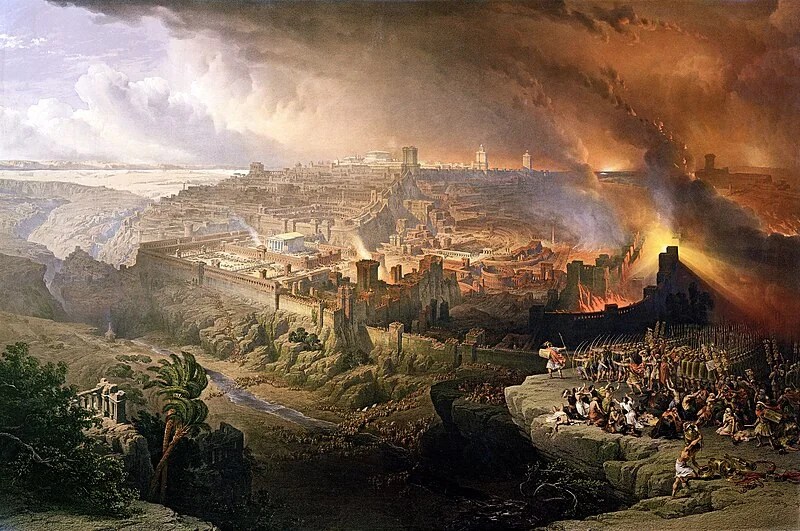
The Roman siege of Jerusalem in 70 C.E.

Part III: The Beginning of the End

Many consider the “West” a nebulous term with no meaning and no history and yet most consider it in decline. As I have referenced, when Oswald Spengler published his epic, The Decline of the West, he posited that the West “wasn’t just in decline; it was being dragged under.” His thesis was that all “cultures” go through a process of birth, blossoming, fruit production and withering to the point of death. The withering phase he called “civilization” because he associated it with a process within the withering phase of excess, debilitation, loss of identity and finally, death. Spengler first published his masterpiece in 1918, and at that time, he saw the West in the withering stage. As he pointed out, the beginning of the withering stage is excess. When civilizations reach the point of excess they become fat; that is not a point of celebration but one of warning. Spengler saw the West at this stage, which forces us to consider a question we would rather not: where is the West now? 

Let’s be clear: the West is not a country, nor does it have geographical boundaries, but it does have a birth, and because it has a birth, it will ultimately have a death. Its birth, according to Spengler, occurred with the fusion of German nobility and the Western Roman Empire, as Spengler saw his native Germany as part of the West. Others point to the marriage of Athens and Jerusalem, but all are references to the merging of the two known worlds at the time into something new and different. Spengler thought the West “blossomed” in the Italian Renaissance, bloomed in the Baroque period and produced its greatest fruit in the 19th century. Gregg posited that the Enlightenment was one example of its fruit, but fruit is only good for a time; eventually it rots.

The Enlightenment, most would say, was not united with Christianity but instead at odds with it. Gregg rejects that idea and any idea that the Enlightenment advanced individual reason at the expense of personal faith. He acknowledges the rise of and focus on reason, but he also points to examples of reason and faith coming together for good during the Enlightenment. He presents one important Enlightenment figure in support of his supposition: Sir Isaac Newton. It was thought that Newton wrote his Principia Mathematica in response to the “materialist assumptions” of Rene Descartes and his views on planetary movements. Newton believed that the entire cosmos, including planetary movement, were governed by a Holy God and his divine providence. It was his faith that drove him to study the world and understand it. Many Enlightenment thinkers considered religion as superstition, but others, like Newton, did not.

As far as products of the Enlightenment, the founding of America is often referenced as one of its greatest. While there is evidence to support this assertion, there is also evidence, i.e., its foundational documents, that tell another story; one where its founders grounded virtue and human morality in reason bathed in a belief of divine goodness. Those Enlightenment ideas that were at odds with the Christian faith coincide with the rise of reductionism and the scientific method as both were coming of age at this time. It was reductionism and modern science that attacked faith, presenting it as incompatible with reason, for the purpose of crowning reason as the only king.   

According to Gregg, there were two claims that severed the reason of Enlightenment with the Christian faith; the first was the belief that there was no fixed human nature, which clashed directly with the Christian belief of a sinful human nature. The second claim—that the only true knowledge was scientific knowledge from the scientific method—contradicted the Christian belief that all knowledge belonged to a Holy God. Gregg argues that both claims isolate science away from faith and subvert all belief in God. Science and faith were presented as mutually exclusive with science celebrated and faith mocked, but, quite unintentionally, the position science claimed and occupied alone would eventually subvert science and reason. We only need to look at current culture and the presence of Critical Theory as proof. It cares nothing for science or reason; it only cares for itself. There is no logic or scientific methodology; it alone is king and ruler. I would like to posit one notion to consider from this point forward: As the Enlightenment was attacking the Christian faith, it was also attacking itself; it just did not know it. 

The ideas and principles it deployed eventually came full circle and were deployed against it. Reason, the scientific method and humanism, all used by the Enlightenment to directly benefit itself, were critiqued, undermined and turned against it by other movements like Romanticism, Idealism, Rationalism and Postmodernism. They revealed that the limitations and exclusions the Enlightenment sought to eliminate from the world were alive and well inside its own ideas, in part, due to its own nature. It is this nature that was, in my opinion, adopted, manipulated and used by Critical Theory to assert itself in the West as the new authority. It is Critical Theory that now pushes the West to the brink of decline and death.  

Stay tuned for the last post in this series as I discuss where the West is now. Until then, remember thinking matters!  

The Rise and Fall of Western Civilization: Part II

Part II: Western Civilization and Christianity

We, in the West, love our freedom, our liberty and all the choices afforded to us. We love free speech, the right to an education and class movement. We vote, are free to be critical and free to believe different things, if we choose. All of these “rights” are ours, at least we believe that they are ours. There is just one minor problem: these rights we claim as ours are found only in the West and nowhere else. They are not really ours but on loan to us from the West, which begs the question, why, then, is the West in decline?

I ended my last post suggesting a connection between Christianity and the West, and in this post, I am going to defend that suggestion. Whether you believe in its truths or not, and you are free to do both in the West, there is no denying the impact Christianity has made, not only on the West, but on the entire world. Many of the beliefs, the values and the traditions we hold dear came to us in the West and from the West, and most of those came to us, like it or not, from Christianity.  

When Christianity entered the world, it came into a world that was a mixture of Roman, Greek and Jew. There were three, Rome, Athens and Jerusalem, major civilizations in the world at the time, all trying to conquer each other, but it was Christianity, according to Gregg, that did the conquering. It made the Jewish God of Abraham available to both the Romans and the Greeks while also appropriating and transforming much of the Jewish thinking into a synthesis of reason and revelation. It was Christianity that changed the world by granting rights to those who had never had rights and introducing change that applied to all people. These ideas morphed into what is known as the West and “Western” thought today. According to Gregg, all of it came out of Judaism through Christianity. It was Christianity that introduced three major ideas that were new and radical; it was these three ideas that contributed to the development of this distinct “Western” culture and “Western” mindset. 

These three ideas were distinct to Christianity and, as we shall see, versions of them were foundational to Western Civilization. First, reason was viewed as divine, which suggested that the world was created by a Holy God and had order and purpose. Second, there was the idea that all human beings had reason and could employ it with assistance in redeemable ways to know truth, including the moral truth of a Holy God. And third, this Christian revolution started by Jesus Christ emphasized a new form of freedom that the world had never seen before. It was a freedom that unfettered all human beings from rulers and their power and provided them a means to a Holy God and to their own betterment. These three ideas changed the entire world and forms of them took root and became foundational to the West as we know it today. 

Those three Christian ideas that changed the world have morphed into three tenets of Western Civilization that we assume to be our own natural rights. They have become a bit distorted over time, but they are still very much alive and active today in the West. We assume they are distinct to the West and products of the West when their geneses are rooted in Christianity. We don’t’ think about them. They are ours, and we assume that they will always be ours because we possess them and have always possessed them. They are part of our normal, our worldview and our paideia if you will. These three ideas are distinct to Western Civilization, and yet they are even more distinct to Christianity, although they are better known by their Western nomenclature. What are they? Well, you will recognize them because they are you and me. These three ideas are three rights we take for granted and call our own; they are the right to an education, the right to a democratic way of life and the right to personal freedom. Each one came to us, not from the West, but from Christianity and along with a host of other “norms” now residing in the West.  

Those three ideas created a revolution of sorts that changed the entire world. They gave everyone power that had only been reserved for kings and queens of old. They put totalitarian regimes and those like them on notice, offering something else, a better form of government, and as much as we want to, we cannot ignore their connection to Christianity. It was Christianity that was affirmed as “the true philosophy” by Clement of Alexandria and lauded for its “integration of faith and reason.” It was Christianity that produced churches, hospitals and schools, including the university, which was founded for the training of the church’s clergy and for the pursuit of truth for the sake of truth. This one product (the university) was a statement on the change that Christianity brought to the world. You can find the university in almost every country in the world today and in its vision, you will find a pursuit of wisdom and knowledge. This educational pursuit was a pursuit that the world had never had the liberty, the ability nor the desire to pursue until this Christian revolution, and all of it was rooted in a belief and in a conviction that there is a Creator God who created a world of order that could be known. Today, our colleges and universities have all but forgotten this connection, but they owe their very existence to Christianity.  

There is wonderful book entitled, The Dying of the Light, that traces the origins of all colleges and universities in the United States. The striking point about this book is that almost every college or university in this country was originally the product of a denomination … the product of some form of Christianity. The Congregationalists, the Baptists, the Presbyterians, the Lutherans, and the Catholics … every denomination that created a colleges or university is in that book and almost every single college or university that was created in this country is in that book. The point not to miss is that these institutions of higher learning were created, in part, due to a mandate from a Holy God and a conviction that this God created a world of order that could be known and should be known, which prompted a curiosity and a desire to learn more about this God and the world he created. One author put it this way, “It [Christianity] launched an age that saw the world as characterized by order, that the human mind can comprehend and a world that merits study simply because it is the world of God.” So, when we talk about the West, in most instances, we are taking about Christianity and its impact on the world. 

It is the West that ushered in the study of science, mathematics and medicine. It is the West that employed democracy in real time and presented it as a better more copious option. It is the West that concerned itself with poverty, slavery and racism, albeit imperfectly. No other country, people group, religion or mindset offered anything close to what the West has offered to the world. It is the West that has taken its advances and advanced itself for better or worse, and while it has had its share of issues, indulgences and mistakes, it has still provided the world with so much. This is Western Civilization and the Western mindset all rolled up into this innocuous phrase we use without a second thought, and today, we find it close to death. Why? In my next post, I begin to examine its fall and death. Until then …  

The Rise and Fall of Western Civilization

Part I: The Development of the West

I recently read an article about the decline and fall of the West, which produced a single thought in my mind in response to this article … Are we living through what many are calling the decline of the West or has the West already fallen? These two questions produced more thoughts and prompted me to do a little reading on the subject. In several articles I read one book was referenced more than all others, The Study of History by Toynbee. It turns out that this is not just any book but, by most accounts, a masterpiece when it comes to Western Civilization. Let me explain why. 

Arnold Toynbee suggested in his book that the West was already in sharp decline. Why did he do this? The Study of History is a multi-volume study of civilization, in which Toynbee studied twenty-one different civilizations across the span of human existence and concluded that nineteen of those twenty-one collapsed when they reached the current moral state of the United States, but here was the shocking part for me: He first published The Study of History in 1931, and in 1931 he posited that the West was in sharp decline and was, according to him, “rotting from within.” Toynbee died in 1975, but I wonder what he would think of our culture today. Are we living in a culture rotting from within or is it already dead?

With this post, I begin a series on the West with the goal of answer the question, is the West in decline or has it already fallen? There are several other excellent books devoted to this topic. Oswald Spengler wrote The Decline of the West, Christopher Dawson wrote Religion and the Rise of Western Culture and Tom Holland wrote Dominion and each author grappled with the same concept regarding the decline of Western Culture. Is Western Culture dead or is it in decline? Let’s find out together. First, let’s explore how the West came to be.   

I begin with Samuel Gregg and his book, Reason, Faith and the Struggle for Western Civilization, which is also excellent when it comes to our topic. In his book, he offers his account of the West, which is like the others but also nuanced with some differences. Gregg argues that Western Civilization was conceived in a marriage of Jerusalem and Athens. His answer is like many others and yet he posits that Western Civilization was born through a marriage of “faith and philosophy” in a version of Christianity born in the West that embraced and applied both faith and reason as one. He sees this “one” coming out of ancient Judaism, which he suggests was a synthesis of both faith and reason as applied in the living of life in a new way. Life was no longer about survival, at least not in the West; there were advancements that made life better and allowed progressions in thought and religion. Gregg states that Judaismde-divinized nature” and was the first worldview/religion to completely reject the ancient idea that kings and rulers were divine and everyone else was to be under them. Judaism, unlike all other religions around it, offered the world a new king. Its rejection of the old idea was through a new view of the cosmos that was spiritually oriented. Judaism saw the cosmos as part of the created order of a universe created by a Holy God and because the universe was created by this Holy God it had order and intelligence and was not formless chaos as all others saw it. 

There was good, in time and space, and hope and all was not lost, according to Judaism, which was a much different narrative of the world than most other historical and religious narratives of the time. What Gregg was proposing was that in Judaism the Jews found a liberation of sorts of the cognitive from time and space. Judaism affirmed that there was a good God in heaven who was a Holy Creator God and that human beings were part of his created order, and not merely interchangeable parts of a larger machine. Human beings were seen as created in the image of this Creator God; they had purpose and were given responsibilities to live as moral beings in this created order. This was a radically different idea than all other ideas before it and what first makes Western Civilization unique. This was a vastly different worldview and would be distinctly western and a foundational mark of Western Civilization. 

The merging of Athens and Jerusalem cannot be underestimated as to its impact on Western Civilization and the Western mind, especially regarding our own current modern Western mindset in the United States. It is the United States that has been the pseudo-capital of Western Civilization for many years now, and it has been the United States that has served as the poster child of the West. The United States has impacted the West, including the Western mindset, more than most. And, now it is this mindset that has become compromised as referenced in part by Alan Bloom in his book, The Closing of the American Mind. It is the American mindset that was so free and so creative that now seems to be more vulnerable and more impacted than all others by the attacks against it. Bloom, in his book, attacks the moral relativism that he claimed was now in control of the colleges and universities. The very freedom brought to us by the West was the very thing being transformed before our eyes. Again, Bloom published his book in 1987, but he appeared to be saying some of the same things. The West, often seen through its colleges and universities, was in decline and dying back in 1987 according to Bloom.  

Back to Gregg, he references that Athens brought both contributions and obstacles to human thinking. It was Athens that was known for its skepticism, its irrationalities and its philosophies; most of them stood in stark contrast to the distinct and different worldview of Jerusalem (Judaism). So, how did they merge when all indications are that they should have clashed? The merging of Judaism and Greek thought, according to Gregg, predates Christianity, which is marked by the birth, death and resurrection of Jesus Christ. There can be no denying the impact of Jesus Christ on the world regardless of your belief about him. Prior to Jesus Christ, educated Jews were more than familiar with Greek thought and moved easily back and forth between Hellenistic and Jewish thinking. This was due to purely pragmatic reasons as the Romans controlled the world and therefore controlled thinking. The Romans were borrowers and refiners. They invented little of their own, but they borrowed from those they conquered and bettered what they borrowed. The Romans allowed those they conquered to keep certain elements of their own culture if they accepted the elements of the Roman culture considered important. It was the Jews who were different than all other cultures; it was the Jews who had this One God who refused to bow down to any other god. Both the Romans and the Greeks viewed the Jews as barbarians. Why? Ironically, it had little to do with their religion and more to do with their thinking and their disposition. The simple answer was that they were not Roman or Greek; the better answer would be to say that they were not Western prior to Christianity. So, there it is … a connection between Christianity and Western Civilization. In my next post, I will explore this connection, but until then …