The Disappearance of Deference: Dissolving Morality

Part IV: The Disappearance of Deference: Dissolving Morality

Full disclosure: this one is a bit long, but the subject matter demanded the length. My apologies.

When it comes to morality, Aristotle believed that moral principles were ingrained into one’s character by past actions “done in right ways and with right attitudes.” These past actions would come from community from those older and wiser. All of this could only take place in communities of differences where morality was much more than a list of wrongs and rights. This was, as Aristotle asserted, ingraining moral principles into one’s character through repeated physical actions done in community with others who would either confirm or correct. It was the action that revealed the morality. Aristotle believed that communal interaction with those older and wiser was how we would recognize the right application for the situation, which, for him, was a form of morality, but none of it mattered without the action. We are born into and live within communities for a reason; we are raised in families with parents; we are taught in schools by teachers and eventually we work and submit to others in vocation, and all of it develops in us a moral sense. The process of maturity, including the development of morality and the ability to reason, involves communities of difference and our interaction with them.

It is important to note the role that action plays in cognitive recognition and moral development. I see this as evidence in support of the importance of communities of difference, which supports Aristotle’s assertion of the relationship between reason and desire, but it would render Kant’s views of reason as merely practical null and void. There is ample evidence to support Aristotle’s notion that a gap exists between reason and desire. This gap between reason and desire has an important distinction; a smaller gap, the more likely we are to think in moral and practical ways, and the more inclined we are to have deference. This smaller gap would also indicate that reason was impacting desire, which is moral in context. A wider gap, the less likely we are to think in practical or moral ways and to have deference, but the issue does not stop there. A wider gap also indicates that we are more likely to reach a point of malicious intent when it comes to morality, due, in part, to reason and desire operating autonomously with little to no impact on each other. 

As sensual people, desire will trump reason if they act independent of each other. In this situation, it will be our desire that pushes us to the point of narcissism and even madness when it comes to morality. Every decision, including moral ones, will be rooted in self, which turns our selfish desires into our own morality. In this moral state, there is no greater good, no concern for others, no empathy and certainly no deference. Our morality and our desire become one. We become hostile to anyone who does not share our ideology, our thoughts or reason as we do, which pushes us to seek community with only those who are like us. We join homogenous groupings that we think share our ideas and beliefs, which seems to confirm our rightness and everyone else’s wrongness, but the opposite is true. These groupings become our morality and determine our thoughts, ideas, and values. In these groups, we think one dimensionally, do little to no thinking on our own and repeat the groups as our own. We do not think in a dialectic way, and our morality becomes narrow and skewed.  

In this moral state, decisions are not based on a greater good or on a concern for others; instead, decisions, policies and even laws are based only on the morality of the group and their explicit ideology or worldview, manifesting through our own perception. It is our perception that becomes our truth, and all thoughts, ideas and decisions are based upon it, which are not original but merely an extension of our grouping. In this moral state, we feel safe and right because we are surrounded by those who share our morality, and our perceptions are always true and right as long as they are rooted in the morality of the grouping. The concept of a greater good dissolves along with empathy for others and all that is left is power. At this point, Aristotle would see this situation as a complete moral failure due to it being based on desire alone. He would see it as a failure to think practically and reason rightly because every situation would be perceived according to one’s own internalized values and for one’s own personal gain, which would come at the expense of all others and any kind of general good. There would also be a personal cost. In this situation, there is no growth or maturity; there is no development. There is only sameness, bitterness, and cynicism.

Sadly, I see this situation playing out before us today. In this moral state, internalized personal values become one’s morality and the main means of reason which form their own reality. In one sense, it is a shared reality with those in the grouping, but in another sense, it is a lonely and isolated place where one feels trapped; to think different thoughts is to commit treason to the grouping. This is devastating because the grouping has become family. It is welcoming and accepting, but only of those who align with its morality and ideology. This causes a loss of a proper perspective on the world and gives way to an isolated and egocentric approach to life. In such a moral state, one’s perceptions are flawed as they become skewed and narrowed, leaving only room for the grouping’s own ideology and morality. Perception instead of reason merges with desire evolving into something masquerading as morality used in moral ways.  

Perception, for Aristotle, was a psychophysical state, which lead him to this idea of akrasia (Please return to my first post for a reminder of what this is.) which revealed the importance of physical action to morality. When a thought moves us to action, we believe and value that thought to the point that we act on it, which is the physical part of morality. Aristotle thought an individual’s actions were not solely defined by their circumstances, thoughts, or ideas but they also included the actions produced by these thoughts and ideas. These physical actions were powerful and moral. For Aristotle, this narrow egocentric view of the world would be unlikely and unable to produce any moral action on behalf of others; it would only be able to produce action for the benefit of self. We are an egocentric people, and our morality is an ongoing fight between the desire to be selfish and the conviction to be selfless, which Aristotle recognized as the battle between reason and desire. 

Aristotle thought that this polarized immoral state was the result of desire dominating reason. For him, it was a lack of character development, which was needed to withstand the temptation of self, that allowed this immoral state to thrive. As people, we will always battle the temptation to be selfish, but it is a battle meant to be fought in community with others who are different and not in isolation on our own. In isolation, especially morally, there will be no means to fight this temptation and to develop the character required to withstand it. It is the relationship between the circumstance of the immediate situation and the circumstance of the particular or the “perfect form” that are the battle lines in the fight to develop the character needed to ward of those temptations. He considered these communities of difference as the proper environment needed to win these battles. 

Aristotle referenced that the battle between reason and desire was difficult because all states of practical thought converge at the same point, which obscured the differences between those who speak of judgment, understanding, practical wisdom and reason with those who possess judgment, understanding, practical wisdom and reason. When we only speak of these issues and no longer act on them, we will never possess them, and they will never become ours to use. These situations indicate that reason and desire are operating independently from one another, and discernment, which is a product of a right relationship between reason and desire and is morally necessary for practical thinking and deference, is no longer being produced, leaving us in an ongoing moral dilemma. 

The answer to this moral dilemma is phronesis, which is roughly translated as practical wisdom, prudence, and sound judgment; it could also be considered deference. For Aristotle, it was this phronesis that acted as intellectual virtue, allowing individuals to make right choices in difficult situations for the greater good, but it was produced only in communities of difference, which is where we learn about virtue. It is virtue that is necessary for phronesis (or deference). Phronesis cannot exist without virtue, and virtue needs phronesis to be developed. For Aristotle, phronesis was the “eye of the soul” and enabled a person, who was virtuous—this virtue came from those past actions done in right ways with right attitudes in community—to do what should be done in a situation, and, if necessary, do it at the expense of person’s selfish desires. It was phronesis that pushed akrasia to the side and replaced it, but again, this could only be developed in communities of difference.  

This phronesis was not about following a set of rigid rules or an explicit ideology; instead, it was more akin to respecting and allowing reason and desire to work as perception and experience, and together, they would serve as the means to finding the “golden mean,” which, for Aristotle, was the appropriate middle or moderate response. Where have all the moderate responses gone? This golden mean does not come from within us, but instead, it comes from outside of us, from others, from community, and from our own internalizing of our interactions with differences. Phronesis, in a virtuous person, gives that person the ability to recognize the right action for the situation in much the same way a coach would coach players. It would be akin to a coach using knowledge, experience, and sense to determine how to prepare players in practice to perform well in a game. This would come from your own knowledge and your own experience developed by someone who mentored you. It would also come from your own sense for the game, which would be based upon how you internalized your past knowledge and experience with your current situation.  

Aristotle compared this phronesis to prudence, which is also analogous to deference. While deference is not practical thinking per say, it does begin in the same right position … an openness to the right action for the situation at the expense of self, which would make its nature moral. Aristotle suggested that when we act morally, we act with courage. Courage is an action made that is right even if it come as the expense of our own desire. He stated that to act this way would require our perception of the action to function as an instantiation, which is a form of courageous behavior (the perfect “form”). In a way, he was saying that acting in moral ways is acting in courageous ways because it is acting for good at the expense of self. It is how reason and desire come together to make a good decision. Sometimes that decision will also be our desire, but many times it will not. 

Aristotle saw practical thinking as a kind of moral temperament, in part, due to the need practical thinking has for selfless action of the individual. This selfless action, according to Aristotle, was a learned action in community and could not be produced in moral isolation by desire alone; it required reason and virtue. Kant suggested it was a priori while Aristotle a posteriori, in part due to the need for virtue. Aristotle believed that passions (desire) alone, which isa priori, could not respond in right ways because of their sensual, self-centered, and innate nature. They are rooted in who we are as people, in our daily desires. However, he also believed that virtue could only be acquired through a process of intentional conditioning through training in communities in possession of virtue, and yes, you guessed it, these communities would need to be communities of difference.

This opens another line of thinking altogether regarding virtue. I will tackle that subject next time. Until then …


The Disappearance of Deference: The Changing Nature of Reason

Part III: Reason

In my last post, I submitted a thesis regarding who we have become as human beings. We are egocentric; we live in communities of sameness and deference is slipping away from who we are. Has reason also changed? To find that answer we need to go back to Aristotle and start with his thoughts on reason. 

Aristotle claimed that abstract forms of reasoning—and most reasoning begins in abstract form—are impossible without imagery; imagery used in reasoning tends to be concrete and come from community. Aristotle suggested that this “imagery” presented a “particular” that the thinker used as an example to measure a thought; he called this imagery a universal (a standard) used to adjust and correct one’s thoughts. One way to think about these particulars or universals would be as if they are akin to Plato’s perfect “forms.” The particular or the form was thought to be the center of cognition, especially when we think about moral ideas. It was a baseline of sorts on which to measure our initial thoughts and perceptions, but, according to Aristotle, these standards do not come from within us; instead, they come from outside of us, from community and the morality and differences found there. It is community that is part of the development of practical thinking and of reason, and, for me, deference is the gate that allows for that development.

But if all ideas are a priori, as many assert today, then reason would also be a priori, which makes little sense if we consider Aristotle’s ideas on reason as accurate. If reason is a priori, it would mean that these particulars, or forms, would no longer function as universal standards because we would no longer interact with community in the ways of the past, which would reduce their impact on us. Our interactions would be primarily with communities of sameness, which would no longer provide moral baselines. Instead, we would seek these communities for confirmation and encouragement, especially if the only communities we engage are those who share our same ideology. In such situations, we would no longer reason; instead, our thinking would be an extension of our own ideology and come in isolated chunks or pieces extending from our own thoughts and in support of our own thoughts. We would not rationalize or even contemplate; we would simply act or not. Everything would be personal to us because every thought would place us at the center. Every thought counter to ours would be perceived as hostile and threating because, in essence, they would be. 

Change, correction and accountability would be our enemy, which means we would keep repeating the same mistakes and never grow or mature. There would be no such thing as a general good because we would have no concern or need for such a good; our only concern would be for our own good. Every thought and action would extend out from us and be rooted in who we are. We would be offended more than encouraged; everything would be personal, and gossip and rumor would serve as a means of confirmation and promotion of our own ideas and thoughts. Thinking this way would not produce any kind of truth or morality, but instead, produce irrationality, dysfunction, and chaos, leaving those who think this way always seeking power and offended if they do not find it. The idea of good would be mangled and reduced to plays of power; the ideas extending from these people would only have two purposes: accumulate power or reluctantly submit to those who have power. There would be no need for respect, deference, truth, or morality. There would be no learning and certainly no reasoning. There would only be divisions, insults, lies and everyone would be watching out only for themselves. Excellence would evaporate and any idea of morality would be considered weakness because every situation would be a play for power, which would be selfish and pragmatic, with morality considered a weakness. Any moral decision for sake of others would be crushed and used for the sake of self.   

With abstract thought, even in this situation, we would still first seek clarification and understanding about an idea before we moved it to action, which is still a form of learning and reasoning, but if we no longer interact or embrace any kind of difference, then, there would be no way for that difference to impact us. Our actions would be reduced to reactions in ways that either benefited us or submitted to the most powerful good at our own expense. Our actions would be reduced to only reactions, which would be purely pragmatic and practical. Any new situation would force either our reaction, which would be based upon an old situation, a power play, if we had power, or our submission to the most powerful idea, but there would be no practical thinking or reasoning as those elements necessary for both would no longer be part of who we are. In each new situation, our own personal good would be the goal. We would no care for others, the greater good or doing what is right.

The absence of practical thinking, according to Aristotle, is ultimately a failure to be moral when we should be moral, which is what separates human beings from all other beings. It would also be a failure to reason properly. Reasoning, practical thinking … both, for Aristotle, were moral in nature. Our tendency, according to Aristotle, is to be too easily swayed to be general in moral situations for selfish purposes, which is what is produced when we live in a world void of deference. Is this not what we see playing out before us in culture? In such a moral state, we would make the choice that is beneficial to us, regardless of its application or situation to others or the greater good. Deference, respect, and concern for others would be gone. The only issue that would matter to us would be our own well-being and this would come at the expense of the greater good and of others. 

The even more disturbing part is that the morally right decision would mean very little to us. We would see it as weak and lacking excellence; we would even present it as a poor decision when it was merely a decision against us. Our response would either be to submit to the decision or invoke our own power to sway the decision toward us. I would question whether we, in this moral state, would even recognize how morally upside-down or selfish our decision was, in part, due to who we had become as a human being. Would the general good be general or even considered good anymore? I am not sure. Would there be a right way to do things, or would that merely be a distant memory? 

Do you recognize any of this? It is the path that we are on. Politicians, entertainers, athletes … all with power and all looking out only for themselves at the expense of everyone else while lecturing the rest of us on what we should be doing. If truth is relative and merely a means to a personal end, then there is no moral basis on which to lecture anyone anymore. There is no good and evil. There is only self. What would be the first sign that our culture is on this wrong path? In my opinion, it would be the disappearance of deference.

This concludes this section, but there is another one the way. Until then … 

The Disappearance of Deference: Analyzing Cultural Divides

Is Deference Gone for Good?

Part I: Akrasia

I think we can agree that we are a divided people. It may be one of the last issues on which we agree, but that does not make it any less true. As divided people, we tend to view those who hold different values and beliefs as the enemy; we offer them no respect, no friendship, and certainly no deference, which prompts my question: Is deference gone for good? Does its absence divide us or are we divided because of its absence? I should probably offer my understanding since the term is one that can now mean many things. 

Deference, for me, is a posture of respect for others and their judgements or opinions, especially those with whom we differ. It is a humility of self and a courteous regard for others. Deference extends beyond a concern for a person; it is also a concern for that person’s reputation and character. It is careful consideration of one’s own thoughts and opinions to avoid gossip, slander, and false accusations. I also see it as embracing difference in such a way as to respect it in both people and ideas. Today, difference divides, which may explain why deference is disappearing. This situation is unhealthy because we have now been given the means to isolate ourselves into our own homogenous groups of sameness. Now, we not only avoid difference—we attack it. I recently read an article on Aristotle’s views on reason that presented an interesting perspective on all this. This series of posts will explore this line of thinking. 

The author began the article with a statement … that Aristotle’s Nicomachean Ethics was generally about practical thinking. While I hold a slightly different view, this idea of practical thinking does speak to my concerns regarding deference. The author suggested that practical thinking, according to Aristotle, was something that “we, as human beings, use to impact others by way of our reason.” It was this statement that garnered my attention because it was a statement rife with implications regarding reason. If Aristotle was right, and I believe that he was, then he has something to say regarding both reason and deference. Let’s begin with Aristotle’s semantics associated with practical thinking. He thought that any kind of thinking that required the “conceptualization of one of more actions” was considered practical thinking due, in part, to the movement of a thought to a physical action. This, for him, was the natural progression of practical thinking, which makes a cleaner distinction between it and cognition. 

According to the author, to understand Aristotle’s views on practical thinking, it is best to begin with the term, “akrasia,” which, for him, was acting against one’s better judgment. Aristotle saw akrasia as “lacking self-mastery; it is often translated as “weakness of will” or “incontinence,” which is an action against one’s better judgment or in accord with one’s own desires at the expense of a right decision, which tends to represent the general good. Could we also say, in a secondary sense, that akrasia is a lack of deference as well? Maybe. According to Aristotle, the failure to act against one’s better judgment for the sake of good was a conflict between reason and desire and a lack of self-control. It is the action that is key. Aristotle saw thinking that produced a physical act as the manifestation of thoughts to actions governed by beliefs and values, making practical thinking moral in nature. It was one’s beliefs and values that often determined when a thought became an action. To act for the good of others or for the general good at the expense of self was, for Aristotle, an element of practical thinking, and, for me, foundational to deference, because the implication is that both practical thinking and deference are moral in some way. However, there are those who would say that the same could be said of evil acts. They, too, are thoughts manifesting as acts, but their moral make up is, instead, immoral in nature. The point being that practical thinking is practical when its thoughts manifest as actions, but it is the nature of those actions that determine its moral makeup, which is where I see it impacting deference.   

I see deference disappearing from our culture and there are many reasons why. After reading this article, I have become convinced that the loss of practical thinking that is moral in nature could be one of those reasons. I believe one major contributor to this loss is technology and its many forms. It now provides the means to promote self while also attacking difference, which is not deference, but it is practical thinking. I believe Aristotle would agree that technology does contribute to this idea of akrasia. Today, most accusations are based upon one’s own perceptions and feelings. While I acknowledge that perceptions and feelings matter more today than they did yesterday, they are still personal and limited, especially when applied beyond oneself and in communal ways. In the past, it would be at great personal risk to apply one’s personal insecurities broadly, and yet today, those expressions seem to be more the norm. Modrak, the author, referenced that a consistent failure to act according to one’s better judgment or for the general good would seem irrational and maybe even criminal. These acts, regardless of their composite, are still moral in nature even if their foundation is more immoral than moral.  Too many of us determine truth according to our own perceptions and feelings with no concern for others or their perceptions and feelings. We often act on these thoughts, and it is this action that makes our thinking practical, but action alone does not determine good or bad in regard to the morality of our actions.  

Determining morality today has less to do with right and wrong and more to do with personal perceptions and feelings. When we use our own perceptions and feelings to determine moral goodness, we are using them as presuppositions—those beliefs that are foundational and guide all our other beliefs—but they remain personal preferences in support only of ourselves. This is problematic. In most cases, they are in direct contrast to our better judgment and to the general good because they are rooted in who we are. The idea that practical thinking is merely the conceptualization of a thought into an action is skewed, and only partially the issue. This, too, is due, in part, to technology. When we use a preference as a presupposition, which we do in social media, when it is actually a preference, we will eventually perceive our preferences as presuppositional thoughts and ideas due to our constant use of them in presuppositional ways. Yet, their sole purpose will still be self-proliferation, which, is, at best, a lack of deference and, at worst, a form of madness.

Let me stop here and explain why I made this logical leap. Acting against one’s better judgement for good is considered moral, but acting for self against what is good used to be considered immoral or amoral, but today, those distinctions have become cloudy. If practical thinking rooted in an individual’s selfish preference now functions as a presupposition, it would be thinking akin to asserting one’s selfish desires as one’s moral foundation, with those selfish desires governing all other beliefs. In the past, we saw selfish actions as evil. It was the villain who was the one who wanted to take over the city for personal gain, but it was the hero who saved the day. Why? Well, it was the hero who acted for the greater good on behalf of the general population at great personal expense. Today, perceptions of actions like these are no longer cut and dry. There is no longer consensus as to their nature.  

According to our nature, our personal perceptions and feelings, as good as they may be, are self-centered and meant to be vetted in community to determine their communal validity before they ever manifest as practical thinking. However, with the onset of technology, more and more perceptions and feelings are finding their way online into like-minded platforms and in like-minded communities. They are no longer vetted in communities by difference, but instead, they are confirmed in online communities of like-minded perceptions and feelings. The dialectic process (thesis – antithesis – synthesis) has all but disappeared in culture, and it is quickly disappearing in academia as well. The vetting process, used in the past to confirm the true from the false, has been replaced with homogenous confirmation celebrations that promote a group’s specific thoughts and ideas as true and right because, in such groups, they are. This is from where the divide comes. Both sides celebrating their thoughts and ideas as true and right.

I see deference, common sense, empathy, and the like developed and refined, in the past, by way of community. Community was necessary because, as social beings, we are meant to live in community with other human beings who will almost certainly be different. We will respect some, dislike others, and befriend others, but we will socialize with everyone and learn and develop inside these percolators of differences found in communities. It is statistically impossible for all our thoughts to be right and true all the time. However, today, we have become isolated, but the isolation I reference is not just a physical one. It has extended into a moral and psychological one, manifesting in forms of moral absolutism or cognitive bias. Living in such moral isolation is living inside one’s own moral rightness in a community of others who share our moral rightness. It is a moral isolation that is reinforced daily through a homogenous community. In this community, individual goals of self-preservation and self-proliferation and those preferences are shared and masquerade as morality. 

In any situation of conflict, the morality of the community will be right because its communal moral focus will always be itself, which makes every decision rooted in the protection and promotion of self. Morality, in this sense, is a priori, innate, and always emanating from within. Living in such a state is living in a created moral reality that is circular, producing more and more of its own morality, which is a vortex of sorts that pulls its members deeper into itself. This is the nature of a cult, but on a more macro-level. It is a belief system in alignment with Kant’s view of morality. That it was rooted in purely rational thought but separate from sensory experience. This view, as we will come to understand, contradicts Aristotle’s views on practical thinking and my views on deference.

This is the context for our next discussion which will focus on the differences between thoughts and perceptions and reason and desire and their relationship with practical thinking and deference. Until then … 

Education, Painted and Soiled: Part IV

Education: Painted and Soiled

Part IV: More of Aristotle’s Nicomachean Ethics  

A clearer picture of education is beginning to emerge. One that is more removed from current views, which is not really a surprise. As I dig a little deeper into Aristotle’s views, I must confess that I have not been Aristotelian for much of my life, but in the later years, I have seen the errors of my ways and come to him. It is projects like these that add to my appreciation of him and his work. 

I begin this section with a quote. Aristotle, in his Metaphysics, wrote, “It is through wonder that men now begin and originally began to philophise … he who wonders and is perplexed is ignorant; but, to escape ignorance [that] men studied philosophy.” The word “escape,” in this instance, is an infinitive which binds itself to ignorance. Ignorance, in this quote, is presented as that which is common, normal, pedestrian and functions more as a trap. The takeaway is that ignorance, to Aristotle, required escape; without escape, every human being was vulnerability to its enticement. Wonder, however, was a door away from ignorance and to philosophy, but be warned, Aristotle understood that wonder would perplex us, especially without philosophy (education). It would become ignorance which would be there waiting to ensnare us if education were not our guide; it would always be waiting for us, to settle, to take the easy way out, to be stagnate—it would always be there to accommodate us if we ever left education. Nothing much has changed.  

Aristotle believed that philosophy (education) was the love and pursuit of wisdom, which destroyed ignorance which he saw as temptation in the forms of apathy and sedentary. It was philosophy (education) that was different, but it required pursuit which was proactive action on the part of the human being. It suggested that the nature of education was fluid and active and not stagnate and sedentary. It would have to be pursued and it would demand our work and commitment. Wonder was the key to all of this; it would draw us deeper into the process. It would be there when we were weary or tired. Wonder was always the beginning, suggesting something important. Wonder was the antithesis of ignorance. It was protection and philosophy’s beginning but never its end. We wonder and risk ignorance the moment we stop. Wonder is also education in every sense of the word. It is wonder that prompts us to know. It is wonder that keeps us knowing and learning. Aristotle considered wonder necessary for both the learner and the teacher.

Aristotle saw the process of instruction as rooted in thinking and learning. It was a series of steps that must be taken by both the instructor and the learner with wonder as the first step in each series. To begin instruction, wonder must be present. It was necessary and if not present, the teacher was to create it for the learner must enter the learning process with curiosity (or wonder). But both the teacher and the learner were responsible for the own posture, and part of their postures was always to be wonder. Both were to enter the encounter curious as to what awaited them. They were to be eager in anticipation of the things they would learn. They were also to understand that they needed each other, and that education could not happen in isolation. It isolation it would always be limited.   

Aristotle’s second step, “individualized” instruction, rested in his belief that each student harbored unique talents, interests and preferences, which demanded a personalized approach to learning. For education to take place, the teacher had to know the learner, but the learner had to know the teacher and had to want to know the teacher. He posited that curiosity, critical thinking and individual inquiry in a student must all be reinforced through the personal guidance and support of the teacher. The role of the teacher was crucial to the success of the student, but the teacher’s role was tied to the learner’s attitude and posture. If the learner did not enter the interaction curious, ready to learn and seeking to know the teacher then the teacher’s role was limited. Education was threatened and ignorance was possible.  

His third step is more well known, The Socratic Method. Aristotle borrowed this concept from Plato and expanded on it. It is a cooperative form of dialogue based on thought-provoking questions and guided reflection thought to produce meaningful learning outcomes. Aristotle encouraged open dialogue between students and teachers for purposes of collaboration and discovery, but they were not to be equal participants. They must respect each other and their respective roles. It was up to the teacher to walk the learner through a process rooted in rigorous debate, which exposed erroneous reasoning leading to deeper understanding. The process was continuous and balanced, and it required both the learner and the teacher to embrace it and respect it.   

The fourth step was theory and practice. For Aristotle, the two came together as one. As I have referenced, he believed that for learning to happen theoretical knowledge and practical application must interact. He saw understanding as requiring both. He wrote, “For the things we have to learn before we can do them, we learn by doing them, e.g. men become builders by building and lyre-players by playing the lyre.” Aristotle often encouraged his students to apply theoretical concepts to practical problems because he believed, in doing so, his students would develop practical wisdom, improve critical thinking and become better problem solvers. For Aristotle, doing was as important as listening and studying. Process was important and could only be learned by doing repeatedly.   

Aristotle believed in many formats and methods. His lectures were thought to be littered with quotations, references, examples and images as he acknowledged the power of enhancing understanding through additional means. His goal was always to engage his students in the best possible ways, and he was always seeking new modes of engagement. As Aristotle taught his students, he understood that learning extended into the cultivation of virtue and morality in students. He sought to nurture individual virtues through his teaching. He believed that to live a fulfilled life we must be morally upright and virtuous. We must put these virtues into practice, or we could not be considered educated. He wrote, “These virtues are formed in many by his doing the actions … The good of man is a working of the soul in the way of excellence in a complete life.”

Aristotle was always faithful to what he called “the mean.” The mean was a balanced approach to life. It was not being over strenuous or excessive nor overly simplistic, superficial or sedentary. His answer was living a life of “harmonious balance,” which he saw as wedded to learning. The Mean or, as it has also been called, the Golden Mean, is moral behavior between two extremes: excess and deficiency. As people, he thought the proper way to live was to find a moderate position between two extremes and live that position to the best of our ability. Aristotle saw right living as living morally upright, which was to live a life faithful to the mean. 

According to Aristotle, education was that which equipped human beings to live such morally upright faithful lives. Education, to provide the means to live such a life, had to be active, moving and an active pursuit. It was not easy, not stagnate and not reactive but it was intentional. It was a process that rested with the learner and the teacher, and both must enter the interaction willing, fully committed and exerting ample effort or very little learning would take place. Virtue, morality, personal responsibility … all of these were important parts of education to Aristotle and marks of an educated life.

I have found that this idea of education is not simple. It is more complex than imagined but it is well worth my efforts and time. Until next time … 

Education, Painted and Soiled: Part II

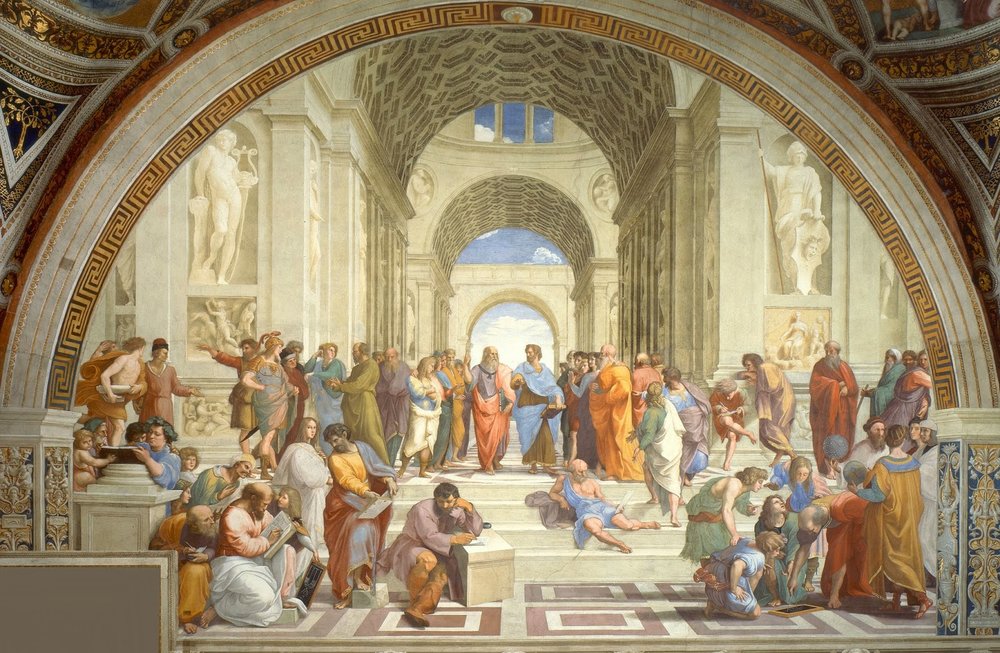
Raphael’s The School of Athens featuring Aristotle and Plato and many others!

Education: Painted and Soiled

Part II: Aristotle  

That nagging question has not gone anywhere. Back peddling to the 16th century helped but not nearly enough. If going back the 16th century helped, then it can’t hurt to go beyond the 16th century, to Aristotle and his views on education. Aristotle lived in the 4th century BC; he was born in Athens in 382 BC and lived until around 322 BC. He studied and wrote on many topics, education being one of those. 

The first Aristotelian idea I bumped into related to education was the idea of hexis, which is “a readiness to sense and to know.” This was a posture of sorts referred to as an “active condition” of a human being. Aristotle saw this condition as acquired and not innate, which is a statement about his thoughts on education. Aristotle borrowed this term from multiple sources, the Greeks and Plato to name two. The importance of hexis was its emphasis on habitation. Aristotle believed that one’s virtues were one’s habits and living a good life depending on living a life of virtuous habits. The adage, you are what you do most, comes from Aristotle’s thoughts on habits.  

For Aristotle, hexis was a constant disposition composed of character, heath and wisdom. It was a blend of personal responsibility, cognitive development and the environment, i.e., the educational process. It was a “habitual state of having” and was something uniquely human. According to Aristotle, it was this “active condition,” this continuous “having (or wanting),” that positioned human beings to live in wise ways with other human beings. This wise way or posture was perceived as education and as communal. The theme of unity and community, found here, is also found in the Latin and in other ancient ideas of education. There was an connotation; it was not as clear, but it was there. It was this idea that education cannot be education in isolation or in selfishness.

Aristotle referenced another important concept in his writings on education, a “guiding eidos,” referring to it as a leading idea. Eidos was the Greek word for “form,” and Aristotle used it to describe the essence of things. Aristotle believed that all physical objects are made of both eidos (form) and hule¢ (matter), two contrasting notions that he saw as necessary in the making of things. This eidos, for Aristotle, prescribed the nature of a product; he used it to describe his thoughts on education, which reveals some of his beliefs and thoughts on education. This “eidos” was a state of being, an attitude, a disposition when referenced regarding human beings … It was a suggestion that human beings live to be happy and to flourish and that both could only be reached together. Aristotle suggested that one of the best ways for them to come together appropriately was inside the process of education. 

As I explored more of Aristotle’s ideas on education, I continued to bump into many subtle references to community. Community, for me, cannot be built without a concern for others, but inside this concern must be something else: a willingness to sacrifice self for the sake others. It was living away from self and towards others. Aristotle’s philosophical theory, virtue ethics, emphasized the development of moral character, i.e., virtues, for this reason. This was living ethically for others; it was living away from self and towards others. Aristotle encourage people to live virtuous lives of courage, justice, liberality, patience and truthfulness. This was a virtuous life, in some respects, for Aristotle. It was as if he saw selfishness and the lack of virtue as signs of being uneducated.

This “guiding eidos” that he referenced was a unique disposition he used in discussions associated with education; Aristotle used the term, halting in connection with it, implying that it was a characteristic of the educated. Aristotle used the term, Halting, to reference movement. He saw this movement, this halting, as a process that “had already begun and would continue” into the future. By connecting this halting to education, he was implying that education “moved” in a similar manner. It was, as processes go, movement which had already begun and would continue into the future. There were no suggestions that it would slow or even end. It was a lifelong process akin to life.

All of this, according to Aristotle, ultimately led to praxis, which was “informed committed action.” This was not reaction, selfishness nor individual pragmatism; it was educated intentional intimate action for the sake of others and eventually for the greater good. For Aristotle, praxis was one of the three basic human activities, which were praxis (action), theoria (theory), and poiesis (making). Praxis was considered practical, thoughtful activity that was to be goal-directed and voluntary, and it demonstrated human freedom. Theoriawas theoretical activity with a single purpose focused on discovering truth. And poeisis was making or productive action, and it created something new. Aristotle believed that praxis must be guided by a moral disposition for one to act in righteous ways. Why? Aristotle believed that there could be good praxis (eupraxia) and bad praxis (dyspraxia), which makes sense considering he believed that hexis and most of education was acquired and not innate. 

The modern idea of education is nowhere to be found in the etymology of the word, in the Latin or in Aristotle’s thoughts on education. Why is that? Do we have it wrong? As I referenced earlier, I believe education has been painted and soiled to the point that it is not even education anymore. It is something else. I believe this “something else” is being presented as education, whether intentional or not, and is now considered by most of us to be education. When our children walk into their schools, they assume—and we do to— that they are receiving an education, but what if they are not? They are receiving something. Are you confident that you know what it is?

There is an infamous quote attributed to Aristotle regarding education, “Education is the process of training man to fulfil his aim by exercising all the faculties to the fullest extent as a member of society.” In this quote, Aristotle’s goal of education is not just focused on man, but that man would become the best member of society that he could possibly be. This is a focus on mankind, not on self, for the sake of community. It was a thought that every man and woman would be a contributing member of society for the betterment of self and community. How could this be done? Aristotle believed that education was one of the chief manners of accomplishing this goal. Education, for him, was not to for vocation nor for self; it was for personal betterment for the purpose of communal betterment; they went together. They needed each other, but there was a danger if we only focused on ourselves, which was why he promoted a virtuous life and recognized the need for a virtuous education. 

We are just scratching the surface. There is so much more and that is if we stay with Aristotle. In my next post I explore his Nicomachean Ethics, which is where he presented more thoughts on education. Until then … 

The Rise and Fall of Western Civilization: Part V

Part V: Death

In my last post, I posited the idea that in the West we stopped pursuing morality in the name of freedom but that is only half the story. We stopped pursuing morality to fully embrace freedom as our new morality. This new morality functioned as the pursuit of whatever we wanted, making freedom something it was never intended to be. It became you and me at the expense of “we.” Freedom will stop being freedom when morality is removed, and when it becomes about you and me it is already gone. We, as human beings, will never stop pursuing. In most cases, we will pursue our own needs and desires, which sounds nice and sounds safe but, it eventually leads to darker places like narcissism and nihilism.

Today, we are told that we are free, and it is Critical Theory that has freed us. It has unshackled us from the chains that have bound us, but were they really binding us? What if those chains were not binding but restraining? What if they were restraining us from becoming evil, from our own demise and from excess? It is excess that the West has given to us as freedom. Let’s be clear: excess is not freedom, and it never will be, and yet, it defines us. It is our desire; it is our dream. Does having more make us free; does it make us happier? I do know that having more makes us want more, and that is not freedom. That is addiction; that is bondage. When we get more, we want more; it never seems to be enough. That sounds oddly familiar, like something else entirely … something at odds with freedom. What happens when I want something that you want? Is that freedom or are we back to a “survival of the fittest” mentality? Maybe, we never left? 

Marxism in the West has taken on many forms and addressed many issues, but it has accomplished its greatest task. It has made the West a land of individualism. We are promised everything, and we have been conditioned to believe that we can have everything. It is this promise that has become our idol, worshipped by everyone at the expense of everyone. Remember Spengler’s critique of civilization, excess was not a point of celebration but a point of concern. It was a warning bell and a flashing red light. In the West, we no longer hear the warning bells or see the flashing red lights? Why? Excess is who we are. This wanting more … it is always there, pushing us to think about ourselves, and every time we do, it is at the expense of someone else. We no longer see others. We only see ourselves. This is what excess does … others become obstacles preventing us from getting more. 

Excess has seeped into our being. It now defines our excellence and is our passion. More is better, easier and what we want most. Best is a distant memory. Excess produces no loyalty, no common sense and no honor; there is only individualism and the striving for more. When we stop and look in the mirror, we see something unfamiliar, something we no longer recognize. We have been living in this land of excess for too long. Excess has become who we are. We think it is good for us, but it is a sickness that is slowly killing us. We are no longer ashamed our actions; we no longer take responsibility for anything. We stopped seeking humility long ago. Our only concern is to get as much as we can for as long as we can.  

This is the West. Excess has replaced our desire for excellence and our concern about goodness with itself; all we want and care about is more. Sound familiar? This is you and me. This is survival of the fittest, chaos theory and AI all rolled up into one. This is what death looks like at the cellular level right before oncosis. Our concern is for ourselves at the expense of everyone else, and it is not moral, not ethical and certainly not civil. It is gluttony; it is embracing profligacy as if it is the air we breathe and the water we drink. Excess has become life to us. We have been told that we can have it all and we have believed that we could, never giving a second thought to what getting it all would do to us or do to others. Just look out your window and watch the world for a moment. What do you see? Bigger, better, more … everywhere. No one is immune. Excess is us and it is everywhere. 

It is 2025; there are few if any traces remaining of the West and its past. The Athens of old is gone and so is Rome, but there is America. It is the land of opportunity, the shining star of the West. It represents all that we could ever want. Is it the West or something else? One author put it this way: “Call American civilization brutish, materialist, or racist (it has been called all of those things), but don’t call it Western. Western civilization declined and fell a century ago, and it’s not coming back.” In other words, the West (America) is not sick; it is not in decline. It is not being rescued or revitalized. It is dead. 

The West is dead. We have been living in its decay and rot for some time now. And, to make matters worse, we killed it. That’s right and its death was due to our individualized gourmandizing. It was our wanting more … our never being content with what we have. We embraced excess without considering the consequences and, there are always consequences. We did not think it would matter, but we should have known better. We should have known that having it all was not possible; that everyone can’t be excellent, happy and wealthy all at the same time. Individual fulfillment does not produce collective excellence, community or even a future and it never will. I thought we learned this lesson over 200 years ago. Have we forgotten them already? 

It is the end of the story for the West. There is no looking back nor is there wishful thinking. Death is final. There are no second chances and no rescues. Death is death. There is now only looking forward towards a new beginning. This is the way of civilizations; instead of mourning death and avoiding it, we should embrace it because the end of one thing is always the beginning of something new. The death of the West means something new is coming, or it might already be here. It might not be what you want or what I want, but it will not be what we have known. It will be different. We have a choice. We can sit and wait, or we can be part of its development. The choice is yours; the choice is mine. Let’s hope that we make a better choice this time. Let’s hope we are together and not apart, and that we have not forgotten the hard lessons of the past as we move into new beginnings. We will need to remember them, or we will be doomed to repeat them. 

This concludes this series. I hope you enjoyed it. Until next time …