
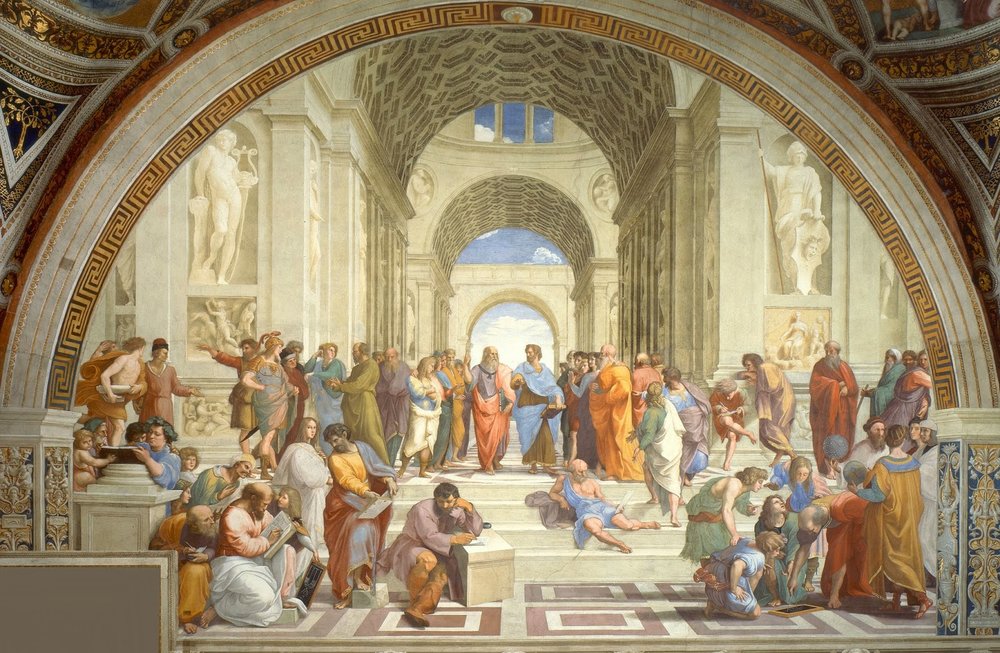
Raphael’s The School of Athens featuring Aristotle and Plato and many others!
Education: Painted and Soiled
Part II: Aristotle
That nagging question has not gone anywhere. Back peddling to the 16th century helped but not nearly enough. If going back the 16th century helped, then it can’t hurt to go beyond the 16th century, to Aristotle and his views on education. Aristotle lived in the 4th century BC; he was born in Athens in 382 BC and lived until around 322 BC. He studied and wrote on many topics, education being one of those.
The first Aristotelian idea I bumped into related to education was the idea of hexis, which is “a readiness to sense and to know.” This was a posture of sorts referred to as an “active condition” of a human being. Aristotle saw this condition as acquired and not innate, which is a statement about his thoughts on education. Aristotle borrowed this term from multiple sources, the Greeks and Plato to name two. The importance of hexis was its emphasis on habitation. Aristotle believed that one’s virtues were one’s habits and living a good life depending on living a life of virtuous habits. The adage, you are what you do most, comes from Aristotle’s thoughts on habits.
For Aristotle, hexis was a constant disposition composed of character, heath and wisdom. It was a blend of personal responsibility, cognitive development and the environment, i.e., the educational process. It was a “habitual state of having” and was something uniquely human. According to Aristotle, it was this “active condition,” this continuous “having (or wanting),” that positioned human beings to live in wise ways with other human beings. This wise way or posture was perceived as education and as communal. The theme of unity and community, found here, is also found in the Latin and in other ancient ideas of education. There was an connotation; it was not as clear, but it was there. It was this idea that education cannot be education in isolation or in selfishness.
Aristotle referenced another important concept in his writings on education, a “guiding eidos,” referring to it as a leading idea. Eidos was the Greek word for “form,” and Aristotle used it to describe the essence of things. Aristotle believed that all physical objects are made of both eidos (form) and hule¢ (matter), two contrasting notions that he saw as necessary in the making of things. This eidos, for Aristotle, prescribed the nature of a product; he used it to describe his thoughts on education, which reveals some of his beliefs and thoughts on education. This “eidos” was a state of being, an attitude, a disposition when referenced regarding human beings … It was a suggestion that human beings live to be happy and to flourish and that both could only be reached together. Aristotle suggested that one of the best ways for them to come together appropriately was inside the process of education.
As I explored more of Aristotle’s ideas on education, I continued to bump into many subtle references to community. Community, for me, cannot be built without a concern for others, but inside this concern must be something else: a willingness to sacrifice self for the sake others. It was living away from self and towards others. Aristotle’s philosophical theory, virtue ethics, emphasized the development of moral character, i.e., virtues, for this reason. This was living ethically for others; it was living away from self and towards others. Aristotle encourage people to live virtuous lives of courage, justice, liberality, patience and truthfulness. This was a virtuous life, in some respects, for Aristotle. It was as if he saw selfishness and the lack of virtue as signs of being uneducated.
This “guiding eidos” that he referenced was a unique disposition he used in discussions associated with education; Aristotle used the term, halting in connection with it, implying that it was a characteristic of the educated. Aristotle used the term, Halting, to reference movement. He saw this movement, this halting, as a process that “had already begun and would continue” into the future. By connecting this halting to education, he was implying that education “moved” in a similar manner. It was, as processes go, movement which had already begun and would continue into the future. There were no suggestions that it would slow or even end. It was a lifelong process akin to life.
All of this, according to Aristotle, ultimately led to praxis, which was “informed committed action.” This was not reaction, selfishness nor individual pragmatism; it was educated intentional intimate action for the sake of others and eventually for the greater good. For Aristotle, praxis was one of the three basic human activities, which were praxis (action), theoria (theory), and poiesis (making). Praxis was considered practical, thoughtful activity that was to be goal-directed and voluntary, and it demonstrated human freedom. Theoriawas theoretical activity with a single purpose focused on discovering truth. And poeisis was making or productive action, and it created something new. Aristotle believed that praxis must be guided by a moral disposition for one to act in righteous ways. Why? Aristotle believed that there could be good praxis (eupraxia) and bad praxis (dyspraxia), which makes sense considering he believed that hexis and most of education was acquired and not innate.
The modern idea of education is nowhere to be found in the etymology of the word, in the Latin or in Aristotle’s thoughts on education. Why is that? Do we have it wrong? As I referenced earlier, I believe education has been painted and soiled to the point that it is not even education anymore. It is something else. I believe this “something else” is being presented as education, whether intentional or not, and is now considered by most of us to be education. When our children walk into their schools, they assume—and we do to— that they are receiving an education, but what if they are not? They are receiving something. Are you confident that you know what it is?
There is an infamous quote attributed to Aristotle regarding education, “Education is the process of training man to fulfil his aim by exercising all the faculties to the fullest extent as a member of society.” In this quote, Aristotle’s goal of education is not just focused on man, but that man would become the best member of society that he could possibly be. This is a focus on mankind, not on self, for the sake of community. It was a thought that every man and woman would be a contributing member of society for the betterment of self and community. How could this be done? Aristotle believed that education was one of the chief manners of accomplishing this goal. Education, for him, was not to for vocation nor for self; it was for personal betterment for the purpose of communal betterment; they went together. They needed each other, but there was a danger if we only focused on ourselves, which was why he promoted a virtuous life and recognized the need for a virtuous education.
We are just scratching the surface. There is so much more and that is if we stay with Aristotle. In my next post I explore his Nicomachean Ethics, which is where he presented more thoughts on education. Until then …

 Bridge Roe: Where Thinking Matters