The Disappearance of Deference: The Importance of Virtue

The Disappearance of Deference: The Importance of Virtue

If you tackled that last post … thank you so much. The writing of that post was a bit cathartic for me, but it did bring me finally to the topic of virtue, which will close this series on deference. Virtue, according to Aristotle, is the disposition to choose the mean relative to oneself in accord with the right principle for the situation. Let me explain what Aristotle means by his idea of the mean. The mean is the middle or the moderate, and it is where I believe truth lives. Polar extremes are where we love to reside because they are quick, clear, and precise. They, however, are not home to truth. The mean emphasizes moderation which is how we are to live. For example, too much water in a short period of time can kill you; too little water over a longer period can kill you. The right amount of water throughout your life will keep you healthy. You will find that this axiom works in most of life. This mean or middle should be the position of a virtuous person. It should be the position of a wise person. We should understand that polarized positions rarely produce wise decisions, but this seems to be one of those lessons we never learn. I think it has something to do with our nature.      

Virtue, according to Aristotle, is a hexis, a state, a stable disposition, or habit of right actions at right times in right ways according to the right principles. It is doing the right thing for the situation or the moment at the expense of self. Here is the complicated part; these right actions that we choose, to be virtuous, they must also be our own choices. They cannot always be choices that come at the expense of ourselves. Aristotle’s point is that we, as people, will struggle to constantly make choices at our own expense; as a matter of human nature, we will not be able to make such choices consistently. However, if we are virtuous people in pursuit of virtue, the virtuous choices that we make will also be our personal choices because of the virtue that is part of who we are. This is why I think Aristotle found virtue so valuable. These right choices that we make are chosen because they embody a mean between desire and reason, which would make the choice, even if chosen for selfish purposes, virtuous, due to our pursuit of virtue. Again, a choice would only be virtuous if the person making the choice was pursuing virtue. We are not just virtuous; it is not a class we take or a characteristic we choose to have. Virtue is a daily pursuit that will come at the expense of self, but that daily pursuit will make us into someone who can and will choose virtue consistently.  

In a virtuous person, reason will be moral and govern desire, which was necessary to live a good life. Aristotle believed that a virtuous action involved the right balance of reason and desire. It was the coming together of the two, and their proper balance that was important, but it required a daily consistent intentional pursuit of virtue. Why was the pursuit important? If we do not pursue virtue, then we will pursue ourselves in some way. As I have referenced earlier, the wider the gap between reason and desire the more selfish and malicious we are, which will strengthen our addiction to ourselves, and that will be who we pursue. The gap is the key. This is why I believe Aristotle advocated a practical form of reasoning. 

The standard for a courageous act was not a general understanding of the act itself, those involved in the act, or even one’s feelings and perceptions of the act or the situation, but, instead, it was a personal standard based upon a principle rooted in the willingness to act against one’s better judgement for the good of others. This act often came at the expense of self, which would become a more difficult decision each time unless one was in daily pursuit of virtue. This was and is why virtue is important, but it is not a stagnate thought or an essential characteristic. It is a fluid and active posture, a mindset and a morality that must be pursued each day. 

We will not live this way if we are selfish, or if we are ruled only by desire. We will only live this way if we are virtuous, which is having the right balance of reason and desire. Our virtuous actions will be those needed for the time and the situation only if we have developed a habit of pursuing virtue daily. We will make the right choice if we have the right balance of reason and desire which will manifest as practical thinking rooted in virtue, which will produce the right action. How do we end up making more virtuous decisions than not? Well, we must possess a belief that an action for the good of others is ultimately also an action for the good of ourselves, and that is a thought only found in virtuous people. Deference for others is one indication of the presence of virtue. 

What do we see today in culture? Do we see deference for others, especially those who are different than we are? Do we see deference in our leaders, in our celebrities or professional athletes? What about truth and honesty in our leadership? What about our news media or our colleges and schools? We should not be surprised at any of what we see for one reason … virtue. Where is the next generation being taught virtue? Where are they being asked to be virtuous? Today, virtue is hardly referenced anymore. It is seen as weakness. We live in a pragmatic secular world that has lulled us to sleep with the many choices we think we have, but the harsh reality is that each choice that we make for convenience or for self is actually a choice that takes us farther away from virtue.    

Has deference left us for good? I am not sure, but I do know that the gap between reason and desire is growing, making us more selfish, more egocentric, and much more needy. If the gap continues to widen, then we can expect more of the same. Right is wrong; everyone is a victim, and no one takes responsibility for anything anymore. There will no longer any shame, and if we are no longer ashamed of anything, then there will be little difference between right and wrong. It is also an indication that reason is dying, and desire is replacing it. If we reason by desire alone, then we are back to power, and we know, all too well, that those with the most power decide our morality and our truth. If that is where we are, then the battles will be fierce because everything is on the line. What will reduce these battles? It depends on when we wake up to the importance of each other. Could it be that deference becomes important to us again? Maybe, but it will not start without a spark and that spark starts with you and me. To change the world, we must begin with ourselves, and maybe a good starting point is with deference for others.  

Thanks for suffering through this series with me. I hope you could tell from my posts, that I learned much from this series. I am so thankful you weathered the storm with me. Thank you for your perseverance of my writing and my thinking. Blessings to all of you! Until next time …  

Education, Painted and Soiled: Part IV

Education: Painted and Soiled

Part IV: More of Aristotle’s Nicomachean Ethics  

A clearer picture of education is beginning to emerge. One that is more removed from current views, which is not really a surprise. As I dig a little deeper into Aristotle’s views, I must confess that I have not been Aristotelian for much of my life, but in the later years, I have seen the errors of my ways and come to him. It is projects like these that add to my appreciation of him and his work. 

I begin this section with a quote. Aristotle, in his Metaphysics, wrote, “It is through wonder that men now begin and originally began to philophise … he who wonders and is perplexed is ignorant; but, to escape ignorance [that] men studied philosophy.” The word “escape,” in this instance, is an infinitive which binds itself to ignorance. Ignorance, in this quote, is presented as that which is common, normal, pedestrian and functions more as a trap. The takeaway is that ignorance, to Aristotle, required escape; without escape, every human being was vulnerability to its enticement. Wonder, however, was a door away from ignorance and to philosophy, but be warned, Aristotle understood that wonder would perplex us, especially without philosophy (education). It would become ignorance which would be there waiting to ensnare us if education were not our guide; it would always be waiting for us, to settle, to take the easy way out, to be stagnate—it would always be there to accommodate us if we ever left education. Nothing much has changed.  

Aristotle believed that philosophy (education) was the love and pursuit of wisdom, which destroyed ignorance which he saw as temptation in the forms of apathy and sedentary. It was philosophy (education) that was different, but it required pursuit which was proactive action on the part of the human being. It suggested that the nature of education was fluid and active and not stagnate and sedentary. It would have to be pursued and it would demand our work and commitment. Wonder was the key to all of this; it would draw us deeper into the process. It would be there when we were weary or tired. Wonder was always the beginning, suggesting something important. Wonder was the antithesis of ignorance. It was protection and philosophy’s beginning but never its end. We wonder and risk ignorance the moment we stop. Wonder is also education in every sense of the word. It is wonder that prompts us to know. It is wonder that keeps us knowing and learning. Aristotle considered wonder necessary for both the learner and the teacher.

Aristotle saw the process of instruction as rooted in thinking and learning. It was a series of steps that must be taken by both the instructor and the learner with wonder as the first step in each series. To begin instruction, wonder must be present. It was necessary and if not present, the teacher was to create it for the learner must enter the learning process with curiosity (or wonder). But both the teacher and the learner were responsible for the own posture, and part of their postures was always to be wonder. Both were to enter the encounter curious as to what awaited them. They were to be eager in anticipation of the things they would learn. They were also to understand that they needed each other, and that education could not happen in isolation. It isolation it would always be limited.   

Aristotle’s second step, “individualized” instruction, rested in his belief that each student harbored unique talents, interests and preferences, which demanded a personalized approach to learning. For education to take place, the teacher had to know the learner, but the learner had to know the teacher and had to want to know the teacher. He posited that curiosity, critical thinking and individual inquiry in a student must all be reinforced through the personal guidance and support of the teacher. The role of the teacher was crucial to the success of the student, but the teacher’s role was tied to the learner’s attitude and posture. If the learner did not enter the interaction curious, ready to learn and seeking to know the teacher then the teacher’s role was limited. Education was threatened and ignorance was possible.  

His third step is more well known, The Socratic Method. Aristotle borrowed this concept from Plato and expanded on it. It is a cooperative form of dialogue based on thought-provoking questions and guided reflection thought to produce meaningful learning outcomes. Aristotle encouraged open dialogue between students and teachers for purposes of collaboration and discovery, but they were not to be equal participants. They must respect each other and their respective roles. It was up to the teacher to walk the learner through a process rooted in rigorous debate, which exposed erroneous reasoning leading to deeper understanding. The process was continuous and balanced, and it required both the learner and the teacher to embrace it and respect it.   

The fourth step was theory and practice. For Aristotle, the two came together as one. As I have referenced, he believed that for learning to happen theoretical knowledge and practical application must interact. He saw understanding as requiring both. He wrote, “For the things we have to learn before we can do them, we learn by doing them, e.g. men become builders by building and lyre-players by playing the lyre.” Aristotle often encouraged his students to apply theoretical concepts to practical problems because he believed, in doing so, his students would develop practical wisdom, improve critical thinking and become better problem solvers. For Aristotle, doing was as important as listening and studying. Process was important and could only be learned by doing repeatedly.   

Aristotle believed in many formats and methods. His lectures were thought to be littered with quotations, references, examples and images as he acknowledged the power of enhancing understanding through additional means. His goal was always to engage his students in the best possible ways, and he was always seeking new modes of engagement. As Aristotle taught his students, he understood that learning extended into the cultivation of virtue and morality in students. He sought to nurture individual virtues through his teaching. He believed that to live a fulfilled life we must be morally upright and virtuous. We must put these virtues into practice, or we could not be considered educated. He wrote, “These virtues are formed in many by his doing the actions … The good of man is a working of the soul in the way of excellence in a complete life.”

Aristotle was always faithful to what he called “the mean.” The mean was a balanced approach to life. It was not being over strenuous or excessive nor overly simplistic, superficial or sedentary. His answer was living a life of “harmonious balance,” which he saw as wedded to learning. The Mean or, as it has also been called, the Golden Mean, is moral behavior between two extremes: excess and deficiency. As people, he thought the proper way to live was to find a moderate position between two extremes and live that position to the best of our ability. Aristotle saw right living as living morally upright, which was to live a life faithful to the mean. 

According to Aristotle, education was that which equipped human beings to live such morally upright faithful lives. Education, to provide the means to live such a life, had to be active, moving and an active pursuit. It was not easy, not stagnate and not reactive but it was intentional. It was a process that rested with the learner and the teacher, and both must enter the interaction willing, fully committed and exerting ample effort or very little learning would take place. Virtue, morality, personal responsibility … all of these were important parts of education to Aristotle and marks of an educated life.

I have found that this idea of education is not simple. It is more complex than imagined but it is well worth my efforts and time. Until next time … 

Education, Painted and Soiled: Part II

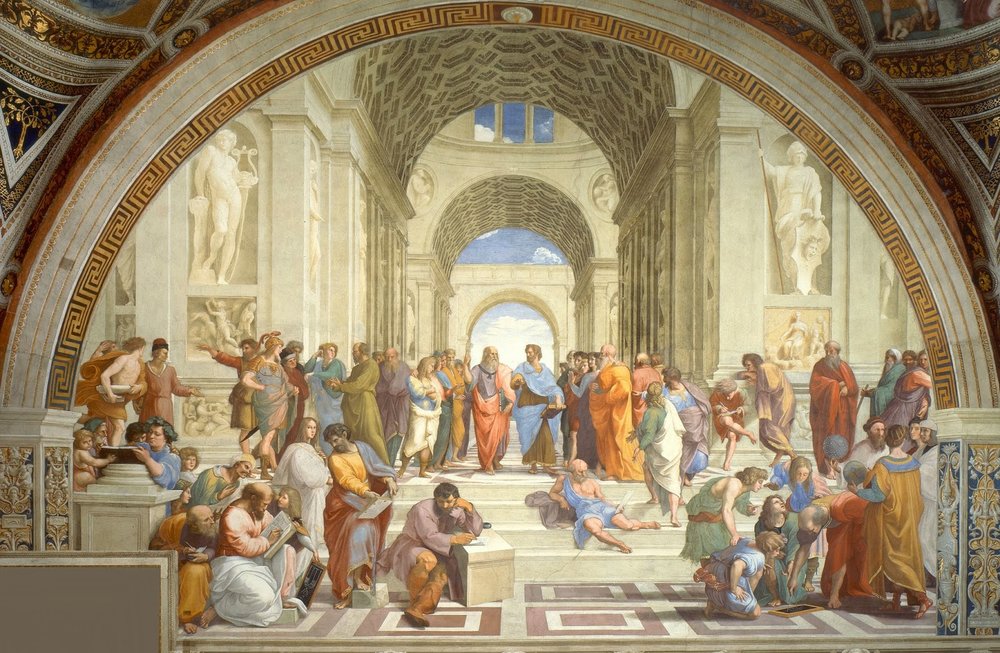
Raphael’s The School of Athens featuring Aristotle and Plato and many others!

Education: Painted and Soiled

Part II: Aristotle  

That nagging question has not gone anywhere. Back peddling to the 16th century helped but not nearly enough. If going back the 16th century helped, then it can’t hurt to go beyond the 16th century, to Aristotle and his views on education. Aristotle lived in the 4th century BC; he was born in Athens in 382 BC and lived until around 322 BC. He studied and wrote on many topics, education being one of those. 

The first Aristotelian idea I bumped into related to education was the idea of hexis, which is “a readiness to sense and to know.” This was a posture of sorts referred to as an “active condition” of a human being. Aristotle saw this condition as acquired and not innate, which is a statement about his thoughts on education. Aristotle borrowed this term from multiple sources, the Greeks and Plato to name two. The importance of hexis was its emphasis on habitation. Aristotle believed that one’s virtues were one’s habits and living a good life depending on living a life of virtuous habits. The adage, you are what you do most, comes from Aristotle’s thoughts on habits.  

For Aristotle, hexis was a constant disposition composed of character, heath and wisdom. It was a blend of personal responsibility, cognitive development and the environment, i.e., the educational process. It was a “habitual state of having” and was something uniquely human. According to Aristotle, it was this “active condition,” this continuous “having (or wanting),” that positioned human beings to live in wise ways with other human beings. This wise way or posture was perceived as education and as communal. The theme of unity and community, found here, is also found in the Latin and in other ancient ideas of education. There was an connotation; it was not as clear, but it was there. It was this idea that education cannot be education in isolation or in selfishness.

Aristotle referenced another important concept in his writings on education, a “guiding eidos,” referring to it as a leading idea. Eidos was the Greek word for “form,” and Aristotle used it to describe the essence of things. Aristotle believed that all physical objects are made of both eidos (form) and hule¢ (matter), two contrasting notions that he saw as necessary in the making of things. This eidos, for Aristotle, prescribed the nature of a product; he used it to describe his thoughts on education, which reveals some of his beliefs and thoughts on education. This “eidos” was a state of being, an attitude, a disposition when referenced regarding human beings … It was a suggestion that human beings live to be happy and to flourish and that both could only be reached together. Aristotle suggested that one of the best ways for them to come together appropriately was inside the process of education. 

As I explored more of Aristotle’s ideas on education, I continued to bump into many subtle references to community. Community, for me, cannot be built without a concern for others, but inside this concern must be something else: a willingness to sacrifice self for the sake others. It was living away from self and towards others. Aristotle’s philosophical theory, virtue ethics, emphasized the development of moral character, i.e., virtues, for this reason. This was living ethically for others; it was living away from self and towards others. Aristotle encourage people to live virtuous lives of courage, justice, liberality, patience and truthfulness. This was a virtuous life, in some respects, for Aristotle. It was as if he saw selfishness and the lack of virtue as signs of being uneducated.

This “guiding eidos” that he referenced was a unique disposition he used in discussions associated with education; Aristotle used the term, halting in connection with it, implying that it was a characteristic of the educated. Aristotle used the term, Halting, to reference movement. He saw this movement, this halting, as a process that “had already begun and would continue” into the future. By connecting this halting to education, he was implying that education “moved” in a similar manner. It was, as processes go, movement which had already begun and would continue into the future. There were no suggestions that it would slow or even end. It was a lifelong process akin to life.

All of this, according to Aristotle, ultimately led to praxis, which was “informed committed action.” This was not reaction, selfishness nor individual pragmatism; it was educated intentional intimate action for the sake of others and eventually for the greater good. For Aristotle, praxis was one of the three basic human activities, which were praxis (action), theoria (theory), and poiesis (making). Praxis was considered practical, thoughtful activity that was to be goal-directed and voluntary, and it demonstrated human freedom. Theoriawas theoretical activity with a single purpose focused on discovering truth. And poeisis was making or productive action, and it created something new. Aristotle believed that praxis must be guided by a moral disposition for one to act in righteous ways. Why? Aristotle believed that there could be good praxis (eupraxia) and bad praxis (dyspraxia), which makes sense considering he believed that hexis and most of education was acquired and not innate. 

The modern idea of education is nowhere to be found in the etymology of the word, in the Latin or in Aristotle’s thoughts on education. Why is that? Do we have it wrong? As I referenced earlier, I believe education has been painted and soiled to the point that it is not even education anymore. It is something else. I believe this “something else” is being presented as education, whether intentional or not, and is now considered by most of us to be education. When our children walk into their schools, they assume—and we do to— that they are receiving an education, but what if they are not? They are receiving something. Are you confident that you know what it is?

There is an infamous quote attributed to Aristotle regarding education, “Education is the process of training man to fulfil his aim by exercising all the faculties to the fullest extent as a member of society.” In this quote, Aristotle’s goal of education is not just focused on man, but that man would become the best member of society that he could possibly be. This is a focus on mankind, not on self, for the sake of community. It was a thought that every man and woman would be a contributing member of society for the betterment of self and community. How could this be done? Aristotle believed that education was one of the chief manners of accomplishing this goal. Education, for him, was not to for vocation nor for self; it was for personal betterment for the purpose of communal betterment; they went together. They needed each other, but there was a danger if we only focused on ourselves, which was why he promoted a virtuous life and recognized the need for a virtuous education. 

We are just scratching the surface. There is so much more and that is if we stay with Aristotle. In my next post I explore his Nicomachean Ethics, which is where he presented more thoughts on education. Until then …