Epistemology: Knowledge, Understanding or Both

Epistemology: Knowledge, Understanding or Both

Have you ever said, “I do not understand?” I am sure you have, but have you ever thought about what it means to understand? It seems so basic a concept that everyone should understand what it means to understand, but do we? Do we understand in the same way as we used to understand? Is understanding someone the same as understanding something? This post explores understanding through the lens of philosophy.  

It is fascinating to read that this concept of understanding, in philosophy, has been “sometimes prominent, sometimes neglected and sometimes viewed with suspicion,” as referenced in the Stanford Encyclopedia of Philosophy (SEP), which was my main resource for this post (Grimm, 2024). As it turns out, understanding, or as it is known in philosophical circles, epistemology, differs depending on time frame. Who knew? 

Let me start with the word “epistemology,” which was formed from the Greek word episteme, which, for centuries, was translated as knowledge, but in the last several decades “a case has been made that ‘understanding’ is the better translation” (Grimm, 2024). This is due, in part, to a change in the semantics of the word “knowledge.” That change was prompted by a shift towards observation as the primary means of obtaining knowledge, which is not so much a change in understanding as it is in the semantics of knowledge. But, should that change how we define understanding?

The SEP references theorist Julia Annas, who notes that “episteme [is] a systematic understanding of things” as opposed to merely being in possession of various bits of truth. We can know (knowledge) what molecular biology is, but that does not mean that we understand molecular biology. There is a clear difference between knowing something and understanding something, or at least there used to be. Both Plato and Aristotle, according to the SEP, considered “episteme” as an “exceptionally high-grade epistemic accomplishment”. They both viewed episteme as both knowing and understanding. The Greeks and most of the Ancients valued this dual idea of understanding and yet, according to the SEP, subtle changes in the semantics of the word took place over time, moving the semantics of episteme from knowing and understanding to just knowing, which, in my opinion, allowed observation a more prominent role regarding understanding. The question is, did observation improve our understanding of understanding? 

There are many theories on why this shift in the semantics of understanding occurred, but it did occur. My concerns do not center on the “why”, but instead, they center on the impact of this shift on present understanding. The idea of understanding went through a period in the past where its overall importance diminished and was replaced by the idea of theorizing, which is not understanding but speculation. According to the SEP, theorists throughout history have proposed various theories about understanding, and most theories did two things: they pulled us away from the original idea of understanding and pushed us towards a focus on self. It was self that was understanding’s biggest threat in the past and it is self that continues to be its biggest threat presently.

When I read that understanding was neglected in the past, I struggled to make sense of why it was neglected. Who would not want to understand? It was only when I understood that, at the time, understanding was thought to be primarily subjective and psychological, with a focus more on an understanding that was familiar, that it made more sense to me.  Familiarity is the idea of being closely acquainted with something or someone. Regarding familiarity’s impact on understanding, it pushed it towards self and away from the dual idea of knowledge and understanding. This push mutated understanding into what equates to an opinion, making it foundationally subjective, that is, until it bumped into science. In the world of science, understanding, or as it is often referenced, epistemology, was forced to move away from subjectivity and towards objectivity to interact with positivism, which was foundationally dominate in science until recently. 

According to the SEP, the notion of a subjective understanding inside epistemology was, rightfully, downplayed in the philosophy of science due, in part, to the efforts of Carl Hempel (Grimm, 2024). Hempel and others were suspicious of this “subjective sense” of understanding and its interaction with science. According to Hempel, “the goodness of an explanation” had, at best, a weak connection to understanding, especially regarding real understanding. Hempel’s point was that a good explanation might produce understanding but then again, it might not but it would still be familiar and seem like understanding. That was not objective, which was needed in science. The work of Henk de Regt made a distinction between the feeling of understanding and real understanding. He argued that “the feeling is neither necessary nor sufficient for genuine understanding.” His point, which seems straightforward, was that real understanding had little to do with feeling. Feeling is not scientific nor is it objective. It is always rooted in self, which is not understanding. 

Understanding is thought to be a deep knowledge of how things work and an ability to communicate that knowledge to others. This presented a question: what is real understanding? According to the SEP, there are multiple positions regarding this one question. It is interesting to note the presence of “luck” in positions of understanding, with one position asserting understanding as akin to full blown luck (the fully externally lucky position). This is where I defer from the SEP and dismiss the idea of luck altogether. These positions assert, in subtle ways, understanding as a pragmatic product-oriented method; all that seems to matter is that you understand, which, by all indications, would not be true for true understanding. True understanding is being able to explain to others in detail the understanding you understand. The fully external lucky position is rather pragmatic and contrary to this idea of understanding. It seems to stop at one’s understanding and does not consider that to truly understand, one must be able to pass on the understanding one understands to another. 

The contrasting position argues that one needs to understand in the “right fashion” in the right manner to understand again, and for me, the word “again” is key. In other words, understanding, to be considered as understanding, always needs to be replicated in a way that can be communicated to others so that they understand, and to do that one must understand the process every time and not just one time. The first position, for me, violates the duality of understanding and knowledge. This is important because, for me, it is the duality that completes understanding. To understand a concept, one must know what the concept is and understand how it works. The first position, the fully externally lucky position, blends knowledge and understanding into something that loses the semantics of both, pushing understanding into a pragmatic area where understanding becomes almost tangible, discounting the process in favor of it as product. This is not understanding but a lower form of knowledge. True understanding is always a process that explains how the product became, how the product works and how the products is applied. 

There are those who argue that understanding does tolerate “certain kinds of luck.” These philosophers hold positions that understanding can be “partly externally lucky.” Is it me or does luck have no place in understanding? If luck has any place in understanding, then that understanding is not understanding but a stumbled upon form of knowledge. No one stumbles onto a medical degree nor the knowledge needed for it. Most would not equate this as the proper application of their position, but understanding builds on itself, and if it does that, then, this application is not as stretched as it would seem. I believe the idea of understanding goes beyond the discussion in this post. It is an esteemed element of our humanity. It is who we are as human beings, and a large part of what makes us a human being.  

There are those—and the number grows daily—who no longer value understanding nor want to spend energy doing it. They consider it an antiquated process and no longer needed because we have technology, specifically, we have AI to do all our understanding for us, right? But do we? Does AI help us understand or does it only provide explanations? Are explanations understanding or are they something else? I believe understanding is distinctly human. I believe it is how we interact and build community. Maybe we don’t need to understand chemistry (I think there will always be a need to understand chemistry and everything else.), but we will always need to understand each other because we all are different. 

If we no longer strive to understand the things that we do not know, how will we ever understand anything or anyone? Will we even want to understand in the future if we no longer seek to understand in the present? Will we become conditioned to enjoy being isolated and introverted? That seems sad and not human. This idea of understanding is much more complex than most realize. The issue is not just one of episteme but one of humanity, at least to me it is. Think long and hard about understanding because once you lose it recovering it will not be easy. Thanks for reading! Until next time …   

Grimm, Stephen, “Understanding”, The Stanford Encyclopedia of Philosophy(Winter 2024 Edition), Edward N. Zalta & Uri Nodelman (eds.), URL = <https://plato.stanford.edu/archives/win2024/entries/understanding/&gt;.

Zetetic Philosophy: The Pursuit of Understanding

Zetetic Philosophy: The Pursuit of Understanding

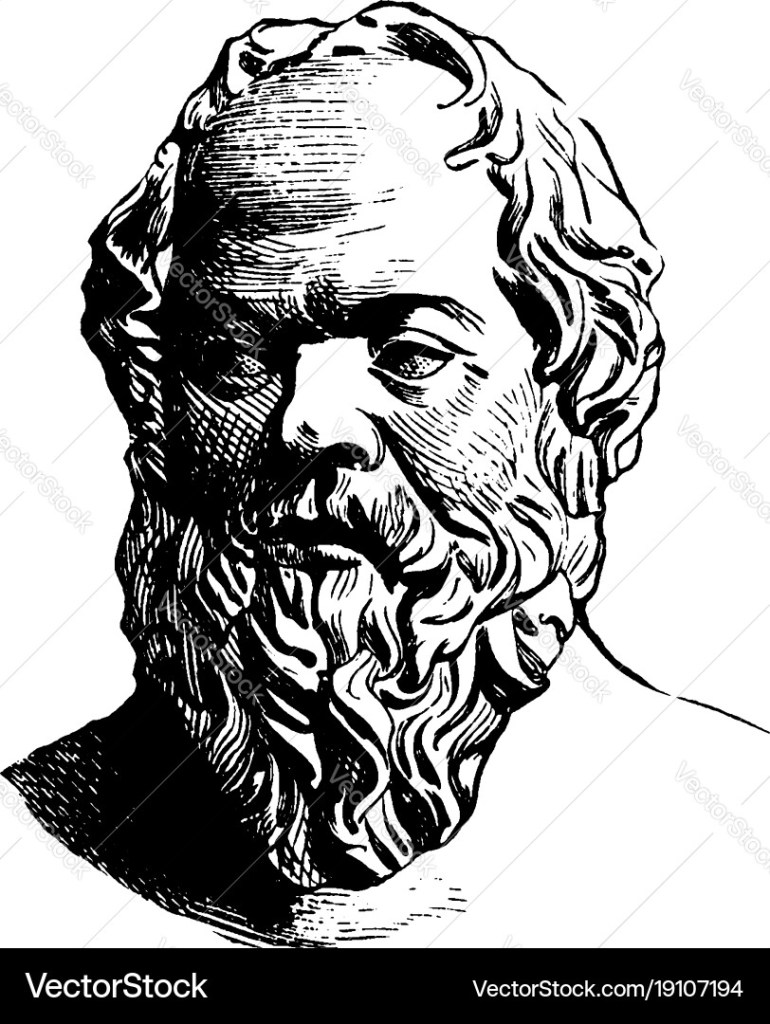
I recently read an article about the pursuit of understanding related to Zetetic Philosophy. The term “zetetic” is not a term we often hear or even use, and yet it is an important one. The term is derived from the Greek word “zeteo,” which means “to search or to examine.” Zetetic Philosophy emphasizes the importance of questions and investigation over relying on preconceived notions, facts and assumptions. This sounds familiar but what many do not realize is that most philosophy today begins at a culturally- accepted position, which is preconceived. The article suggested that we should view Socrates as a Zetetic Philosopher due in part to his detailed explanation in the Republic of the ideal type of formal education. This intrigued me, but education is not the reason I read this article; understanding is. 

If you read the Republic (and I recommend that you do), you will encounter the philosopher-kings, Socrates ideal rulers. They are noble and intelligent known by their virtues who think through a certain praxis, thus the moniker philosopher-king. Socrates referred to their thinking process as the dialectic and presented it as a positive form of dialogue that incorporated “arguments in order to achieve a sure and true understanding of reality (Being).” The dialectic was a form Socrates used to test how and why things are the way they are. For Socrates, the dialectic was a method to achieve knowledge, of what he called the “Good-in-itself,” by distinguishing “the good” from everything else. Many see the dialectic as the Socratic Method. They are not one and the same but two different methods. 

The Socratic Method differed from the dialectic, in part, due to the “method of questioning,” which expressed more ignorance than understanding, which seems odd and counter intuitive. Both processed through the antithesis to confirm what is true, but only the Socratic Method embraced uncertainty as a healthy part of the process. In the Socratic Method, the teacher must hold knowledge—know something and give account of that something known—to impart knowledge or lead others in obtaining knowledge. The teacher must master both the knowledge and the method of distribution of the knowledge to move past the stage of personal ignorance to lead others to understanding. This is not a weakness of the Socratic Method but a strength. Read any of Plato’s dialogues, you will find that Socrates was this type of teacher. 

The author suggested that Socrates, as a teacher, had the following characteristics as a teacher: the desired results were met, he had the answers he sought from his students, his method unfolds in a “teleological” manner and his form of knowledge is different than the knowledge associated with the virtues he conceived. This is in stark contrast to Socrates numerous claims of ignorance, but this idea of ignorance is important or else he would not keep using it. In the Republic, Socrates denied several times that he was in possession of a certain kind of knowledge. He stated several times that he knew nothing. What is happening here? Is ignorance an important part of knowing? 

Several authors have pointed out that Socrates sought to be a co-participant in the learning process with his students, even abjuring the moniker of “teacher” as too formal to achieve equal status with his students. Was ignorance a means of this equal status? This is, in some sense, Socrates maintaining a posture of seeking and yearning for wisdom in the same manner as his students. The author implored us not to fall for Socrates trying to present himself as a radical nihilist skeptic but to look deeper, deeper into this idea of understanding as it relates to ignorance. Seeing Socrates as a zetetic philosopher is “antithetic to the philosophical ideal of the philosopher-kings of the Republic who were to lead their city-state towards that which is good and true,” or at least that was their goal?

These philosopher-kings are referred to as echonic philosophers (traditional), and Socrates never claims to be their equal. This idea of echonic philosophy, which these kings are thought to possess, is found in Book VII of the Republic and represents authenticity and proper education which was supposed to provide the possessor of both an ability to grasp what it takes to rule. Yet, the author references Socrates as a zetetic philosopher, which is a philosopher who embraces a a philosophy that is ongoing, dynamic and critical in analysis. It is one with no real answers and instead seeks to continue to inquire. Its understanding is not found in Plato’s forms but grounded in humanity and its limits and finitude. This is an important point regarding the pursuit of understanding. It is a never-ending process that is always fluid, ongoing and never ending. 

The author implies that we must learn from Socrates that real education is based on zetetic philosophy, as this is, according to Plato, a “turning around of the soul” back to itself in an enlightened state. This suggests something more about education and about understanding, especially if we look at the three moments referenced in the zetetic journey found in Plato’s Allegory of the Cave. First, there is liberation from bonds, then there is ascent upward to the light and finally there is the return to the cave. These three moments come together to fully express enlightenment or education and understanding. This idea of zetetic philosophy was thought to be that which avoided expecting absolute, irrefutable instances of truth, as if they did not exist. 

The implication is that we must recognize our ignorance and our limitations as human beings first. This is where the pursuit of understanding begins. It does not begin within the knowledge itself, but within us, recognizing first our humanness and acknowledging second our limitations. Therefore, all pursuits of understanding, as hard as this may be to understand, seem to begin within us and not within the knowledge that we seek to understand. Is this the message of Socrates? Does this make sense? I am not sure, but it does force me to do one thing … think and that is always a good thing. Until next time …   

How Do We Know What Is Real?

How do we know what is real?

I took a trip back to where I was raised to visit family and friends. It was a wonderful trip but quick and too short, but that is sometimes life. It was good for my soul and even better for my mind. I loved all the conversations I had. I loved listening to how others arrived at their own points of view. Some of us still hold the same values and have adapted to life in some of the same ways. Others hold different values and have adapted to life in different ways. Why? One of the subjects that came up was reality and how many different versions of reality are out there now. As I was driving back home, a question came into my mind—how do we know what is real? —and I could not shake it. 

My standard practice when I get one of these questions is to go poking around those people I respect, read or follow and see what they think. In my latest search, I stumbled upon a reference to an article with an interesting title, so I looked it up and read it. The article was in Psychology Today, which, for me, is not one of my usual references, but the title was too inviting. The article, “How Do We Know What Is Real?” By Ralph Lewis, M.D., was well worth my time and maybe worth yours too. Before I get into the article, let me set some foundational timbers for this post.   

First, let’s be clear; we experience the world through our five senses; that is given. Second, it is best to experience the world with all five of our senses. Most agree on that point as well. It is the way most of us live and we give it little thought. We just do it. Point three: Most theorists would call this experience subjective and question its reliability, but Lewis points out that “subjective perception” is still a crucial source of data for almost everyone. We rely on it every day as we live our lives. Consider science, even its practices and methods incorporate senses, i.e., observation, which is technically considered subjective and yet still a foundationally part of the scientific method. Dr. Lewis writes, “Science is just a method to minimize the distorting effects of our perceptions and intuitions and to approximate a more objective view of reality.” This is intuition and it is and should be greatly valued. You use it and so do I. It is the primary focus of this post. Most professionals use it. They depend on their own “trained” intuition to do their job. Doctors, financial advisors, plumbers, teachers, engineers and many others, all use trained intuition to excel in their vocations. 

But here is the issue I want to focus on; trained intuition is not universal absolute truth nor is it reality. It is a form of discernment that allows us to problem solve. It is assumption and inference developed through our education and training that works with who we are to solve issues. It is also based on our ideology which is a composite of our beliefs and values. This makes it uniquely ours, and it tends to work only for us. But this means that we often see our intuition and as reality. In some respects, it is, but it is not ultimate reality for us. The more success we experience the more egocentric we become, and this puts us in a position to think our reality is everyone’s reality. It never is. Your doctor may have an intuition about why you are sick, but that is the result of his or her interaction with you and your issue. At best, it is a temporary situational reality that works for your current situation, but that is as far as it can go. As Lewis states, “But it [intuition] can be completely off base” and lead even experts astray.” Lewis continues, “We have to be aware that our intuitions and firmly held assumptions may be completely wrong.” This leads me to a question. Where does intuition lie? The answer is the brain. 

The brain is a “well-honed but imperfect virtual reality machine,” according to Lewis. We don’t have a brain; we are a brain. Our brains produce subjective perceptions which are representations of our external world—our very own form of virtual reality. According to Lewis, we can be confident that most of the time these subjective perceptions that our brains produce are faithful representations of our actual external world. Social cues are just one example of our brains making a subjective perception. In most instances, we are right, but I think we have all experienced a time or two when we were wrong. 

Our brains, according to Lewis, rely on patterns, approximations, assumptions and best guesses. Our brains often take shortcuts, fill gaps and make predictions and all of these things are based upon our intuition which flows from those subjective perceptions. Lewis is clear; subjective perceptions are real, but they are not what they seem, even to those of us who own them. The brain is a “confederation of independent modules,” all working together. Lewis writes regarding this, “The vastly complex unconscious neuronal determinants that give rise to our choices and actions are unknowable to us.” 

The brain just works, and it works well due to the subjectivity of our experiences, but, as real as they seem, they are not reality for us, and they cannot be reality for us. The more successful we are the more our tendency will be to think that our reality is everyone else’s reality, which, again, is when we get in trouble. When we push our intuition as if it is reality, then we will think it is reality. When this happens, we merge our intuition with our existing ideology, and they become one. We will always find others who share and reinforce our ideology, then it is our ideology that becomes our reality. This tends to isolate us inside our ideology which becomes our ultimate reality. This is the Land of Oz and not reality at all. This is where real issues arise in the form of narcissism and nihilism.

Lewis goes into mystical experiences and hallucinatory or dissociative experiences to make his point. He posits that these experiences seem so real to those who have them that they believe that they have discovered a transcendental reality. They have not discovered an alternative reality. They have merely experienced the power of a chemical or drug or the power of suggestion. The brain thrives because of subjectivity, but that subjectivity makes it vulnerable to external influences like drugs and persuasion. We would be naive to assume that our subjective perception of the world was anything but that, and yet this is where many are today. There is no longer a concern about doing the right thing, working hard, having integrity, honor or even telling the truth. The only concern right now is for self … to be right. We are in a war of opinions, and everyone is armed with their own editorial comments. The battles wage because the winners get to declare what is true, until the next battle comes, and then, the cycle starts all over again. This is our world today and determining what is real is no longer determining what is true. Our elections have revealed that, have they not? How do we know what is real? I think the better question might be, do we care about what is real? Until we do, we will never determine what is real.

Education, Painted and Soiled: Part V

Education, Painted and Soiled:

Part V: True Education 

In 1916, John Dewey referred to education as “a social process—a process of living and not a preparation for future living.” While I think Dewey got many things about education wrong, I think he got this one right. Education is a social process. It is life and for a lifetime, but defining it seems to limit it. Definitions are ends for the means they serve. Education, for me, cannot be put into a box, nor should it be, which suggests that I am engaged in a fool’s errand. Let’s find out. 

Aristotle implied that education was not formal instruction nor was it just knowledge; it was much more, but what was it? For Aristotle, it involved developing both intellectual and moral virtues through practice and experience, and it was for a specific purpose, to produce flourishing human beings. This idea of human flourishing was, for Aristotle, the ultimate telos, i.e., the end goal, for all human beings, but this telos implies something else about education.

In this post, I will look at education from one last angle with the hope that I see something that makes sense to me. I want to look at education from the perspective of how we experience it. One author I recently read referenced Erich Fromm and his distinction between having and being. This is as good of a lens as any other to use. Fromm defines “having” and “being” as modes of existence and as different ways of understanding ourselves, the world in which we live and those living in this world with us.

According to Fromm, “having” is concerned with ownership and possession with a focus on controlling; “being,” on the other hand, is rooted in love and concern with a focus on shared experience and productive activity. Being engages the world while getting seeks to possess and control the world. Fromm saw these as two modes of human existence: the mode of having and the mode of being. The mode of having perceives everything as a potential possession while the mode of being perceives self as the carrier of certain properties and abilities.

Fromm thought “having” emphasized a duality between the owner and the thing owned. It was a view of the world with self at the center and all other things arranged in a circle around self. They are distinct from self and their relationship to self is only through their ownership by self. Being is about those qualities that merge with our existence … skills that belong to us that we can exercise, but these skills cannot be taken from us. They are part of us. They are ours. What Fromm proposed was that we have a choice on how to live. Do we live lives having or being? Fromm emphasized that there was a difference between a society set to live for people or for things. Where did that difference take root? I think you know the answer. 

Looking at education through the ideas of “having” and “being” clarify some things for me. In one sense, education can be something possessed as in, “I have a degree.” In this sense, education is one of those things to be possessed by self. It is part of the circle of stuff surrounding self, but then in another sense education can become part of us in the sense of “being” educated. If education is merely a paper on a wall, then, yes, there is a chance that I could lose that piece of paper, but if I am educated and continue to be educated then I lose nothing and gain everything. 

This approach forces me to confront my pursuit of education. I have been looking at education as something to define, but I have learned that such an approach is misaligned and the pursuit untenable. Education is not a thing to possess but instead it is a part of being, of who we are, or at least it should be. If education is as Dewey says—a social process—then we must treat it as a social process. Education, then, is like other aspects of our social world. It is akin to the interaction of family. It is friendships and courtships. It is an evening with friends, a day at work or even a family vacation. How do we define these things? The quick answer is we don’t because they are part of who we are as social beings. We learn these things over the course of a lifetime, starting as children. We are taught by our parents, progress into school and then into college. We eventually have our own children and start the cycle all over again. 

If education is “being” then it will define who we are more than we care to admit. It is not a neutral process but one that will impact us. In the same way that our parents defined who we are as children, education will have the same impact if we grant it the right. The push to educate your children at younger ages—there are many K4 programs out there—is a push to replace your impact on your own children with an educational one. This impact is masquerading as knowledge, either a core body of knowledge or a survey of chosen content. There is a hidden curriculum inside this content, and that hidden curriculum is this: every teacher and school teach from a perspective of the world which they will present to your children as true and right. Do you know what perspective of the world your school presents to your children as true and right? Many schools will claim that their focus is only on knowledge and content. Well, that is a perspective of the world, is it not? Shouldn’t you be the one who defines what is right and true for your four-year-old?  Do your beliefs and values align with the beliefs and values of the school your children attend? These are good questions to have on your mind when considering educational choices.

As I close this series on education, let me sum up what I have learned. First, education is not just content. It is so much more and no matter how hard we try to make it just about content, it will never be just about content. Two, education is not one dimensional. It is multi-dimensional, and it is always social. Aristotle presented the idea that education is about the posture of wisdom, heath and morality and a lifetime of movement, and there are implications if he is even a little right. Third, the foundation of education is morality whether one cares to admit that or not. Fourth, education will change culture. If we do not understand this aspect of education, then we are doomed to be overrun by those who do. To change culture, you must gain control of the schools. History tells us that there are many who have understood this and used this understanding to their benefit. Fifth, with great wisdom comes great responsibility. One does not gain education for only knowledge’s sake. Education provides power. Finally, education is a social process. It is akin to life and something we should engage for our entire lives in a manner akin to friendships, marriages and families. We work at these over the course of our lifetimes. We should do the same in our educational interactions. 

There is much more to address inside this topic of education, but for me, this concludes this series on education. Remember, thinking matters and so does education. Until next time …   

Education, Painted and Soiled: Part IV

Education: Painted and Soiled

Part IV: More of Aristotle’s Nicomachean Ethics  

A clearer picture of education is beginning to emerge. One that is more removed from current views, which is not really a surprise. As I dig a little deeper into Aristotle’s views, I must confess that I have not been Aristotelian for much of my life, but in the later years, I have seen the errors of my ways and come to him. It is projects like these that add to my appreciation of him and his work. 

I begin this section with a quote. Aristotle, in his Metaphysics, wrote, “It is through wonder that men now begin and originally began to philophise … he who wonders and is perplexed is ignorant; but, to escape ignorance [that] men studied philosophy.” The word “escape,” in this instance, is an infinitive which binds itself to ignorance. Ignorance, in this quote, is presented as that which is common, normal, pedestrian and functions more as a trap. The takeaway is that ignorance, to Aristotle, required escape; without escape, every human being was vulnerability to its enticement. Wonder, however, was a door away from ignorance and to philosophy, but be warned, Aristotle understood that wonder would perplex us, especially without philosophy (education). It would become ignorance which would be there waiting to ensnare us if education were not our guide; it would always be waiting for us, to settle, to take the easy way out, to be stagnate—it would always be there to accommodate us if we ever left education. Nothing much has changed.  

Aristotle believed that philosophy (education) was the love and pursuit of wisdom, which destroyed ignorance which he saw as temptation in the forms of apathy and sedentary. It was philosophy (education) that was different, but it required pursuit which was proactive action on the part of the human being. It suggested that the nature of education was fluid and active and not stagnate and sedentary. It would have to be pursued and it would demand our work and commitment. Wonder was the key to all of this; it would draw us deeper into the process. It would be there when we were weary or tired. Wonder was always the beginning, suggesting something important. Wonder was the antithesis of ignorance. It was protection and philosophy’s beginning but never its end. We wonder and risk ignorance the moment we stop. Wonder is also education in every sense of the word. It is wonder that prompts us to know. It is wonder that keeps us knowing and learning. Aristotle considered wonder necessary for both the learner and the teacher.

Aristotle saw the process of instruction as rooted in thinking and learning. It was a series of steps that must be taken by both the instructor and the learner with wonder as the first step in each series. To begin instruction, wonder must be present. It was necessary and if not present, the teacher was to create it for the learner must enter the learning process with curiosity (or wonder). But both the teacher and the learner were responsible for the own posture, and part of their postures was always to be wonder. Both were to enter the encounter curious as to what awaited them. They were to be eager in anticipation of the things they would learn. They were also to understand that they needed each other, and that education could not happen in isolation. It isolation it would always be limited.   

Aristotle’s second step, “individualized” instruction, rested in his belief that each student harbored unique talents, interests and preferences, which demanded a personalized approach to learning. For education to take place, the teacher had to know the learner, but the learner had to know the teacher and had to want to know the teacher. He posited that curiosity, critical thinking and individual inquiry in a student must all be reinforced through the personal guidance and support of the teacher. The role of the teacher was crucial to the success of the student, but the teacher’s role was tied to the learner’s attitude and posture. If the learner did not enter the interaction curious, ready to learn and seeking to know the teacher then the teacher’s role was limited. Education was threatened and ignorance was possible.  

His third step is more well known, The Socratic Method. Aristotle borrowed this concept from Plato and expanded on it. It is a cooperative form of dialogue based on thought-provoking questions and guided reflection thought to produce meaningful learning outcomes. Aristotle encouraged open dialogue between students and teachers for purposes of collaboration and discovery, but they were not to be equal participants. They must respect each other and their respective roles. It was up to the teacher to walk the learner through a process rooted in rigorous debate, which exposed erroneous reasoning leading to deeper understanding. The process was continuous and balanced, and it required both the learner and the teacher to embrace it and respect it.   

The fourth step was theory and practice. For Aristotle, the two came together as one. As I have referenced, he believed that for learning to happen theoretical knowledge and practical application must interact. He saw understanding as requiring both. He wrote, “For the things we have to learn before we can do them, we learn by doing them, e.g. men become builders by building and lyre-players by playing the lyre.” Aristotle often encouraged his students to apply theoretical concepts to practical problems because he believed, in doing so, his students would develop practical wisdom, improve critical thinking and become better problem solvers. For Aristotle, doing was as important as listening and studying. Process was important and could only be learned by doing repeatedly.   

Aristotle believed in many formats and methods. His lectures were thought to be littered with quotations, references, examples and images as he acknowledged the power of enhancing understanding through additional means. His goal was always to engage his students in the best possible ways, and he was always seeking new modes of engagement. As Aristotle taught his students, he understood that learning extended into the cultivation of virtue and morality in students. He sought to nurture individual virtues through his teaching. He believed that to live a fulfilled life we must be morally upright and virtuous. We must put these virtues into practice, or we could not be considered educated. He wrote, “These virtues are formed in many by his doing the actions … The good of man is a working of the soul in the way of excellence in a complete life.”

Aristotle was always faithful to what he called “the mean.” The mean was a balanced approach to life. It was not being over strenuous or excessive nor overly simplistic, superficial or sedentary. His answer was living a life of “harmonious balance,” which he saw as wedded to learning. The Mean or, as it has also been called, the Golden Mean, is moral behavior between two extremes: excess and deficiency. As people, he thought the proper way to live was to find a moderate position between two extremes and live that position to the best of our ability. Aristotle saw right living as living morally upright, which was to live a life faithful to the mean. 

According to Aristotle, education was that which equipped human beings to live such morally upright faithful lives. Education, to provide the means to live such a life, had to be active, moving and an active pursuit. It was not easy, not stagnate and not reactive but it was intentional. It was a process that rested with the learner and the teacher, and both must enter the interaction willing, fully committed and exerting ample effort or very little learning would take place. Virtue, morality, personal responsibility … all of these were important parts of education to Aristotle and marks of an educated life.

I have found that this idea of education is not simple. It is more complex than imagined but it is well worth my efforts and time. Until next time … 

Education, Painted and Soiled: Part III

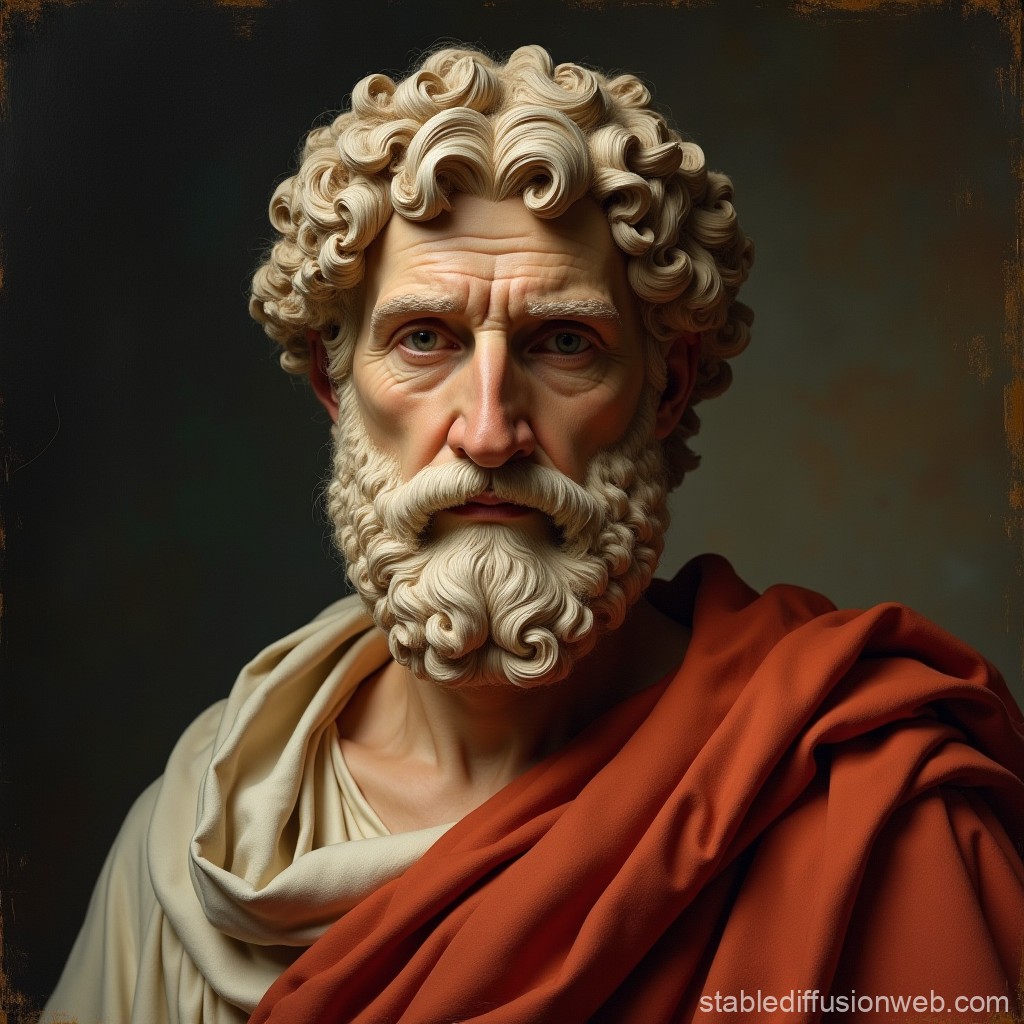
A Portrait of Aristotle

Part III: Aristotle’s Nicomachean Ethics  

In his Nicomachean Ethics, Aristotle presented four principles that I believe clarify his thoughts on education and provide more information in my quest to discover what education truly is. It was Aristotle’s belief that through these four principles human beings think and learn and would think and learn “all the more.” A picture of what education is supposed to be is beginning to form. Let’s get started. 

The first principle he called Anamnesis, which loosely translated means reminiscence or recollection. In the Greek, it is literally “a calling to mind.” As a concept, it suggested that we acquire knowledge externally, but we also have it inherently within us. Both were important and both were meant to interact with each other. Therefore, processes of introspection and reflection were considered important as both were manifestations of this interaction. These processes today are considered higher ordered thinking, but to Aristotle, they were foundational and necessary to all learning. Anamnesis, for Aristotle, was many things but it was primarily for the sake of remembering; he also thought it had secondary uses, as also that which facilitated, perceived, imagined, thought and understood. The proper aim of Anamnesis was the establishment of a truthful relationship between the representation (present) and the represented (past) through the interaction of the external and the internal leading to “the” truth. 

The second principle was termed Experience, which was thought, by Aristotle, to be required for understanding. A person with experience was one who had acquired external knowledge through interaction over time with one’s environment. It was one who engaged in the education for life. Experience was also that which developed coping skills, an appropriate attitude and a sense of the situation. Experience, to Aristotle, was not a knowledge of universals that could be memorized and applied but instead it was a knowledge of particulars, specifics, much like theories or axioms, regarding the way the world work. Aristotle saw culture and the environment through a lens of particulars and not universals, which speaks to his views on both. Experience, for Aristotle, took the form of the recognitional and the practical. It was not one over the other; it was both. He saw experience as compatible with general facts and was clear; understanding cannot be obtained through reason (inherent) alone; it required more. This idea of experience was not limited to the cognitive (inherent); it also required the engagement of one’s entire being (external), and the interaction of the two. 

The third principle was habituation (ethos). This is an important principle as it reflects Aristotle’s belief that we are what we repeatedly do. Aristotle believed that learning, like life, was a process that was active and moving. He argued that virtuous behavior—he saw life as needing to be lived in virtuous ways— was not just something learned, a good idea or even an intellectual pursuit; it was living through consistent practice, moral training and learning, which he thought required intentionality. We live according to what we believe, and we tend to act according to those beliefs with intent. There is personal responsibility applied to each of us and it flows out of our intent. This idea of intentionality was prominent in Aristotle’s thoughts on education and in his other areas of study as well. Believing alone was not sufficient; reactions and feelings were not sufficient. According to Aristotle, we must be actively engaged with and ultimately embody the values we believe. We must live them and be them or they do not exist in us and are not us. They instead become items we carry like luggage and apply situationally. Values alone without consistent application were more emotion than education, more ideas than virtues. To be educated, Aristotle believed one must live that which they believed, which he saw as living virtuously. The implication was that if we did not live the values we believed, then we did not really believe them or worse, they were not worthy of emulation. Living a life without virtues was living uneducated, less civilized and more barbaric.  

The fourth and final principle was practical wisdom. Aristotle believed that sound judgment and ethical decision making are the products of a synthesis of theoretical knowledge and real-world application. Practical wisdom was the manifestation of being an educated being. This was a blend of the cognitive (inherent) and the physical (external) coming together in the form of experience, which Aristotle saw as habitation manifesting as deliberation. This was education to him. Deliberation is long, conscious and careful consideration; it is applying those principles that you believe are true and right, that you have become convinced over time through scrutiny and analysis are true and right. Practical wisdom requires deliberation to discover the best course of action for a given situation. It is not a reaction or a quick decision. Deliberation was the result of the first three prior principles applied in full. To deliberate, Aristotle believed, was to function as an educated person.   

As I examine Aristotle’s ideas on education I see a balance between two conflicting concepts: theory and practice. Aristotle believed that true education required engagement with knowledge inherent (internal and a priori) and knowledge external (experience) to become wise, but dwelling only in one area or the other was not wisdom to Aristotle. Wisdom was a balance between the two; knowing something was not the same as living the something that you know. We find these same beliefs present in his ideas on pedagogy. He believed teaching required personalized instruction, active engagement, and the cultivation of wisdom; all focused on the learner and not the teacher and yet, he considered the teacher vital to the learning process. 

To many of us, these concepts are strange. Our perception of education is as a door. Education is the key that unlocks that door and on the other side of that door is a wonderful world of opportunities that await us. But that is not the picture that Aristotle paints. Education for him, was much different. It seemed more like maturity or growth, more a norm than a privilege. It seemed to be something common and necessary to human beings much like food and water. It was individual but for the sake of community. It was almost as if community would not happen without it. There is more to explore and discover as this quest for the origins of education continues. Until next time …   

Education, Painted and Soiled: Part II

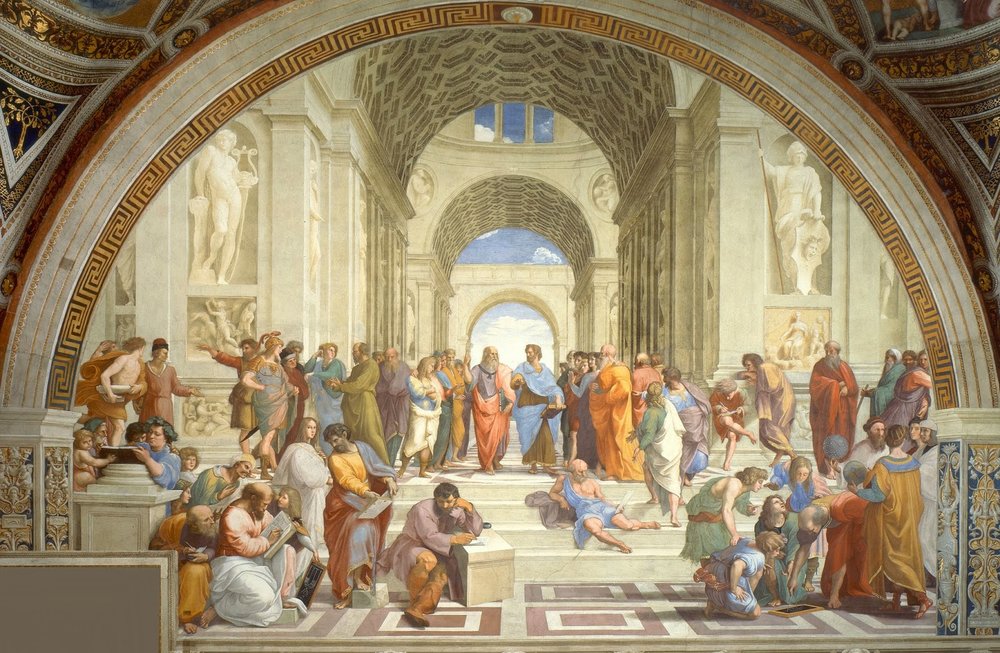
Raphael’s The School of Athens featuring Aristotle and Plato and many others!

Education: Painted and Soiled

Part II: Aristotle  

That nagging question has not gone anywhere. Back peddling to the 16th century helped but not nearly enough. If going back the 16th century helped, then it can’t hurt to go beyond the 16th century, to Aristotle and his views on education. Aristotle lived in the 4th century BC; he was born in Athens in 382 BC and lived until around 322 BC. He studied and wrote on many topics, education being one of those. 

The first Aristotelian idea I bumped into related to education was the idea of hexis, which is “a readiness to sense and to know.” This was a posture of sorts referred to as an “active condition” of a human being. Aristotle saw this condition as acquired and not innate, which is a statement about his thoughts on education. Aristotle borrowed this term from multiple sources, the Greeks and Plato to name two. The importance of hexis was its emphasis on habitation. Aristotle believed that one’s virtues were one’s habits and living a good life depending on living a life of virtuous habits. The adage, you are what you do most, comes from Aristotle’s thoughts on habits.  

For Aristotle, hexis was a constant disposition composed of character, heath and wisdom. It was a blend of personal responsibility, cognitive development and the environment, i.e., the educational process. It was a “habitual state of having” and was something uniquely human. According to Aristotle, it was this “active condition,” this continuous “having (or wanting),” that positioned human beings to live in wise ways with other human beings. This wise way or posture was perceived as education and as communal. The theme of unity and community, found here, is also found in the Latin and in other ancient ideas of education. There was an connotation; it was not as clear, but it was there. It was this idea that education cannot be education in isolation or in selfishness.

Aristotle referenced another important concept in his writings on education, a “guiding eidos,” referring to it as a leading idea. Eidos was the Greek word for “form,” and Aristotle used it to describe the essence of things. Aristotle believed that all physical objects are made of both eidos (form) and hule¢ (matter), two contrasting notions that he saw as necessary in the making of things. This eidos, for Aristotle, prescribed the nature of a product; he used it to describe his thoughts on education, which reveals some of his beliefs and thoughts on education. This “eidos” was a state of being, an attitude, a disposition when referenced regarding human beings … It was a suggestion that human beings live to be happy and to flourish and that both could only be reached together. Aristotle suggested that one of the best ways for them to come together appropriately was inside the process of education. 

As I explored more of Aristotle’s ideas on education, I continued to bump into many subtle references to community. Community, for me, cannot be built without a concern for others, but inside this concern must be something else: a willingness to sacrifice self for the sake others. It was living away from self and towards others. Aristotle’s philosophical theory, virtue ethics, emphasized the development of moral character, i.e., virtues, for this reason. This was living ethically for others; it was living away from self and towards others. Aristotle encourage people to live virtuous lives of courage, justice, liberality, patience and truthfulness. This was a virtuous life, in some respects, for Aristotle. It was as if he saw selfishness and the lack of virtue as signs of being uneducated.

This “guiding eidos” that he referenced was a unique disposition he used in discussions associated with education; Aristotle used the term, halting in connection with it, implying that it was a characteristic of the educated. Aristotle used the term, Halting, to reference movement. He saw this movement, this halting, as a process that “had already begun and would continue” into the future. By connecting this halting to education, he was implying that education “moved” in a similar manner. It was, as processes go, movement which had already begun and would continue into the future. There were no suggestions that it would slow or even end. It was a lifelong process akin to life.

All of this, according to Aristotle, ultimately led to praxis, which was “informed committed action.” This was not reaction, selfishness nor individual pragmatism; it was educated intentional intimate action for the sake of others and eventually for the greater good. For Aristotle, praxis was one of the three basic human activities, which were praxis (action), theoria (theory), and poiesis (making). Praxis was considered practical, thoughtful activity that was to be goal-directed and voluntary, and it demonstrated human freedom. Theoriawas theoretical activity with a single purpose focused on discovering truth. And poeisis was making or productive action, and it created something new. Aristotle believed that praxis must be guided by a moral disposition for one to act in righteous ways. Why? Aristotle believed that there could be good praxis (eupraxia) and bad praxis (dyspraxia), which makes sense considering he believed that hexis and most of education was acquired and not innate. 

The modern idea of education is nowhere to be found in the etymology of the word, in the Latin or in Aristotle’s thoughts on education. Why is that? Do we have it wrong? As I referenced earlier, I believe education has been painted and soiled to the point that it is not even education anymore. It is something else. I believe this “something else” is being presented as education, whether intentional or not, and is now considered by most of us to be education. When our children walk into their schools, they assume—and we do to— that they are receiving an education, but what if they are not? They are receiving something. Are you confident that you know what it is?

There is an infamous quote attributed to Aristotle regarding education, “Education is the process of training man to fulfil his aim by exercising all the faculties to the fullest extent as a member of society.” In this quote, Aristotle’s goal of education is not just focused on man, but that man would become the best member of society that he could possibly be. This is a focus on mankind, not on self, for the sake of community. It was a thought that every man and woman would be a contributing member of society for the betterment of self and community. How could this be done? Aristotle believed that education was one of the chief manners of accomplishing this goal. Education, for him, was not to for vocation nor for self; it was for personal betterment for the purpose of communal betterment; they went together. They needed each other, but there was a danger if we only focused on ourselves, which was why he promoted a virtuous life and recognized the need for a virtuous education. 

We are just scratching the surface. There is so much more and that is if we stay with Aristotle. In my next post I explore his Nicomachean Ethics, which is where he presented more thoughts on education. Until then … 

Education, Painted and Soiled: Part I

Part I: Semantics  

I have had this question about education for some time. I thought it was a simple one, but I soon found that it was not. My problem—I wanted a simple answer. But there doesn’t appear to be one. Defining education is hard. I believe it is now harder than it ever has been. Why? Well, first, I believe modern education is a painted and soiled version of itself and second, I believe it has strayed so far from its true self that most of us have no idea what it is anymore. I see modern education buried under mounds of fads and trends. I have no real rational reason to make such a statement, but, just the same, the thought will not leave me.   

The idea of education fascinates me. I still marvel at the process and recall with fondness my own educational experiences. I loved all my schooling and I have had a lot; some might say too much. I loved the small town two-room schoolhouse, my grammar and middle school experiences. I loved being bused to the large city high school, my high school experience, and of course, I loved my college experiences: who wouldn’t love those. The idea of high school has always fascinated me. Students, teachers, lockers, sports teams, class changes, hallways … the whole thing was an amazing experience for me. I saw it as its own little eco-system of which I was a part. I thought the process was as close to perfection as one could get. Then, I messed it all up and became a teacher. I went from the front of the curtain to the back of it and have never been the same. What I found behind the curtain smashed my rose-colored glasses into a thousand tiny pieces.

From my very first day as a teacher, I saw teaching as a craft and a practice; it was something to be honored and respected. I walked into that first class ready to change the world. I still remember my classroom: lots of space, large windows and a big teacher desk in the corner overlooking the student desks that sat under its shadow. That first day I learned a lot and every day after that one. I wanted to be better, and I wanted better for my students, so I read and studied. I talked to my fellow teachers. I talked with my administration. I observed those with more experience. I worked in different schools and in different roles and kept learning. As the years went by, things, both good and bad, happened to me. I woke up one morning and I realized something—this thing I was doing was not really education. It was something else.

What is this thing that I have dedicated the better part of my life to? If it’s not education, what is it? I can’t condemn it based on feelings, can I? That is not very educated of me, is it? Yet, that is what I am doing; I am acting on this sense that what I was doing was not really education but something else. It was, for me, two steps forward and two steps back. It was walking knee-deep in the mud and sense of lostness. No one cares about my opinion. No one even knows who I am. Why should I care? Well, I do. It matters to me. Should it matter to you? That is up to you, but you have experienced education in some of the same ways that I have. It has impacted who you are.  

The adage I am using, painted and soiled, is a product of my time in education and the things I have seen over the years. I believe some of what has been piled on top of education over the years has been intentional (painted) and some of it organic (soiled). Some of it was good, but a lot of it was bad. What proof do I have to make such statements? Well, none; it is only speculation right now, but I want to find out more and that means something, even if it means something only to me. Someone once told me if you want to discover hard truth, you must be willing to go backwards. Sometimes going backwards is difficult, but speculation will reign if you never go backwards. When you do stop, turn around and go backwards, you will be on a different path. That is a start. It is also a form of freedom. The process of seeking, even if you never find anything, is freedom and worth every minute you spend on it, at least it is for me. So, let’s stop, turn around and begin the back peddling by exploring education’s etymology.   

I found that this strange wonderful English word “education” is derived from two Latin words dating back to the middle of the 16th century, which is my first step backwards. The first of the two Latin words is educo, which is also found in the forms of educare, educavi and educatum. It is generally defined as “to bring up,” “to rear,” “to guide,” and “to direct.” These imply a process akin to the rearing of children either by a family or in a community. There are suggestions that this educo, as an action, has more in common with raising children than teaching children, which intimates that education, in the past, was broader and included values, beliefs and morality as part of its composite. This may surprise us, but it should not. This process was not confined to children; it was extended to adolescents and adults, especially when seeking and needing guidance, which, again, suggests something beyond subjects.

There is another idea that this Latin word conveys. While it does contrasts ideas of schooling, it also complements processes of schooling. As an idea, it is more analogous to a generation-to-generation cultural transfer of information akin to that which would be found in secluded civilizations where elders transfer their history to the next generation of leaders. This transfer is not of subjects but of beliefs, values and even traditions. It conveys a view of the world as true and right. This word, “educo,” implies an extension of learning into the broader culture and community. The use of “educo” does intimate a school setting, but, as I referenced earlier, it also intimates something beyond that setting. Its existence depends on its balanced relationship with all other learning, which is not limited to formal instruction. The implication is that learning is communal and cultural. 

There is a second Latin word found in the English word of education, and that word is educere, which is the more common of the two. It is also found in the forms educo, educere, eduxi and eductum. It is defined in the following ways: “to draw out,” “to lead out,” “to raise up,” “to bring up” and “to rear a child.” From this word, we draw closer to current semantics associated with education; one author referenced that educere presented education as “a slow and skillful process of extracting the latent potentialities of comprehension and dedication, in contradistinction with indoctrination,” which is akin to a process of teaching students a core body of knowledge. Sound familiar? This word does push back on the idea of education as indoctrination, instead, embracing the educational ideal of freedom of selection. But there is a difference. Freedom, in educere, is presented as part of the process of education; whereas today, freedom is presented and perceived as a product of education. 

When both Latin words come together to form the word, education, ideas of nourishing or rearing are more pronounced than ideas of teaching, but both are there. There is the presence of instruction, but it is systemic to the process and coupled with the idea of rearing or raising. Several authors referenced that the English word education could refer to both the process of training and the product or results of training, which has more to do with 16th century semantics than 21st century ones. The Latin also suggests that this idea of education is less formal instruction, more rearing and raising and more intimate. It is something beyond a teacher, a classroom or even subjects; it is something more relational and more familial. This paints a different picture than the education we have today, and yet, it is still not clear to me.

The etymology does go back to the 1500s and the Latin word educationem, which was defined as “upbringing or training.” It was this word that was the source of the Middle French word for education that gave rise to our English word, which entered the English language around 1530. This pulls us closer to the origins of education, but the picture is still murky. We need to go back farther, back to the Greeks, to Aristotle, and to 300 BC. Will that be far enough back? Only time will tell. Until next time … 

Another Favorite Quote

One of the my favorite poets is this man, Mr. Langton Hughes. I am not much of a poet and rarely get moved by poetry, but his poetry moves me more than most other poetry. I admit, some of his poetry does nothing for me, some of it I do not understand, but then, some of it that just makes so much sense to me. To this day, I still can’t explain it.

Here is another one of my favorite quotes, which just so happens to be from Mr. Hughes. I hope you enjoy it as much as I do!

“When people care for you and cry for you they can straighten out your soul.”

The Rise and Fall of Western Civilization: Part V

Part V: Death

In my last post, I posited the idea that in the West we stopped pursuing morality in the name of freedom but that is only half the story. We stopped pursuing morality to fully embrace freedom as our new morality. This new morality functioned as the pursuit of whatever we wanted, making freedom something it was never intended to be. It became you and me at the expense of “we.” Freedom will stop being freedom when morality is removed, and when it becomes about you and me it is already gone. We, as human beings, will never stop pursuing. In most cases, we will pursue our own needs and desires, which sounds nice and sounds safe but, it eventually leads to darker places like narcissism and nihilism.

Today, we are told that we are free, and it is Critical Theory that has freed us. It has unshackled us from the chains that have bound us, but were they really binding us? What if those chains were not binding but restraining? What if they were restraining us from becoming evil, from our own demise and from excess? It is excess that the West has given to us as freedom. Let’s be clear: excess is not freedom, and it never will be, and yet, it defines us. It is our desire; it is our dream. Does having more make us free; does it make us happier? I do know that having more makes us want more, and that is not freedom. That is addiction; that is bondage. When we get more, we want more; it never seems to be enough. That sounds oddly familiar, like something else entirely … something at odds with freedom. What happens when I want something that you want? Is that freedom or are we back to a “survival of the fittest” mentality? Maybe, we never left? 

Marxism in the West has taken on many forms and addressed many issues, but it has accomplished its greatest task. It has made the West a land of individualism. We are promised everything, and we have been conditioned to believe that we can have everything. It is this promise that has become our idol, worshipped by everyone at the expense of everyone. Remember Spengler’s critique of civilization, excess was not a point of celebration but a point of concern. It was a warning bell and a flashing red light. In the West, we no longer hear the warning bells or see the flashing red lights? Why? Excess is who we are. This wanting more … it is always there, pushing us to think about ourselves, and every time we do, it is at the expense of someone else. We no longer see others. We only see ourselves. This is what excess does … others become obstacles preventing us from getting more. 

Excess has seeped into our being. It now defines our excellence and is our passion. More is better, easier and what we want most. Best is a distant memory. Excess produces no loyalty, no common sense and no honor; there is only individualism and the striving for more. When we stop and look in the mirror, we see something unfamiliar, something we no longer recognize. We have been living in this land of excess for too long. Excess has become who we are. We think it is good for us, but it is a sickness that is slowly killing us. We are no longer ashamed our actions; we no longer take responsibility for anything. We stopped seeking humility long ago. Our only concern is to get as much as we can for as long as we can.  

This is the West. Excess has replaced our desire for excellence and our concern about goodness with itself; all we want and care about is more. Sound familiar? This is you and me. This is survival of the fittest, chaos theory and AI all rolled up into one. This is what death looks like at the cellular level right before oncosis. Our concern is for ourselves at the expense of everyone else, and it is not moral, not ethical and certainly not civil. It is gluttony; it is embracing profligacy as if it is the air we breathe and the water we drink. Excess has become life to us. We have been told that we can have it all and we have believed that we could, never giving a second thought to what getting it all would do to us or do to others. Just look out your window and watch the world for a moment. What do you see? Bigger, better, more … everywhere. No one is immune. Excess is us and it is everywhere. 

It is 2025; there are few if any traces remaining of the West and its past. The Athens of old is gone and so is Rome, but there is America. It is the land of opportunity, the shining star of the West. It represents all that we could ever want. Is it the West or something else? One author put it this way: “Call American civilization brutish, materialist, or racist (it has been called all of those things), but don’t call it Western. Western civilization declined and fell a century ago, and it’s not coming back.” In other words, the West (America) is not sick; it is not in decline. It is not being rescued or revitalized. It is dead. 

The West is dead. We have been living in its decay and rot for some time now. And, to make matters worse, we killed it. That’s right and its death was due to our individualized gourmandizing. It was our wanting more … our never being content with what we have. We embraced excess without considering the consequences and, there are always consequences. We did not think it would matter, but we should have known better. We should have known that having it all was not possible; that everyone can’t be excellent, happy and wealthy all at the same time. Individual fulfillment does not produce collective excellence, community or even a future and it never will. I thought we learned this lesson over 200 years ago. Have we forgotten them already? 

It is the end of the story for the West. There is no looking back nor is there wishful thinking. Death is final. There are no second chances and no rescues. Death is death. There is now only looking forward towards a new beginning. This is the way of civilizations; instead of mourning death and avoiding it, we should embrace it because the end of one thing is always the beginning of something new. The death of the West means something new is coming, or it might already be here. It might not be what you want or what I want, but it will not be what we have known. It will be different. We have a choice. We can sit and wait, or we can be part of its development. The choice is yours; the choice is mine. Let’s hope that we make a better choice this time. Let’s hope we are together and not apart, and that we have not forgotten the hard lessons of the past as we move into new beginnings. We will need to remember them, or we will be doomed to repeat them. 

This concludes this series. I hope you enjoyed it. Until next time …  

The Rise and Fall of Western Civilization: Part IV

Part IV: Decline

My intention was for this to be the last post in this series, but the more I read the more I realized that there was more to say than could be contained in one final post. Therefore, there will be one more post after this one. Let’s get started! 

In the 21st century, we have seen many cultural changes. Tried and true traditional beliefs have been attacked, longstanding norms have been destroyed and many new ideologies have emerged. There are those who would suggest that these new ideologies are by-products of the West. Gregg would contend that these new “influential and secular ideologies” offered themselves initially as “emancipations to rationality and science,” which have always been perceived as pathways to reason. Karl Marx and his philosophy, Marxism, asserted itself as one of those pathways, but Marxism, ironically, does not value reason. Marx regarded the human mind as “extremely limited” when it came to knowing truth. His colleague and fellow Marxist, Friedrich Engels, shared this belief, believing that “ultimate truths” are rare in the natural sciences and that the final and ultimate moral truth was “the rarest of all.” Marx concluded that man’s ultimate origin and the nature of good and evil were futile pursuits not worth time or energy, forcing him to embrace a more Promethean view of man as a self-created existential being (Prometheus was a Greek god who modeled humans from clay and taught them agriculture and all the ways to live. He also stole fire and gave it to them, allowing them self-sufficiency.). Reason, or any higher ordered thinking, was not needed in a pragmatic Marxist world. What was needed, according to Marxists, was more Marxism.  

To provide Marxism to the masses, Marx and Engels created a secular more widely accepted Marxist ideology, intentionally designed with religious nuances to be presented as more a religious faith than a philosophy. Marx, Engels and other Marxists sought to replace traditional religious beliefs with Marxism, and they did it through the synthesis of faith and reason, a process already adversely impacted by the Enlightenment. It was their intent to replace faith with Marxism through the reason of the Enlightenment. Marxism was entwined with this reason to consume it and squeeze faith completely out of it, turning it into something Marxist-like. It was Marxism that was now synthesized with this new reason, which produced a Marxist worldview that could be packaged and delivered to the world. It was built to critique, not in constructive ways, but with destructive tendencies that weakened and destroyed, paving the way for it to rule. But it was built with a flaw. It assumed a particular understanding of the human condition as true and right. 

It was Nietzsche, initially, an advocate of the Enlightenment and of Marxism, who saw this flaw and the manifestations of it. He, ultimately, rejected the Enlightenment, the reason it produced and the Marxism it embraced, recognizing that while it was built to undermined Christianity and those traditional religious norms associated with it (Christianity was both a traditional belief and longstanding dominant ideology.), it would never stop there. Nietzsche understood that it would eventually undermine the entire culture and everything in it. The flaw was an assumption … That human nature was good, and that it only needed a better culture in which to live to thrive. It soon discovered that the human condition was just as corrupt inside a Marxist culture as it was outside of it.   

Nietzsche is an interesting case study when it comes to the West. In The Gay Science, he wrote, “it is still a metaphysical faith upon which our faith in science rests—that even we knowers of today, we godless anti-metaphysicians, still take our fire, too, from the flame lit by the thousand-year-old faith which was also Plato’s faith, that God is truth; that truth is divine.” I think Nietzsche understood that truth, God, Christianity, science—all of it came together as one in this culture known as the West. It was this culture that was unique and unlike any culture before it. It was a culture of the many functioning as one; it acted as one, moved as one and changed as one. Nietzsche understood the West, but he also understood that if they stood as one, they would fall as one, and that included everything. 

Marxism, to overcome the West, had to undermine the West and overtake the beliefs and ideologies that were so dominant for so long. It forgot that once it had overtaken the West it would, itself, become the dominant ideology, and go from the hunter to the hunted. This is precisely what Nietzsche was addressing in The Gay Science. When he wrote, “God is dead,” he wrote that “we” killed him. Not you or me; not he, but “we” killed him, implying that this collective whole of the West, this many acting as one, was in trouble. He understood that a rejection of any one thing in the West would ultimately be a rejection of everything, including those things that were good. This was the nature of the West.

Freeing individuals to pursue life, liberty and happiness sounds like freedom and functions like freedom for a time, but it does not take long before freedom become excess, and excess becomes selfishness and narcissism. In the West, we stopped pursuing morality in the name of freedom because, in our excess, we became confused regarding what freedom was. Freedom become something it was never intended to be. What happened? You will have to come back and read my last post to find out! Until then … 

The Rise and Fall of Western Civilization: Part III

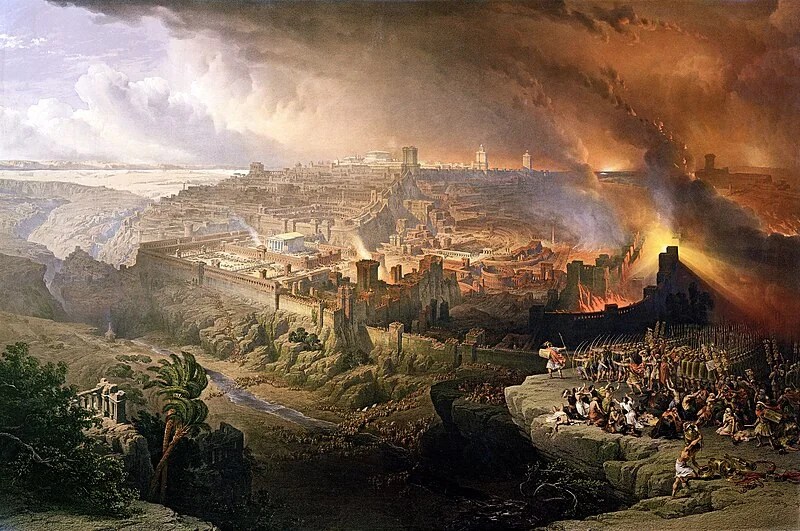
The Roman siege of Jerusalem in 70 C.E.

Part III: The Beginning of the End

Many consider the “West” a nebulous term with no meaning and no history and yet most consider it in decline. As I have referenced, when Oswald Spengler published his epic, The Decline of the West, he posited that the West “wasn’t just in decline; it was being dragged under.” His thesis was that all “cultures” go through a process of birth, blossoming, fruit production and withering to the point of death. The withering phase he called “civilization” because he associated it with a process within the withering phase of excess, debilitation, loss of identity and finally, death. Spengler first published his masterpiece in 1918, and at that time, he saw the West in the withering stage. As he pointed out, the beginning of the withering stage is excess. When civilizations reach the point of excess they become fat; that is not a point of celebration but one of warning. Spengler saw the West at this stage, which forces us to consider a question we would rather not: where is the West now? 

Let’s be clear: the West is not a country, nor does it have geographical boundaries, but it does have a birth, and because it has a birth, it will ultimately have a death. Its birth, according to Spengler, occurred with the fusion of German nobility and the Western Roman Empire, as Spengler saw his native Germany as part of the West. Others point to the marriage of Athens and Jerusalem, but all are references to the merging of the two known worlds at the time into something new and different. Spengler thought the West “blossomed” in the Italian Renaissance, bloomed in the Baroque period and produced its greatest fruit in the 19th century. Gregg posited that the Enlightenment was one example of its fruit, but fruit is only good for a time; eventually it rots.

The Enlightenment, most would say, was not united with Christianity but instead at odds with it. Gregg rejects that idea and any idea that the Enlightenment advanced individual reason at the expense of personal faith. He acknowledges the rise of and focus on reason, but he also points to examples of reason and faith coming together for good during the Enlightenment. He presents one important Enlightenment figure in support of his supposition: Sir Isaac Newton. It was thought that Newton wrote his Principia Mathematica in response to the “materialist assumptions” of Rene Descartes and his views on planetary movements. Newton believed that the entire cosmos, including planetary movement, were governed by a Holy God and his divine providence. It was his faith that drove him to study the world and understand it. Many Enlightenment thinkers considered religion as superstition, but others, like Newton, did not.

As far as products of the Enlightenment, the founding of America is often referenced as one of its greatest. While there is evidence to support this assertion, there is also evidence, i.e., its foundational documents, that tell another story; one where its founders grounded virtue and human morality in reason bathed in a belief of divine goodness. Those Enlightenment ideas that were at odds with the Christian faith coincide with the rise of reductionism and the scientific method as both were coming of age at this time. It was reductionism and modern science that attacked faith, presenting it as incompatible with reason, for the purpose of crowning reason as the only king.   

According to Gregg, there were two claims that severed the reason of Enlightenment with the Christian faith; the first was the belief that there was no fixed human nature, which clashed directly with the Christian belief of a sinful human nature. The second claim—that the only true knowledge was scientific knowledge from the scientific method—contradicted the Christian belief that all knowledge belonged to a Holy God. Gregg argues that both claims isolate science away from faith and subvert all belief in God. Science and faith were presented as mutually exclusive with science celebrated and faith mocked, but, quite unintentionally, the position science claimed and occupied alone would eventually subvert science and reason. We only need to look at current culture and the presence of Critical Theory as proof. It cares nothing for science or reason; it only cares for itself. There is no logic or scientific methodology; it alone is king and ruler. I would like to posit one notion to consider from this point forward: As the Enlightenment was attacking the Christian faith, it was also attacking itself; it just did not know it. 

The ideas and principles it deployed eventually came full circle and were deployed against it. Reason, the scientific method and humanism, all used by the Enlightenment to directly benefit itself, were critiqued, undermined and turned against it by other movements like Romanticism, Idealism, Rationalism and Postmodernism. They revealed that the limitations and exclusions the Enlightenment sought to eliminate from the world were alive and well inside its own ideas, in part, due to its own nature. It is this nature that was, in my opinion, adopted, manipulated and used by Critical Theory to assert itself in the West as the new authority. It is Critical Theory that now pushes the West to the brink of decline and death.  

Stay tuned for the last post in this series as I discuss where the West is now. Until then, remember thinking matters!  

Happy New Year

Happy New Year! Welcome to 2025! Today is the day resolutions begin to dance in our heads as we contemplate new beginnings. A new year is strange, is it not? It is the one day of the year when the whole world welcomes … no, celebrates change. Every other day of the year most of the world fights change. Leo Tolstoy provides us a little insight on this. My new year’s gift to you is this quote from him. Read it twice as there is wisdom in his words. Happy New Year!

“We imagine that when we are thrown out of our usual ruts all is lost, but it is only then that what is new and good begins. While there is life there is happiness. There is much, much before us.” Leo Tolstoy

The Rise and Fall of Western Civilization: Part II

Part II: Western Civilization and Christianity

We, in the West, love our freedom, our liberty and all the choices afforded to us. We love free speech, the right to an education and class movement. We vote, are free to be critical and free to believe different things, if we choose. All of these “rights” are ours, at least we believe that they are ours. There is just one minor problem: these rights we claim as ours are found only in the West and nowhere else. They are not really ours but on loan to us from the West, which begs the question, why, then, is the West in decline?

I ended my last post suggesting a connection between Christianity and the West, and in this post, I am going to defend that suggestion. Whether you believe in its truths or not, and you are free to do both in the West, there is no denying the impact Christianity has made, not only on the West, but on the entire world. Many of the beliefs, the values and the traditions we hold dear came to us in the West and from the West, and most of those came to us, like it or not, from Christianity.  

When Christianity entered the world, it came into a world that was a mixture of Roman, Greek and Jew. There were three, Rome, Athens and Jerusalem, major civilizations in the world at the time, all trying to conquer each other, but it was Christianity, according to Gregg, that did the conquering. It made the Jewish God of Abraham available to both the Romans and the Greeks while also appropriating and transforming much of the Jewish thinking into a synthesis of reason and revelation. It was Christianity that changed the world by granting rights to those who had never had rights and introducing change that applied to all people. These ideas morphed into what is known as the West and “Western” thought today. According to Gregg, all of it came out of Judaism through Christianity. It was Christianity that introduced three major ideas that were new and radical; it was these three ideas that contributed to the development of this distinct “Western” culture and “Western” mindset. 

These three ideas were distinct to Christianity and, as we shall see, versions of them were foundational to Western Civilization. First, reason was viewed as divine, which suggested that the world was created by a Holy God and had order and purpose. Second, there was the idea that all human beings had reason and could employ it with assistance in redeemable ways to know truth, including the moral truth of a Holy God. And third, this Christian revolution started by Jesus Christ emphasized a new form of freedom that the world had never seen before. It was a freedom that unfettered all human beings from rulers and their power and provided them a means to a Holy God and to their own betterment. These three ideas changed the entire world and forms of them took root and became foundational to the West as we know it today. 

Those three Christian ideas that changed the world have morphed into three tenets of Western Civilization that we assume to be our own natural rights. They have become a bit distorted over time, but they are still very much alive and active today in the West. We assume they are distinct to the West and products of the West when their geneses are rooted in Christianity. We don’t’ think about them. They are ours, and we assume that they will always be ours because we possess them and have always possessed them. They are part of our normal, our worldview and our paideia if you will. These three ideas are distinct to Western Civilization, and yet they are even more distinct to Christianity, although they are better known by their Western nomenclature. What are they? Well, you will recognize them because they are you and me. These three ideas are three rights we take for granted and call our own; they are the right to an education, the right to a democratic way of life and the right to personal freedom. Each one came to us, not from the West, but from Christianity and along with a host of other “norms” now residing in the West.  

Those three ideas created a revolution of sorts that changed the entire world. They gave everyone power that had only been reserved for kings and queens of old. They put totalitarian regimes and those like them on notice, offering something else, a better form of government, and as much as we want to, we cannot ignore their connection to Christianity. It was Christianity that was affirmed as “the true philosophy” by Clement of Alexandria and lauded for its “integration of faith and reason.” It was Christianity that produced churches, hospitals and schools, including the university, which was founded for the training of the church’s clergy and for the pursuit of truth for the sake of truth. This one product (the university) was a statement on the change that Christianity brought to the world. You can find the university in almost every country in the world today and in its vision, you will find a pursuit of wisdom and knowledge. This educational pursuit was a pursuit that the world had never had the liberty, the ability nor the desire to pursue until this Christian revolution, and all of it was rooted in a belief and in a conviction that there is a Creator God who created a world of order that could be known. Today, our colleges and universities have all but forgotten this connection, but they owe their very existence to Christianity.  

There is wonderful book entitled, The Dying of the Light, that traces the origins of all colleges and universities in the United States. The striking point about this book is that almost every college or university in this country was originally the product of a denomination … the product of some form of Christianity. The Congregationalists, the Baptists, the Presbyterians, the Lutherans, and the Catholics … every denomination that created a colleges or university is in that book and almost every single college or university that was created in this country is in that book. The point not to miss is that these institutions of higher learning were created, in part, due to a mandate from a Holy God and a conviction that this God created a world of order that could be known and should be known, which prompted a curiosity and a desire to learn more about this God and the world he created. One author put it this way, “It [Christianity] launched an age that saw the world as characterized by order, that the human mind can comprehend and a world that merits study simply because it is the world of God.” So, when we talk about the West, in most instances, we are taking about Christianity and its impact on the world. 

It is the West that ushered in the study of science, mathematics and medicine. It is the West that employed democracy in real time and presented it as a better more copious option. It is the West that concerned itself with poverty, slavery and racism, albeit imperfectly. No other country, people group, religion or mindset offered anything close to what the West has offered to the world. It is the West that has taken its advances and advanced itself for better or worse, and while it has had its share of issues, indulgences and mistakes, it has still provided the world with so much. This is Western Civilization and the Western mindset all rolled up into this innocuous phrase we use without a second thought, and today, we find it close to death. Why? In my next post, I begin to examine its fall and death. Until then …  

A Christmas Tradition

A Christmas tradition of mine is to post this poem on Christmas Day. It is one of my favorite poems. It was written on December 25, 1863 by Wadsworth in response to hearing that his son, Charles Appleton Wadsworth had been wounded in a battle in Virginia.

I hope you enjoy it as much as I do. I wish all of you a very Merry Christmas!

Christmas Bells by Henry Wadsworth Longfellow

I heard the bells on Christmas Day
Their old, familiar carols play,
    And wild and sweet
    The words repeat 
Of peace on earth, good-will to men!

And thought how, as the day had come,
The belfries of all Christendom
    Had rolled along
    The unbroken song
Of peace on earth, good-will to men!

Till ringing, singing on its way,
The world revolved from night to day,
    A voice, a chime,
    A chant sublime 
Of peace on earth, good-will to men!

Then from each black, accursed mouth
The cannon thundered in the South,
    And with the sound 
    The carols drowned
Of peace on earth, good-will to men! 

It was as if an earthquake rent
The hearth-stones of a continent,
    And made forlorn
    The households born
Of peace on earth, good-will to men!

And in despair I bowed my head;
“There is no peace on earth,” I said;
    “For hate is strong,
    And mocks the song 
Of peace on earth, good-will to men!”

Then pealed the bells more loud and deep:
“God is not dead, nor doth He sleep;
    The Wrong shall fail,
    The Right prevail,
With peace on earth, good-will to men.”